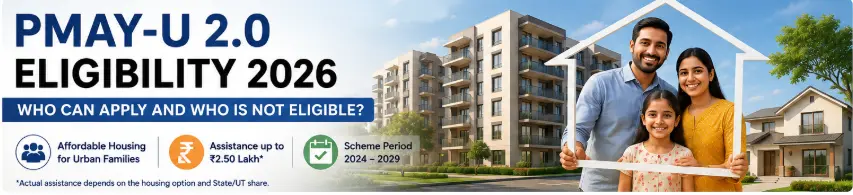
PMAY-U 2.0 Eligibility 2026: Quick Answer
PMAY-U 2.0 eligibility mainly depends on five things:
- You must be living in an eligible urban area.
- Your household income must fall within the applicable EWS, LIG or MIG category.
- You and your beneficiary family must not own a pucca house anywhere in India.
- You must not have received a government housing benefit during the previous 20 years, subject to the scheme’s conditions.
- You must satisfy the requirements of the PMAY-U 2.0 housing option you choose.
The four options are BLC, AHP, ARH and ISS, and not every income group is eligible for every option.
That last point is important.
Being generally eligible for PMAY-U 2.0 does not mean you automatically qualify for every benefit under the scheme.
What Is PMAY-U 2.0 Eligibility?
PMAY-U 2.0 is designed to provide housing assistance to eligible families in urban areas through four different verticals:
- Beneficiary-Led Construction (BLC)
- Affordable Housing in Partnership (AHP)
- Affordable Rental Housing (ARH)
- Interest Subsidy Scheme (ISS)
The scheme can support eligible beneficiaries who want to construct, purchase or rent affordable housing, depending on the applicable vertical.
So when someone asks, “Am I eligible for PMAY-U 2.0?”, there isn’t a single yes-or-no answer based only on income.
You need to look at your location, household, house ownership, previous housing benefits, and the housing option you need.
You should always verify the latest eligibility requirements through the official PMAY-U 2.0 portal because government scheme rules, application procedures, and implementation details can change.
PMAY-U 2.0 Income Limit 2026
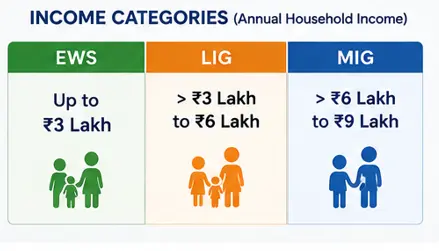
The current scheme guidelines divide households into three broad income categories.
| Category | Annual household income |
|---|---|
| EWS | Up to ₹3 lakh |
| LIG | Above ₹3 lakh up to ₹6 lakh |
| MIG | Above ₹6 lakh up to ₹9 lakh |
These are annual household income limits, not simply the salary of one person. The official guidelines define EWS up to ₹3 lakh, LIG from ₹3 lakh up to ₹6 lakh, and MIG from ₹6 lakh up to ₹9 lakh. States and Union Territories have some flexibility to redefine the EWS income criterion with approval from the Ministry of Housing and Urban Affairs.
Example
Suppose a family has a combined annual household income of ₹5.5 lakh.
That family falls within the LIG income range under the standard PMAY-U 2.0 classification.
A family earning ₹8 lakh annually falls within the MIG range.
But income alone does not make the application eligible.
The family must satisfy the other conditions too.
You Must Live in an Urban Area
This is one of the first things to check.
PMAY-U 2.0 is the Urban housing mission.
The official eligibility criteria cover eligible families living in urban areas.
Therefore, don’t apply for PMAY-U 2.0 simply because you have seen an advertisement about a “PMAY housing subsidy.”
First, determine whether your residence falls under the applicable urban jurisdiction.
If you are in a rural area, PMAY-G may be the relevant housing programme instead, depending on your circumstances and jurisdiction.
The official PMAY-U 2.0 FAQ specifically says beneficiaries may receive benefits under PMAY-G or PMAY-U 2.0 according to their jurisdiction.
You Should Not Own a Pucca House Anywhere in India
This is probably the most important PMAY-U 2.0 eligibility condition.
The rule is not simply:
“I don’t own a house in my current city.”
The official condition is broader.
The beneficiary family should not own a pucca house anywhere in India in the name of the applicant or a member of the family.
So, for example, if you live in a rented house in Bhubaneswar but your beneficiary family already owns a qualifying pucca house in another part of India, you cannot simply claim eligibility because you do not own a house in Bhubaneswar.
This is an area where applicants should be particularly careful while giving their declaration.
What Does “Pucca House” Mean?
Under the PMAY-U 2.0 FAQ, a pucca house is an all-weather dwelling unit with walls and roof made from sturdy and durable materials such as burnt bricks, stone packed with cement or lime, cement concrete, timber, GI sheets, asbestos sheets or machine-made tiles.
So don’t judge eligibility merely by asking:
“Is my house expensive?”
The relevant question is whether the dwelling falls within the scheme’s definition of a pucca house.
Previous Government Housing Benefit Can Make You Ineligible
There is another condition that many people may overlook.
If you or your family have already received a house under a Central Government, State/UT Government or Local Self Government housing scheme during the previous 20 years, you are generally not eligible for PMAY-U 2.0.
This is why simply saying:
“I don’t own a house now, so I should qualify.”
can be wrong.
Your previous housing benefit history matters too.
What If Your Parents Previously Received a Housing Benefit?
This situation is more complicated.
The PMAY-U 2.0 guidelines state that if a pucca house was provided to the parents of an otherwise eligible beneficiary under an earlier housing scheme, the beneficiary may be considered after other eligible families whose parents did not receive such a benefit are included.
So this should not be simplified into an automatic “yes” or “no.”
If your parents previously received a government housing benefit, disclose the information honestly and allow the relevant authority to determine eligibility according to the applicable rules.
Who Is Considered a Beneficiary Family?
For PMAY-U 2.0, the beneficiary family broadly comprises:
- Husband
- Wife
- Unmarried sons
- Unmarried daughters
The official PMAY-U 2.0 material uses the beneficiary family concept when applying the house-ownership condition.
This means you should not check only your own name before applying.
You also need to consider the relevant family members covered by the scheme.
Can a Single Person Apply?
This is an area where online explanations can become confusing.
The PMAY-U 2.0 official FAQ explains that a single unmarried person is generally treated as part of a family rather than automatically being considered a completely separate family. However, an unmarried beneficiary may take a loan to purchase or construct a house in their own name or jointly with a family member, subject to the scheme’s eligibility conditions.
Therefore, don’t assume:
“I am unmarried, so I cannot apply.”
But don’t assume the opposite either.
The household and previous-benefit conditions still need to be satisfied.
Aadhaar Is Also Important
The PMAY-U 2.0 guidelines require eligible beneficiaries, including relevant family members, to have Aadhaar or Aadhaar Virtual ID integrated with the beneficiary details. Where an eligible beneficiary does not have Aadhaar/Aadhaar Virtual ID, the guidelines direct States/UTs to facilitate enrolment on priority.
This means your Aadhaar details should be kept ready before starting the application.
More importantly, make sure the information you provide is consistent with your other documents.
Understanding the PMAY-U 2.0 Eligibility 2026 rules before applying can help you avoid submitting an application that does not meet the scheme’s requirements.
Which PMAY-U 2.0 Vertical Can You Use?
This is where general eligibility and specific eligibility become different.
PMAY-U 2.0 has four verticals:
| Vertical | Main purpose |
|---|---|
| BLC | Constructing a new house on eligible land |
| AHP | Affordable housing through eligible housing projects |
| ARH | Affordable rental housing |
| ISS | Interest subsidy on eligible home loans |
The official PMAY-U 2.0 FAQ confirms these four verticals.
You should therefore decide what kind of housing assistance you actually need before starting the application.
Who Can Use BLC?
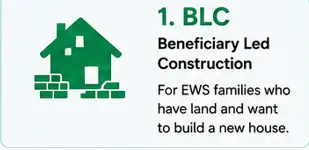
BLC stands for Beneficiary-Led Construction.
It is intended for eligible EWS families who want to construct a new house on their own available land.
The official guidelines provide for landless beneficiaries to potentially receive heritable but non-transferable land rights from the State/UT, at the State/UT’s own expense, which can make them eligible under BLC.
So if you are an EWS family and already have suitable land, BLC may be the route worth investigating.
But it is not a general home-repair benefit.
Who Can Use AHP?
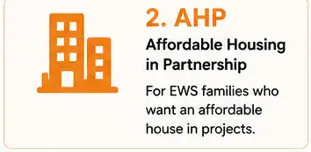
AHP means Affordable Housing in Partnership.
It is designed around eligible affordable housing projects and EWS beneficiaries.
This option is more relevant if you are looking to obtain an affordable house through an eligible project rather than construct your own house on your land.
The exact project availability and implementation can depend on the concerned State, Urban Local Body and implementing agencies.
Who Can Use ARH?
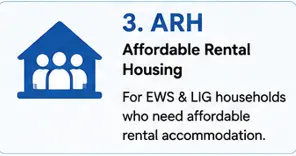
ARH means Affordable Rental Housing.
This is different from the other options because you don’t necessarily have to be trying to buy or construct your own house.
The ARH vertical is aimed at providing affordable rental housing for eligible groups including EWS and LIG households.
This can be particularly relevant for people such as migrant workers and other urban residents who need affordable accommodation.
Who Can Use ISS?
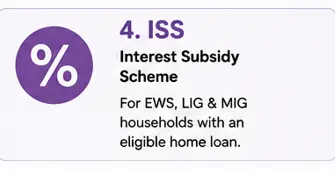
ISS means Interest Subsidy Scheme.
This is the home-loan-linked component.
Eligible EWS, LIG and MIG households can potentially receive an interest subsidy on qualifying home loans for purchase, repurchase or construction of a house. The official portal currently states that the relevant loans must be sanctioned and disbursed on or after 1 September 2024.
The income limits for ISS are:
- EWS: up to ₹3 lakh
- LIG: up to ₹6 lakh
- MIG: up to ₹9 lakh
There are additional loan, property, and other conditions, so being within the income limit alone does not guarantee ISS eligibility.
PMAY-U 2.0 Eligibility: Simple Self-Check
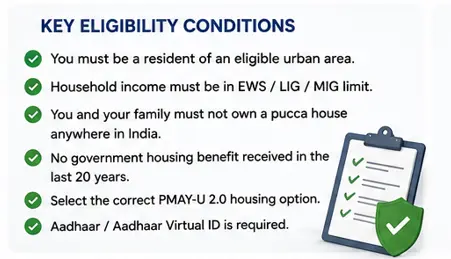
Before starting the application, ask yourself these questions:
1. Do I live in an eligible urban area?
If yes, continue.
2. Is my annual household income within the applicable EWS, LIG or MIG range?
If yes, continue.
3. Does anyone in my beneficiary family own a pucca house anywhere in India?
If yes, you generally do not meet the basic eligibility condition.
4. Have my family or I received a government housing benefit during the previous 20 years?
If yes, you may not be eligible.
5. Do I have Aadhaar/Aadhaar Virtual ID details ready for the relevant beneficiaries?
If yes, continue.
6. Do I know which PMAY-U 2.0 vertical fits my situation?
If not, don’t rush into the application.
This last point is particularly important because the official eligibility portal tells applicants to understand the four verticals carefully before selecting one. Once a vertical is selected, it cannot be changed later through the application process.
Who Gets Preference Under PMAY-U 2.0?
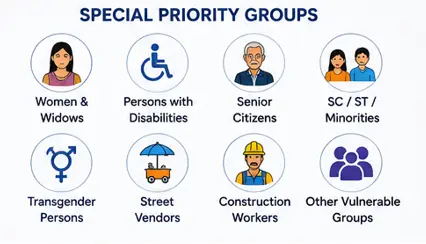
PMAY-U 2.0 gives preference to several vulnerable groups.
These include:
- Widows
- Single women
- Persons with disabilities
- Senior citizens
- Transgender persons
- Scheduled Castes
- Scheduled Tribes
- Minorities
- Other weaker and vulnerable sections
The guidelines also give special focus to groups such as:
- Safai Karmis
- Street vendors identified under PMSVANidhi
- Artisans under PM Vishwakarma
- Anganwadi workers
- Building and construction workers
- Residents of slums and chawls
But there is an important distinction:
Preference is not the same as automatic approval.
You still have to satisfy the applicable eligibility requirements.
What If I Don’t Have Land?
Not having land does not necessarily end the possibility of receiving PMAY-U 2.0 assistance.
For eligible landless beneficiaries, States and UTs may provide heritable but non-transferable land rights, commonly referred to as pattas, at their own expense, making the beneficiary eligible under BLC.
However, this does not mean every landless applicant will automatically receive land.
The actual implementation depends on the concerned State/UT.
If BLC is not suitable, other verticals may also be relevant depending on your eligibility.
Can You Get PMAY-U 2.0 If You Are Already Benefiting From PMAY-G?
The scheme has provisions to prevent duplication between PMAY-G and PMAY-U 2.0.
The official guidelines state that beneficiaries may avail benefits under PMAY-G or PMAY-U 2.0 according to their jurisdiction, with data linkage intended to prevent duplication.
So don’t attempt to claim the same housing benefit through both programmes.
Does Meeting the Eligibility Conditions Guarantee Approval?
No.
This is one of the most important things to understand.
Meeting the basic conditions means you may be eligible to apply.
It does not mean the Government has already approved your benefit.
The official PMAY-U 2.0 eligibility portal explicitly says that filling out the application does not itself entitle a citizen to receive the benefit. Eligibility has to be verified by the relevant State, UT, ULB, Central Nodal Agency or Primary Lending Institution, depending on the applicable vertical.
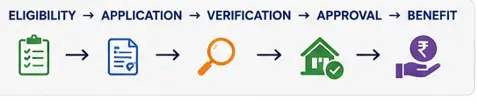
So think of the process as:
Eligibility → Application → Verification → Sanction/Approval → Benefit
not:
Application → Guaranteed money
Documents to Keep Ready
Depending on the vertical and your circumstances, you may need:
- Aadhaar
- Aadhaar Virtual ID where applicable
- Bank account details
- Income-related information/proof
- Family details
- Land ownership documents for BLC
- Home-loan and property documents for ISS
- Undertaking regarding eligibility
- Other documents requested by the State, ULB, CSC or lending institution
The official FAQ specifically mentions Aadhaar, bank details, the prescribed eligibility undertaking and land ownership documents for BLC, along with other documents that may be specified by the relevant authorities.
Common PMAY-U 2.0 Eligibility Mistakes
Mistake 1: Checking only your own house ownership
The scheme considers the beneficiary family.
Mistake 2: Assuming rented accommodation automatically qualifies you
Living on rent does not by itself establish eligibility.
Your income, family details and other conditions still matter.
Mistake 3: Looking only at monthly income
PMAY-U 2.0 uses annual household income categories.
Mistake 4: Ignoring previous housing benefits
The previous 20-year condition can matter.
Mistake 5: Choosing a vertical randomly
You should understand BLC, AHP, ARH and ISS before making your selection.
Mistake 6: Assuming preference means guaranteed approval
Special groups receive preference, but verification and other eligibility requirements still apply.
Mistake 7: Believing an online form guarantees the benefit
It doesn’t.
PMAY-U 2.0 Eligibility Checklist 2026
Use this checklist before applying:
☐ I live in an eligible urban area.
☐ My household income falls within EWS, LIG or MIG limits.
☐ My beneficiary family does not own a pucca house anywhere in India.
☐ I have checked our previous government housing benefits.
☐ I have not received a disqualifying housing benefit during the previous 20 years.
☐ I have the required Aadhaar/Aadhaar Virtual ID information.
☐ I understand which PMAY-U 2.0 vertical suits my situation.
☐ I have the relevant documents.
☐ I understand that the application does not guarantee approval.
If you can answer these questions confidently, you are in a much better position to proceed with the official application process.
Before applying, review the PMAY-U 2.0 Eligibility 2026 conditions carefully and verify your family, income, housing and location details.
Frequently Asked Questions
Q1. What is the PMAY-U 2.0 eligibility criteria?
PMAY-U 2.0 generally covers eligible EWS, LIG and MIG families living in urban areas who do not own a pucca house anywhere in India and who satisfy the scheme’s other conditions, including the previous housing-benefit restriction.
Q2. What is the PMAY-U 2.0 income limit?
The standard annual household income limits are up to ₹3 lakh for EWS, above ₹3 lakh up to ₹6 lakh for LIG, and above ₹6 lakh up to ₹9 lakh for MIG.
Q3. Can I apply if I own a pucca house?
Generally, no. The beneficiary family should not own a pucca house anywhere in India.
Q4. Can I apply if I live in a rented house?
Living in a rented house does not automatically make you eligible. You still need to satisfy the income, house-ownership, previous-benefit and other applicable conditions.
Q5. Can I apply if my parents received a government house?
This requires careful examination. The PMAY-U 2.0 guidelines contain a specific provision concerning parents who previously received a pucca house under a housing scheme. Such beneficiaries may receive consideration after other eligible families whose parents did not receive the earlier benefit.
Q6. Is PMAY-U 2.0 only for EWS families?
No. PMAY-U 2.0 covers EWS, LIG and MIG households, although the applicable vertical differs by category.
Q7. Can a landless EWS family apply?
Potentially, yes. States/UTs may provide eligible landless beneficiaries with heritable but non-transferable land rights for BLC, subject to implementation arrangements. Other PMAY-U 2.0 verticals may also be relevant depending on eligibility.
Q8. Can I choose any PMAY-U 2.0 vertical?
You should choose only the vertical for which you meet the applicable conditions. The official eligibility portal warns that once a vertical is selected, it cannot later be changed through the application process.
Q9. Does PMAY-U 2.0 eligibility mean I will definitely receive the benefit?
No. Eligibility must be verified by the relevant authorities or participating institutions before the benefit is sanctioned.
Final Takeaway
The easiest way to understand PMAY-U 2.0 eligibility in 2026 is to forget the idea that this is simply an income-based housing scheme.
Your income is only one part of the test.
You also need to look at where you live, whether your beneficiary family owns a pucca house, whether your family has already received a government housing benefit and which PMAY-U 2.0 vertical fits your situation.
The three numbers worth remembering are:
₹3 lakh → EWS
₹6 lakh → LIG
₹9 lakh → MIG
But those numbers alone do not decide your eligibility.
Before applying, check your house ownership, previous housing benefit history and the correct housing vertical. And use the official PMAY-U 2.0 portal or your concerned ULB/CSC rather than relying on third-party websites.
The official PMAY-U 2.0 portal is the final place to verify your eligibility before submitting an application.
Main guide:
“PMAY-U 2.0 Guide 2026: Eligibility, Benefits, Housing Options & How to Apply”
Supporting Post 2: How to Apply for PMAY-U 2.0 Online 2026
Supporting Post 3: PMAY-U 2.0 BLC Guide
Supporting Post 4: PMAY-U 2.0 AHP Guide
Supporting Post 5: PMAY-U 2.0 ARH Guide
Supporting Post 6: PMAY-U 2.0 ISS Guide
Supporting Post 7: PMAY-U 2.0 Documents Required
Supporting Post 8: PMAY-U 2.0 Application Status
Supporting Post 9: PMAY-U 2.0 Rejected? Reasons & What to Do