
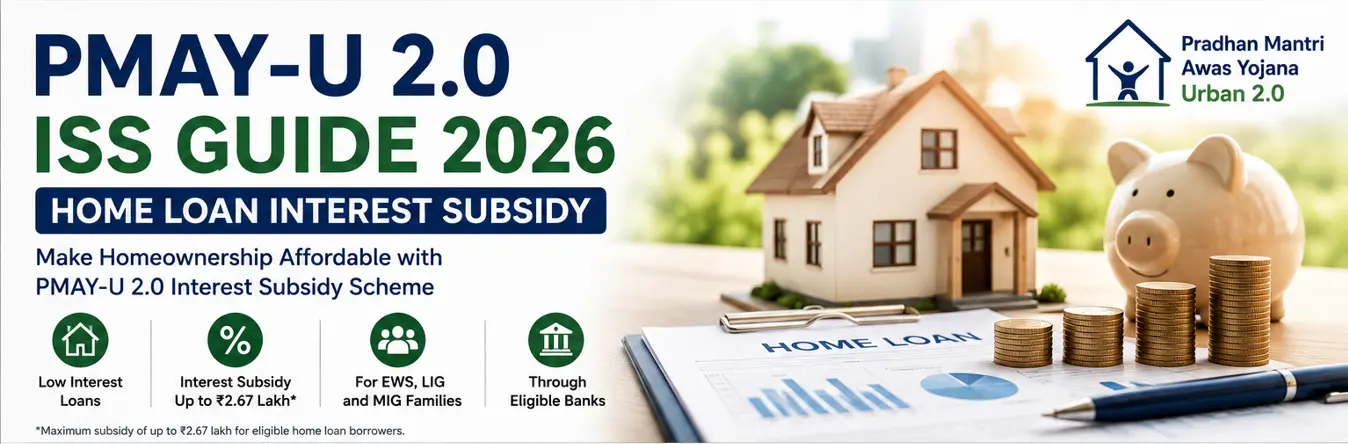
PMAY-U 2.0 does not provide every eligible family with a house or a direct cash payment. Under the Interest Subsidy Scheme (ISS), eligible urban families can receive government support on a qualifying home loan.
This can reduce the principal outstanding on the home loan and may reduce the EMI or loan tenure.
The PMAY-U 2.0 ISS vertical is meant for eligible EWS, LIG and MIG households purchasing, repurchasing or constructing a house, subject to the scheme conditions.
The most important point to understand is this:
Getting a home loan does not automatically mean you will receive the PMAY-U 2.0 ISS subsidy. You must meet the scheme conditions and follow the prescribed application process.
This guide explains the current official rules in simple language.
Quick Answer: What Is PMAY-U 2.0 ISS?
The Interest Subsidy Scheme (ISS) is one of the four verticals under PMAY-U 2.0.
It provides an interest subsidy benefit on eligible home loans sanctioned and disbursed on or after 1 September 2024 for the purchase, repurchase or construction of a house.
Under the scheme guidelines, eligible households can receive:
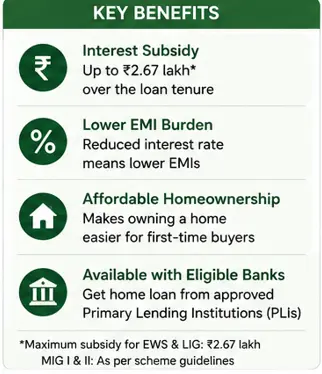
- 4% interest subsidy
- On the first ₹8 lakh of the eligible loan
- For a subsidy calculation period of up to 12 years
- Maximum home loan considered under the scheme: ₹25 lakh
- Maximum property value: ₹35 lakh
- Maximum possible subsidy release: ₹1.80 lakh
- Maximum NPV benefit: ₹1.50 lakh
- Maximum carpet area: 120 square metres
The subsidy is released subject to the applicable scheme conditions.
What Does PMAY-U 2.0 ISS Mean?
PMAY-U 2.0 is implemented through four major verticals:
- Beneficiary-Led Construction (BLC)
- Affordable Housing in Partnership (AHP)
- Affordable Rental Housing (ARH)
- Interest Subsidy Scheme (ISS)
The ISS vertical is different from BLC or AHP.
Instead of receiving support for a construction project, an eligible beneficiary under ISS receives a subsidy benefit linked to an eligible home loan.
PMAY-U 2.0 ISS Eligibility 2026
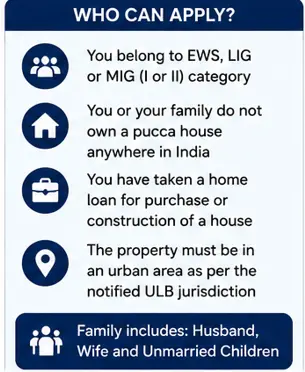
Your eligibility depends on several conditions.
1. Household Income
The scheme covers households within the following income categories:
| Category | Annual Household Income |
|---|---|
| EWS | Up to ₹3 lakh |
| LIG | Up to ₹6 lakh |
| MIG | Up to ₹9 lakh |
The official guidelines provide these income limits for ISS eligibility.
2. Maximum Household Income
For the ISS benefit, the household income should not exceed ₹9 lakh per year.
A household with income above this limit is not eligible under the current ISS rules.
3. Home Loan Limit
The maximum housing loan under the scheme eligibility framework is:
₹25 lakh
However, this does not mean the entire ₹25 lakh receives the 4% subsidy.
The subsidy is applicable only on the first ₹8 lakh, subject to the other scheme conditions.
4. Maximum House Value
The property value should not exceed:
₹35 lakh
This is an important condition that borrowers should check before assuming they qualify for the scheme.
5. Maximum Carpet Area
The maximum permitted carpet area under ISS is:
120 square metres
The applicable property should fall within this limit.
PMAY-U 2.0 ISS Subsidy Amount
The maximum possible actual subsidy release under the scheme is:
₹1.80 lakh
The maximum Net Present Value (NPV) benefit specified in the guidelines is:
₹1.50 lakh
The actual benefit should not be interpreted as a flat cash payment made directly into a personal savings account.
The subsidy is linked to the eligible home loan and its treatment follows the scheme’s subsidy release process.
How Does the 4% Interest Subsidy Work?
The official scheme provides:
4% interest subsidy on the first ₹8 lakh of the eligible loan, for a period of up to 12 years.
Suppose a person takes a home loan of ₹20 lakh.
The subsidy calculation is not applied to the entire ₹20 lakh loan.
The interest subsidy component applies to the first eligible ₹8 lakh, subject to the scheme rules.
The remaining loan amount is subject to the lender’s applicable home loan terms and interest rate.
The maximum eligible home loan can be ₹25 lakh, but that does not increase the subsidised portion beyond ₹8 lakh.
How Is the PMAY-U 2.0 ISS Subsidy Released?
This point is often misunderstood.
The subsidy is not designed as a single unrestricted cash transfer to the borrower.
According to the official guidelines, the subsidy is released through the loan account process. The subsidy can reduce the principal outstanding on the home loan.
This may result in:
- A lower EMI, or
- A shorter loan tenure
depending on the loan arrangement and applicable process.
The scheme guidelines state that the subsidy is released in five yearly instalments, subject to conditions including the loan remaining active and more than 50% of the principal remaining outstanding at the relevant time.
Important: The Full ₹1.80 Lakh May Not Be Received at Once
Do not plan your finances assuming that ₹1.80 lakh will immediately appear in your loan account.
The scheme provides for a structured release process over yearly instalments and continuing eligibility conditions apply.
Your lending institution can explain how the subsidy credit affects your specific loan account.
Who Is Not Eligible for PMAY-U 2.0 ISS?
You should carefully review the exclusion conditions.
1. You Have Already Received a Housing Benefit Covered by the Exclusion Rules
The official eligibility framework requires a declaration regarding previous benefits under housing schemes.
The Unified Web Portal checks relevant eligibility declarations and records.
2. Your Household Income Exceeds ₹9 Lakh
ISS eligibility is limited to households within the prescribed income ceiling.
3. Your Home Loan Exceeds ₹25 Lakh
A loan above the scheme’s maximum limit does not meet the stated ISS eligibility parameter.
4. The Property Value Exceeds ₹35 Lakh
The maximum house value under ISS is ₹35 lakh.
5. The Carpet Area Exceeds 120 Square Metres
The house must remain within the prescribed carpet-area limit.
6. You Are Buying Only Land
The official FAQ states that the subsidy is not available merely for purchasing land for building a house.
7. You Want the Subsidy for Repair Work
The ISS subsidy is not intended for ordinary repair work or incremental additions such as adding a kitchen or bathroom to an existing house.
Can You Construct a House on Your Own Land?
Yes, an eligible beneficiary may construct a house on land they own, subject to the ISS conditions.
The carpet area must remain within the applicable limit of 120 square metres and other eligibility requirements must be satisfied.
Can Informal Sector Workers Apply?
Potentially, yes.
The official FAQ specifically states that eligible informal-sector workers, such as street vendors, small shop owners, service providers, drivers and watchmen, may be eligible if they satisfy the scheme requirements.
However, eligibility under the scheme does not guarantee that a home loan will be approved.
The lending institution separately evaluates the loan application according to its lending policies.
How to Apply for PMAY-U 2.0 ISS
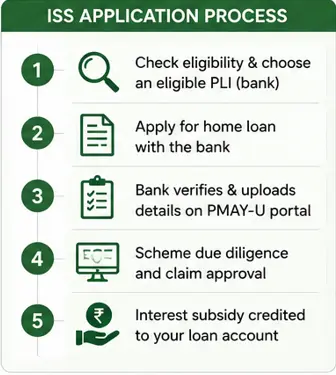
The official application process is important.
You cannot simply walk into a bank and assume that an ordinary home loan application will automatically activate the ISS benefit.
For the ISS vertical, eligible beneficiaries are required to register their demand through the PMAY-U 2.0 Unified Web Portal.
After registration, the application is forwarded to the relevant Primary Lending Institution (PLI) for further action according to the beneficiary’s eligibility and loan requirements.
Step 1: Confirm That ISS Is the Right PMAY-U 2.0 Vertical
Before applying, check whether ISS suits your situation.
ISS is relevant if you need an eligible home loan for:
- Purchasing a house
- Repurchasing a house
- Constructing a house
If your situation involves a government housing project, self-construction assistance or rental housing, another PMAY-U 2.0 vertical may be more relevant.
Choose carefully.
The beneficiary application manual warns that once a vertical is selected, it cannot simply be changed later.
Step 2: Register Through the Unified Web Portal
For ISS, the official process requires registration through the PMAY-U 2.0 Unified Web Portal.
The official PMAY-HFA portal provides the ISS application and eligibility information. PMAY-U 2.0 ISS official portal
Enter information carefully.
Incorrect information regarding income, family members, property or loan details can create problems during verification.
Step 3: Provide the Required Home Loan Information
The application process requires the relevant lending institution information.
Your application is subsequently handled with the concerned Primary Lending Institution (PLI) under the scheme process.
Step 4: Submit Required Documents
Documents may include:
- Aadhaar card
- PAN card
- Address proof
- Income proof or certificate
- Home loan-related documents
- Property documents
- Other documents required by the authorities or lending institution
The exact document requirement may vary according to the verification process and the PLI.
Step 5: Loan Processing and Eligibility Verification
Your PLI evaluates the home loan application.
This is separate from simply submitting a PMAY-U 2.0 application.
The lender may check:
- Income and repayment capacity
- Property documents
- Loan eligibility
- Scheme conditions
- Aadhaar-based verification and de-duplication requirements
Submitting an application does not itself guarantee either:
- Home loan approval, or
- PMAY-U 2.0 ISS subsidy approval
The beneficiary manual specifically makes this distinction.
Can You Apply Directly Through a Bank for ISS?
According to the official PMAY-U 2.0 FAQ, a beneficiary seeking the ISS benefit must apply through the Unified Web Portal.
The process then connects the application with the concerned lending institution.
Therefore, do not assume that applying only for a normal home loan directly with a bank will automatically create an ISS application.
What Is a Primary Lending Institution (PLI)?
A Primary Lending Institution, or PLI, is a financial institution participating in the scheme framework and extending eligible home loans.
The PMAY-U 2.0 system works with participating lending institutions for processing the loan and subsidy-related process.
Not every financial institution or every home loan product should automatically be assumed to be eligible for ISS processing.
Confirm the current position with the concerned lender and the official portal.
When Will the Subsidy Be Credited?
The exact timing can depend on:
- Loan disbursement
- Eligibility verification
- Processing by the lending institution
- Subsidy claim procedures
- Release through the scheme system
The official guidelines state that the Ministry releases subsidy through the designated institutional process after the applicable loan and claim procedures are completed. Beneficiaries are intended to receive information through the registered mobile number.
The PLI has a role in claiming and crediting the subsidy through the scheme process.
PMAY-U 2.0 ISS: A Simple Example
Suppose:
- Annual household income: ₹8 lakh
- Home loan: ₹20 lakh
- House value: ₹32 lakh
- Carpet area: Within 120 square metres
This person may fall within the financial limits of ISS.
However, that does not automatically mean the person will receive the subsidy.
The borrower must still satisfy all applicable eligibility requirements and the loan must be processed under the prescribed PMAY-U 2.0 ISS process.
The 4% subsidy calculation applies only to the first ₹8 lakh of the eligible loan, not automatically to the entire ₹20 lakh loan.
PMAY-U 2.0 ISS Eligibility Checklist
Before applying, check the following:
- Is your annual household income within ₹9 lakh?
- Is the home loan within ₹25 lakh?
- Is the property value within ₹35 lakh?
- Is the carpet area within 120 square metres?
- Are you purchasing, repurchasing or constructing an eligible house?
- Have you checked the housing-benefit declaration requirements?
- Have you selected the correct PMAY-U 2.0 vertical?
- Have you registered through the official Unified Web Portal?
- Is your selected lending institution participating in the applicable ISS process?
- Have you submitted accurate information and documents?
Common Mistakes to Avoid
1. Confusing PMAY-U 2.0 ISS With the Old CLSS
Older PMAY housing information is still widely available online.
Do not automatically apply the old Credit Linked Subsidy Scheme (CLSS) rules to PMAY-U 2.0 ISS.
The PMAY-U 2.0 ISS framework has its own:
- Income limits
- Loan limits
- Property-value limits
- Subsidy structure
- Application process
Always check the current PMAY-U 2.0 guidelines rather than relying on an old article or social-media video.
2. Thinking ₹1.80 Lakh Is an Immediate Cash Payment
The maximum subsidy figure should not be treated as guaranteed instant cash.
The release is linked to the scheme’s subsidy process and continuing loan conditions.
3. Assuming the Entire Home Loan Gets a 4% Subsidy
The 4% subsidy applies to the first ₹8 lakh of the eligible loan, subject to the scheme rules.
4. Applying for the Wrong PMAY-U 2.0 Vertical
PMAY-U 2.0 has four different verticals.
Choosing the wrong one can create complications later.
5. Relying Only on a Bank Advertisement
A home loan product may mention government schemes, but the borrower should independently confirm:
- The current ISS rules
- Portal registration requirements
- PLI participation
- Eligibility conditions
Frequently Asked Questions
Q1. Is PMAY-U 2.0 ISS available in 2026?
Yes, the PMAY-U 2.0 ISS vertical is part of the current PMAY-U 2.0 framework. Official government sources continue to publish scheme-related information and implementation updates.
Q2. What is the maximum PMAY-U 2.0 ISS subsidy?
The maximum actual subsidy release specified in the scheme guidelines is ₹1.80 lakh, subject to eligibility and scheme conditions.
Q3. What is the PMAY-U 2.0 ISS interest subsidy rate?
The scheme provides a 4% interest subsidy on the first ₹8 lakh of the eligible loan, for the specified subsidy calculation period of up to 12 years.
Q4. Can I take a ₹25 lakh home loan under ISS?
The scheme’s maximum eligible housing loan is ₹25 lakh, provided other conditions are satisfied.
However, the subsidy is not applied to the full ₹25 lakh. The subsidised portion is limited to the first ₹8 lakh.
Q5. What is the maximum property value?
The maximum house value under ISS is ₹35 lakh.
Q6. Can I get ISS for buying land?
No. The official FAQ states that the subsidy is not available merely for purchasing land for construction.
Q7. Can I get ISS for house repairs?
No. Ordinary repair work or incremental additions to an existing house are not covered under the ISS benefit.
Q8. Can informal workers apply?
Eligible informal-sector workers can apply if they meet the applicable scheme requirements.
Q9. Is the home loan automatically approved if I qualify for ISS?
No.
Scheme eligibility and home loan approval are different matters.
The lending institution evaluates the loan according to its own applicable lending and verification requirements.
Final Takeaway
The PMAY-U 2.0 ISS can provide meaningful home loan support for eligible urban households, but the benefit is not automatic.
Before taking a major financial decision, check five things carefully:
- Your household income
- The home loan amount
- The property value
- The carpet area
- The official application and lending process
The biggest mistake would be taking a home loan after assuming that the PMAY subsidy is guaranteed.
First, verify your eligibility through the official PMAY-U 2.0 system and confirm the scheme process with the concerned lending institution.
For the latest rules, guidelines, and updates, use the official PMAY-U website and the PMAY-U 2.0 Unified Web Portal.
Editorial Note
Scheme rules, portal processes, and participating lending institutions can change. This guide is based on official PMAY-U 2.0 scheme information available as of 2026. Before submitting a home loan or subsidy application, verify the latest requirements on the official government portal and with the concerned Primary Lending Institution.
Related Benefitomics Guides