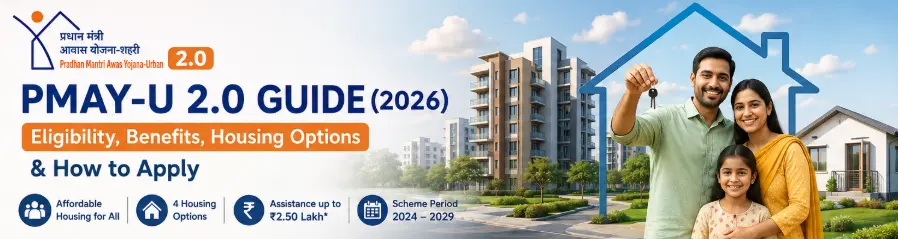
PMAY-U 2.0 Guide India (2026)
PMAY-U 2.0 is the Government of India’s urban housing mission for eligible families who need help to construct, purchase, or rent an affordable house.
The scheme is being implemented for five years, from 1 September 2024 to 2029, and works through four housing options:
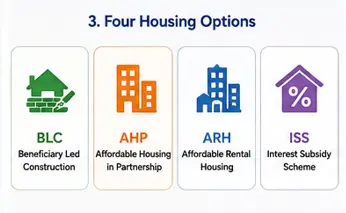
- Beneficiary Led Construction (BLC)
- Affordable Housing in Partnership (AHP)
- Affordable Rental Housing (ARH)
- Interest Subsidy Scheme (ISS)
Eligible families generally need to belong to the EWS, LIG, or MIG income groups, live in an eligible urban area, and not own a pucca house anywhere in India in the name of the applicant or another member of the beneficiary family.
The Government states that assistance under PMAY-U 2.0 can be up to ₹2.50 lakh per unit, but that does not mean every applicant receives ₹2.50 lakh in cash. The actual benefit depends on the housing option, State/UT contribution, and the applicant’s circumstances.
That distinction is important before you apply.
What Is PMAY-U 2.0?
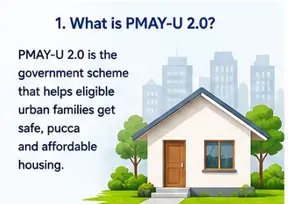
Pradhan Mantri Awas Yojana-Urban 2.0, or PMAY-U 2.0, is the current urban version of the Government’s Housing for All mission.
Its purpose is straightforward: To help eligible urban families get access to affordable housing through construction, purchase, rental housing, or an eligible home-loan subsidy.
The scheme is being implemented through States and Union Territories, Urban Local Bodies, implementing agencies and participating lending institutions, depending on the housing option selected.
The Government’s stated target is to support 1 crore urban poor and middle-class families over the five-year implementation period.
But PMAY-U 2.0 is easier to understand if you stop thinking of it as one benefit.
It is really four different housing routes under one mission.
Who Can Be Eligible for PMAY-U 2.0?
The basic eligibility test is:
Urban household
EWS/LIG/MIG income category
No pucca house anywhere in India
Meets the conditions of the selected PMAY-U 2.0 option
The official FAQ defines a beneficiary family as the husband, wife, and unmarried children.
There is also a previous-benefit restriction. According to the current official PMAY-U 2.0 portal, applicants who have received benefits from a Central, State, or Local Government housing scheme during the previous 20 years are not eligible for PMAY-U 2.0.
Your previous housing benefit history can matter too.
PMAY-U 2.0 Income Limits
So don’t assume that being without a house today automatically makes you eligible.
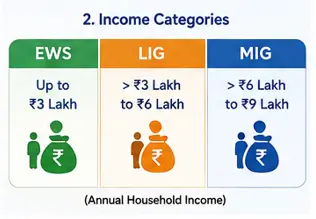
The current official income categories are:
| Category | Annual household income |
|---|---|
| EWS | Up to ₹3 lakh |
| LIG | Above ₹3 lakh up to ₹6 lakh |
| MIG | Above ₹6 lakh up to ₹9 lakh |
These are annual household income categories, not monthly salary categories.
For example, a household earning ₹7 lakh a year falls within the MIG range for PMAY-U 2.0.
That does not automatically mean it will receive the benefit. The family must also satisfy the other conditions and the requirements of the selected vertical.
What Counts as a Pucca House?
This is one of the most important eligibility conditions.
PMAY-U 2.0 generally requires that the beneficiary family does not own a pucca house anywhere in India in the name of the applicant or any member of the family.
The official definition describes a pucca house as an all-weather dwelling with walls and roof made from sturdy and durable materials.
Therefore, don’t interpret the rule as:
“I don’t own a house in my current city.”
The relevant condition is much broader.
The family should not own a qualifying pucca house anywhere in India.
Who Is the Beneficiary Family?
For PMAY-U 2.0, the beneficiary family consists of:
Husband + wife + unmarried sons and/or unmarried daughters.
This matters when determining house ownership and eligibility.
For example, you should not check only the applicant’s name and assume everything is fine. The scheme considers the beneficiary family.
The Four PMAY-U 2.0 Housing Options
This is where PMAY-U 2.0 becomes much more useful.
You have four different routes:
1. BLC
For eligible EWS families who want to construct a new house on their own eligible land.
2. AHP
For eligible EWS beneficiaries purchasing or accessing affordable houses developed through participating public or private agencies.
3. ARH
For eligible EWS and LIG households looking for affordable rental housing.
4. ISS
For eligible EWS, LIG, and MIG households taking an eligible home loan for purchasing, repurchasing, or constructing a house.
The biggest mistake would be selecting an option without understanding what it is actually designed for.
Which PMAY-U 2.0 Option Is Right for You?
Use this simple guide.
| Your situation | Option to investigate |
|---|---|
| EWS family + eligible land + want to build | BLC |
| EWS family + want an affordable house in a project | AHP |
| EWS/LIG family + need affordable rental housing | ARH |
| EWS/LIG/MIG + qualifying home loan | ISS |
This is a starting point, not an approval decision.
The official application system warns applicants to understand the four verticals carefully because once a vertical is selected, it cannot be changed later through the application process.
That makes this decision more important than it might appear.
PMAY-U 2.0 BLC: Build Your Own House
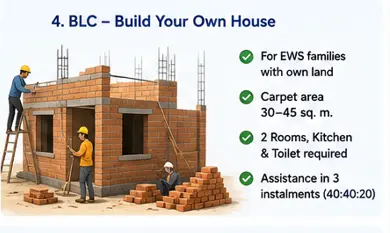
BLC stands for Beneficiary-Led Construction.
This option is designed for eligible EWS families who have their own available land and want to construct a new pucca house.
The permitted house size is generally 30 to 45 square metres of carpet area, subject to the scheme’s construction and building-safety requirements.
The completed house must include at least:
- Two rooms
- Kitchen
- Toilet/bathroom
BLC is for new construction.
It is not a general renovation subsidy. Enhancement, extension, and renovation of an existing house are not permitted under the BLC vertical.
What If an Eligible EWS Family Has No Land?
The official guidelines allow States/UTs, at their own expense, to provide eligible landless beneficiaries with heritable but non-transferable land rights, commonly referred to as pattas, which can make them eligible for BLC.
But don’t assume that every landless applicant will automatically receive land.
This depends on the State/UT and its implementation arrangements.
How Is BLC Assistance Released?
The BLC Central Assistance is released in three instalments in a 40:40:20 ratio, linked to the progress of construction, through DBT to the beneficiary’s bank account.
So if you’re considering BLC, understand one thing clearly:
The assistance is linked to construction progress.
It isn’t simply “apply today and receive the entire amount tomorrow.”
PMAY-U 2.0 AHP: Affordable Housing in Partnership
AHP means Affordable Housing in Partnership.
This route is designed around affordable housing projects developed by public agencies, private agencies, or other eligible implementing entities.
It is primarily relevant to eligible EWS beneficiaries who want to purchase or obtain an allotted affordable house rather than construct one themselves.
The official PMAY-U 2.0 guidelines describe AHP as a route involving affordable housing projects and eligible EWS beneficiaries. The scheme also provides mechanisms such as redeemable housing vouchers in certain eligible private-sector projects.
This means AHP is fundamentally different from BLC.
BLC: You construct on eligible land.
AHP: You access an eligible affordable housing project.
The exact project availability, beneficiary allocation, and local implementation can therefore vary between cities.
The Ministry has also published an AHP Standard Operating Procedure in April 2026, so the implementation details for AHP should be checked against the latest official material when a reader is applying.
PMAY-U 2.0 ARH: Affordable Rental Housing
Not everyone looking for housing wants to buy a house.
A migrant worker may need a reasonably priced room near employment.
A working woman may need safe rental accommodation.
A construction worker may need affordable housing near a project.
This is where Affordable Rental Housing (ARH) comes in.
ARH is intended for eligible EWS and LIG households and includes various groups of urban residents such as migrants and workers.
The scheme provides two broad models.
Model 1
Existing government-funded vacant houses can be converted into rental housing through public agencies or public-private arrangements.
Model 2
Public or private entities can construct, operate, and maintain rental housing for eligible urban residents.
ARH therefore addresses a completely different problem from BLC.
You are not necessarily trying to become a homeowner.
You are trying to obtain affordable rental accommodation.
PMAY-U 2.0 ISS: Home Loan Interest Subsidy
The fourth option is particularly important for middle-income households.
ISS means Interest Subsidy Scheme.
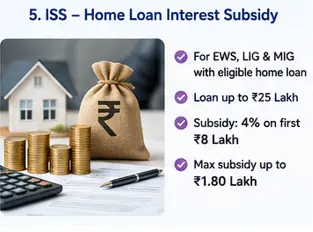
It provides a subsidy on qualifying home loans for eligible EWS, LIG, and MIG households.
The current official PMAY-U 2.0 ISS page says eligible home loans must be sanctioned and disbursed on or after 1 September 2024 and can be used for purchase, repurchase or construction of a house.
The current limits include:
- Household income up to ₹3 lakh for EWS
- Up to ₹6 lakh for LIG
- Up to ₹9 lakh for MIG
- Loan value up to ₹25 lakh
- Property value up to ₹35 lakh
- 4% subsidy on the first ₹8 lakh
- Maximum subsidy release of ₹1.80 lakh
- Maximum eligible carpet area of 120 sq m
The subsidy is subject to the full scheme conditions, including loan tenure requirements.
So don’t describe ISS as a ₹1.80 lakh cash payment.
It is an interest subsidy connected to an eligible home loan.
PMAY-U 2.0 Benefit: How Much Can You Get?
This is one of the most misunderstood parts of the scheme.
The Government states that assistance under PMAY-U 2.0 can be up to ₹2.50 lakh per unit.
But that figure should not be interpreted as:
“Every eligible person gets ₹2.50 lakh directly into their bank account.”
The actual benefit depends on:
- The vertical selected
- Central assistance
- State/UT contribution
- Project structure
- Applicant’s circumstances
- Home-loan eligibility in the case of ISS
For example, BLC assistance is released according to construction progress, while ISS operates through an interest-subsidy mechanism.
This is why articles promising a guaranteed ₹2.50 lakh payment to every applicant are misleading.
What Does a PMAY-U 2.0 House Need to Have?
The official FAQ says a new pucca house under PMAY-U 2.0 should have at least:
- Two rooms
- Kitchen
- Toilet/bathroom
It also requires basic facilities such as:
- Electricity
- Water connection
- Kitchen
- Toilet
The scheme guidelines also refer to basic civic infrastructure such as water, sanitation, sewerage, roads and electricity.
So the objective is not simply to construct four walls.
The housing is intended to provide basic living facilities.
Who Gets Special Attention Under PMAY-U 2.0?
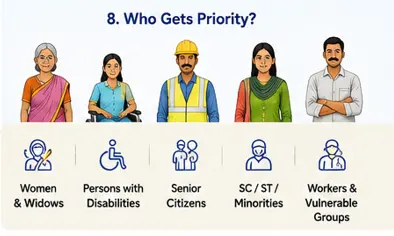
The scheme gives special focus to vulnerable and disadvantaged groups.
These include groups such as:
- Widows
- Single women
- Senior citizens
- Persons with disabilities
- Transgender persons
- Scheduled Castes
- Scheduled Tribes
- Minorities
- Other vulnerable groups
Special attention is also given to groups such as:
- Safai Karmis
- Street vendors
- PM Vishwakarma artisans
- Anganwadi workers
- Building and construction workers
- Slum and chawl residents
Preference or special focus does not mean automatic approval.
The applicant still has to satisfy the applicable eligibility conditions.
What Documents May Be Required?
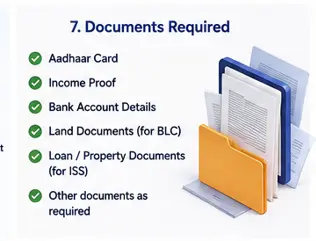
The exact document list can vary according to the vertical and the local implementation process.
You should generally keep the following ready:
- Aadhaar
- Mobile number
- Bank account details
- Income proof where required
- Family details
- Land ownership documents for BLC
- Home-loan/property documents for ISS where applicable
- Any additional documents requested by the ULB, State/UT or implementing agency
The official PMAY-U 2.0 material specifically identifies Aadhaar, bank details, eligibility undertaking and land ownership documents for relevant BLC applications.
Don’t upload documents to an unofficial website just because someone claims to be processing your PMAY application.
How to Apply for PMAY-U 2.0 Online
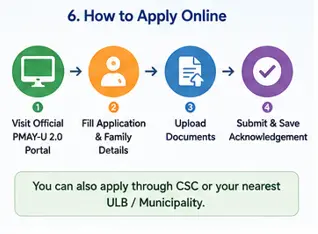
The official PMAY-U 2.0 system provides a Unified Web Portal for registering housing demand and applying for benefits.
Applicants can also use Common Service Centres (CSCs) and concerned Urban Local Bodies/Municipalities.
Step 1: Check Your Eligibility
Before opening the application, check:
- Urban eligibility
- Household income
- Pucca-house ownership
- Previous housing benefits
- Family details
Don’t start by filling in the form.
Start by determining whether the scheme fits you.
Step 2: Decide Which Vertical Applies
Choose between:
BLC
AHP
ARH
ISS
Take this step seriously because the official portal warns that the selected vertical cannot later be changed through the application process.
Step 3: Open the Official PMAY-U 2.0 Portal
Use the official PMAY-U 2.0 website.
Avoid third-party websites claiming to be the PMAY application portal.
Step 4: Enter Your Details
Provide the information requested by the application.
Check:
- Name
- Aadhaar details
- Family information
- Income
- Address
- Mobile number
- Bank details
Step 5: Provide Supporting Information
Depending on the selected vertical, you may need additional information.
For example:
BLC: land ownership information is important.
ISS: income, loan, and property information becomes important.
Step 6: Review Before Submission
Don’t rush through this screen.
A small error in:
- Aadhaar
- name
- mobile number
- family details
- income
- bank information
can create problems during verification.
Step 7: Submit and Save Your Acknowledgement
After submission, save the application/acknowledgement details provided by the portal.
Take a screenshot or keep the reference number safely.
Step 8: Wait for Verification
This is where many applicants misunderstand government schemes.
Application submitted does not mean benefit approved.
The official PMAY-U 2.0 eligibility system explicitly states that submitting the application does not by itself entitle a citizen to benefits. Eligibility must be verified by the relevant State/UT, ULB, Central Nodal Agency or Primary Lending Institution, depending on the case.
Can You Apply Through a CSC?
Yes.
The official FAQ allows applications through:
- Unified Web Portal
- Common Service Centres
- Concerned ULB/Municipality
If you are not comfortable with online forms, a CSC can be useful.
But remember:
A CSC can help you submit an application. It cannot guarantee that the Government will approve it.
Check the information yourself before submission.
What If You Live in a Newly Notified Town?
PMAY-U 2.0 covers statutory towns and also allows towns notified during the implementation period to be included, subject to the applicable approval process.
So don’t rely only on an old list of cities.
The current official PMAY-U 2.0 system should be checked for the status of your town.
PMAY-U 2.0 vs PMAY-G
This distinction is important.
PMAY-U 2.0 is for eligible urban areas.
PMAY-G is the rural housing programme.
The official PMAY-U 2.0 portal states that beneficiaries may receive benefits under either PMAY-G or PMAY-U 2.0 depending on their jurisdiction.
Therefore, if you live in a rural area, don’t automatically apply for PMAY-U 2.0 simply because you saw an advertisement about urban housing.
First, establish which jurisdiction applies to your residence.
Can You Apply If You Already Own a Pucca House?
Generally, no.
The core PMAY-U 2.0 condition is that the beneficiary family should not own a pucca house anywhere in India.
And remember that the condition considers the beneficiary family, not just the person filling out the application.
Can You Apply If You Received a Government House Earlier?
The current official PMAY-U 2.0 portal says applicants who have received benefits under a Central, State or Local Government housing scheme in the previous 20 years are not eligible.
So check your previous housing benefit history before applying.
Can PMAY-U 2.0 Be Used for Renovation?
For BLC, no.
BLC is intended for construction of a new pucca house. The official guidelines do not permit enhancement, extension or renovation of an existing house under this vertical.
This is an important distinction because someone searching “PMAY house repair subsidy” may otherwise misunderstand the scheme.
Common PMAY-U 2.0 Mistakes
Choosing a vertical without understanding it
Don’t select BLC just because it sounds like direct construction assistance.
Assuming everyone gets ₹2.50 lakh
The scheme’s assistance structure varies.
Ignoring the no-pucca-house condition
The condition applies across India.
Forgetting the previous 20-year housing-benefit rule
This can affect eligibility.
Assuming application means approval
It doesn’t.
Using an unofficial application website
Start from the official PMAY-U 2.0 portal.
Giving incorrect family or income information
Verification can expose inconsistencies.
Changing your selected vertical later
The official application system warns that the selected vertical cannot subsequently be changed through the application process.
PMAY-U 2.0 Application Checklist
Before you apply, check these one by one:
☐ I live in an eligible urban area.
☐ My household income falls within the relevant category.
☐ My family does not own a pucca house anywhere in India.
☐ I have checked whether my family received a government housing benefit during the previous 20 years.
☐ I understand BLC, AHP, ARH and ISS.
☐ I know which vertical fits my situation.
☐ I have the required documents.
☐ My Aadhaar and personal details are correct.
☐ My bank details are correct.
☐ I am applying through an official channel.
☐ I will save my application acknowledgement.
If you cannot confidently tick the first few boxes, don’t rush into the application.
Frequently Asked Questions
Q1. What is PMAY-U 2.0?
PMAY-U 2.0 is the Government’s current urban housing mission that assists with four routes: BLC, AHP, ARH, and ISS for eligible urban families.
Q2. What is the PMAY-U 2.0 income limit?
EWS is up to ₹3 lakh annual household income, LIG is above ₹3 lakh up to ₹6 lakh, and MIG is above ₹6 lakh up to ₹9 lakh.
Q3. How much money is available under PMAY-U 2.0?
Government assistance can be up to ₹2.50 lakh per unit, but the amount and method of benefit depend on the selected vertical and applicable funding structure.
Q4. Can I apply for PMAY-U 2.0 if I own a house?
If the applicant or another member of the beneficiary family owns a pucca house anywhere in India, the family generally does not meet the basic PMAY-U 2.0 eligibility condition.
Q5. What are the four PMAY-U 2.0 verticals?
They are Beneficiary-Led Construction, Affordable Housing in Partnership, Affordable Rental Housing and Interest Subsidy Scheme.
Q6. Which PMAY-U 2.0 option is for home loans?
The Interest Subsidy Scheme (ISS) is the home-loan-linked component for eligible EWS, LIG and MIG households.
Q7. Can an EWS family construct its own house?
Yes, eligible EWS beneficiaries with available land can use the BLC vertical to construct a new pucca house subject to the scheme’s conditions.
Q8. Can PMAY-U 2.0 help with house renovation?
Not under BLC. BLC is for construction of a new pucca house, not renovation or extension of an existing house.
Q9. Can I apply through a CSC?
Yes. The official FAQ lists CSCs and concerned ULBs/Municipalities as application channels in addition to the Unified Web Portal.
Q10. Can I change my PMAY-U 2.0 vertical after selecting it?
The current official eligibility system says that once a vertical is selected, it cannot be changed at a later stage through the application process.
Q11. Does submitting the PMAY-U 2.0 form guarantee approval?
No. The application must be verified by the appropriate authorities or participating institution according to the selected vertical.
Q12. What is the PMAY-U 2.0 implementation period?
The mission is being implemented for five years from 1 September 2024 to 2029.
Final Takeaway
PMAY-U 2.0 is not simply a scheme where every eligible person applies and receives the same housing amount.
It is a four-option urban housing programme.
If you are an eligible EWS family with land and want to build, look at BLC.
If you are looking for an affordable house in an eligible housing project, investigate AHP.
If you need affordable rental accommodation, look at ARH.
If you are taking a qualifying home loan, ISS may be the relevant option.
Before applying, check the three things that can eliminate many applications immediately:
your household income, your family’s house ownership, and your previous housing benefits.
Then choose the correct vertical carefully because the official application system says the selected option cannot later be changed through the process.
Most importantly, don’t confuse application with approval.
Your application still has to pass the applicable verification process.
That is the practical way to approach PMAY-U 2.0 in 2026.
Official PMAY-U 2.0 Sources
For Benefitomics, I recommend linking directly to these rather than sending readers to third-party PMAY websites: