If you are looking for government housing assistance, one question comes up repeatedly:
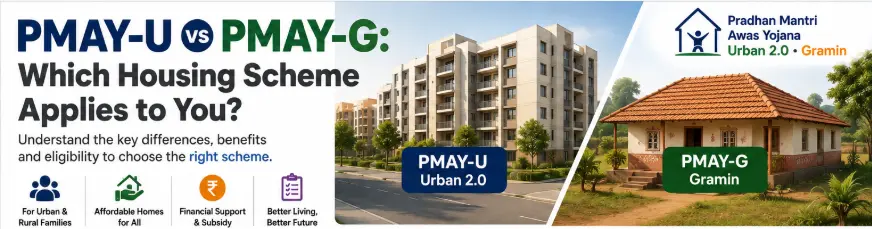
Should I apply under PMAY-U or PMAY-G?
The answer mainly depends on where your household falls under the official urban or rural jurisdiction. It is not simply a matter of choosing the scheme with the higher benefit.
PMAY-U 2.0 is designed for eligible families in urban areas, while PMAY-G focuses on eligible rural households. The two schemes also differ in eligibility, beneficiary identification and the type of housing assistance available.
The most important rule: You generally cannot choose PMAY-U or PMAY-G purely based on personal preference. The applicable scheme depends on your jurisdiction and eligibility.
This guide explains the difference clearly.
Quick Answer: PMAY-U vs PMAY-G
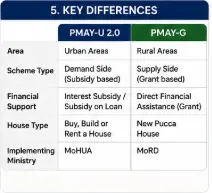
| Point | PMAY-U 2.0 | PMAY-G |
|---|---|---|
| Full name | Pradhan Mantri Awas Yojana – Urban 2.0 | Pradhan Mantri Awaas Yojana – Gramin |
| Area covered | Urban areas | Rural areas |
| Main target group | Eligible urban EWS, LIG and MIG families | Eligible rural houseless households and qualifying households living in kutcha houses |
| Basic purpose | Construct, purchase or rent affordable housing through different verticals | Construct pucca houses with basic amenities for eligible rural households |
| Income categories | EWS, LIG and MIG | Beneficiary selection is based mainly on housing deprivation and exclusion criteria rather than the PMAY-U income categories |
| Implementation | Through States, UTs, ULBs and PLIs, depending on the vertical | Through the rural development framework and beneficiary identification process |
| Current implementation period | 2024 to 2029 | FY 2024-25 to 2028-29 |
The official PMAY-U 2.0 guidelines specifically state that beneficiaries may receive benefits under PMAY-G or PMAY-U 2.0 according to their jurisdiction, with system linkage intended to avoid duplicate beneficiaries.
What Is PMAY-U 2.0?
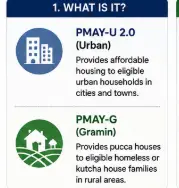
Pradhan Mantri Awas Yojana – Urban 2.0, or PMAY-U 2.0, is the government housing mission for eligible families in urban areas.
It was launched for implementation in September 2024 and is planned for five years up to 2029. The scheme provides support to eligible beneficiaries to construct, purchase or rent affordable housing through four verticals.
The four PMAY-U 2.0 verticals are:
- Beneficiary-Led Construction (BLC)
- Affordable Housing in Partnership (AHP)
- Affordable Rental Housing (ARH)
- Interest Subsidy Scheme (ISS)
The appropriate vertical depends on the applicant’s circumstances and housing requirement.
What Is PMAY-G?
Pradhan Mantri Awaas Yojana – Gramin, or PMAY-G, is the government housing scheme for eligible rural households.
Its objective is to provide assistance for the construction of pucca houses with basic amenities for eligible rural households.
For the current phase, the government approved implementation during FY 2024-25 to 2028-29 for additional rural housing assistance.
Under the established PMAY-G beneficiary framework, the eligible universe includes houseless households and qualifying households living in zero, one or two rooms with kutcha walls and kutcha roofs, subject to the applicable identification and exclusion process.
The Biggest Difference: Urban vs Rural Area
This is the first question you should answer.
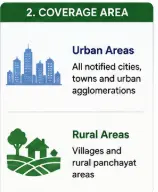
You May Fall Under PMAY-U 2.0 If You Live in an Urban Area
PMAY-U 2.0 is intended for eligible families living in urban areas.
The scheme covers eligible beneficiaries in statutory towns and other notified urban planning and development areas covered under the applicable scheme framework.
You May Fall Under PMAY-G If You Live in a Rural Area
PMAY-G is designed for eligible rural households.
The beneficiary identification process is linked to housing deprivation criteria and the applicable verified beneficiary lists and surveys.
What If Your Area Is Near an Urban-Rural Boundary?
This is where many people become confused.
The official PMAY-U 2.0 FAQ directly addresses this situation.
It states that beneficiaries may avail benefits under PMAY-G or PMAY-U 2.0 depending on their jurisdiction.
Important
Do not decide based only on:
- Whether your village is close to a city
- Whether you have a city PIN code
- Whether nearby areas are developing rapidly
- Whether you personally consider your locality urban
The official jurisdiction matters.
PMAY-U vs PMAY-G: Eligibility Comparison
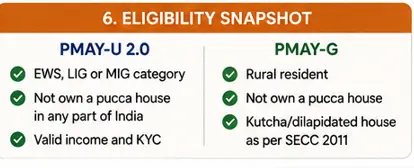
PMAY-U 2.0 Eligibility
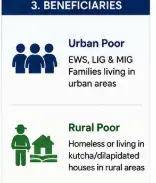
Under PMAY-U 2.0, the basic eligibility framework includes families:
- Living in urban areas
- Belonging to EWS, LIG or MIG segments
- Not owning a pucca house anywhere in India in the name of the beneficiary or an eligible family member
The PMAY-U 2.0 guidelines define the beneficiary family as comprising a husband, wife and unmarried children.
The scheme also contains conditions relating to previous housing benefits.
For example, the guidelines state that a family that has received a house under a Central, State, UT or local government housing scheme during the preceding 20 years is not eligible under PMAY-U 2.0, subject to the applicable scheme provisions.
PMAY-G Eligibility
PMAY-G works differently.
The beneficiary universe focuses on eligible rural households based on housing deprivation and exclusion criteria.
Official government information describes the eligible universe as including:
- Houseless households
- Qualifying households living in kutcha houses
The established beneficiary identification process uses SECC 2011 data and finalized Awaas+ survey lists, along with verification processes. The current phase also involves updating beneficiary identification through the applicable process.
This is a major difference: PMAY-G is not simply an “income slab” scheme like PMAY-U 2.0. Rural beneficiary identification depends heavily on housing deprivation and the applicable official selection process.
PMAY-U vs PMAY-G Income Criteria
PMAY-U 2.0
PMAY-U 2.0 uses these broad household income categories:
| Category | Annual Household Income |
|---|---|
| EWS | Up to ₹3 lakh |
| LIG | Above ₹3 lakh up to ₹6 lakh |
| MIG | Above ₹6 lakh up to ₹9 lakh |
The applicable benefits and vertical eligibility can differ between these categories.
PMAY-G
PMAY-G does not use these PMAY-U-style EWS, LIG, and MIG slabs as its primary beneficiary selection framework.
Instead, the scheme focuses on rural housing deprivation and the applicable exclusion and beneficiary identification process.
PMAY-U vs PMAY-G Benefits
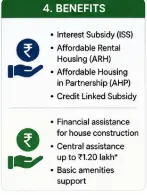
This is another area where people should avoid oversimplifying.
The benefit structure of the two schemes is different.
PMAY-U 2.0 Benefits
PMAY-U 2.0 assists four separate verticals.
Depending on eligibility and the selected vertical, support may relate to:
- Constructing a house
- Purchasing an affordable house
- Renting affordable housing
- Interest subsidy on an eligible home loan
Government assistance under PMAY-U 2.0 can be up to ₹2.50 lakh per unit, subject to the applicable vertical and scheme conditions.
This does not mean that every applicant automatically receives ₹2.50 lakh.
The actual benefit depends on the applicable vertical and eligibility.
PMAY-G Benefits
For the current PMAY-G framework, the approved unit assistance is:
- ₹1.20 lakh in plain areas
- ₹1.30 lakh in North Eastern and specified hilly areas
Additional assistance of ₹12,000 for toilet construction is provided through convergence with Swachh Bharat Mission–Gramin, subject to the applicable framework.
The support structure can involve other convergence provisions as applicable.
PMAY-U vs PMAY-G: Beneficiary Selection
This is one of the biggest practical differences.
PMAY-U 2.0
Eligible urban beneficiaries can enter the scheme through the applicable PMAY-U 2.0 process.
The application and verification process can involve:
- Unified Web Portal
- Urban Local Bodies
- States or UTs
- Primary Lending Institutions for ISS
The exact process depends on the selected vertical.
PMAY-G
PMAY-G beneficiary identification is more closely linked to the official rural housing beneficiary selection process.
Government information describes identification using:
- Housing deprivation parameters
- SECC 2011 data
- Applicable exclusion criteria
- Awaas+ survey data
- Gram Sabha verification and related processes
Therefore, simply being poor or living in a rural area does not automatically mean that a person can independently create a new PMAY-G application and immediately receive assistance.
The applicable beneficiary identification process matters.
Can You Choose Between PMAY-U and PMAY-G?
Generally, you should not treat PMAY-U and PMAY-G as two schemes from which you can freely choose the more attractive option.
The official PMAY-U 2.0 guidelines are clear that beneficiaries may receive benefits under PMAY-G or PMAY-U 2.0 according to their jurisdiction.
There is also a linkage between the relevant systems to help prevent duplication of beneficiaries.
Example 1: You Live in a Municipality
If your residence falls within the applicable urban jurisdiction, PMAY-U 2.0 may be the relevant scheme.
You must still satisfy the scheme’s eligibility conditions.
Example 2: You Live in a Village Under Rural Jurisdiction
PMAY-G may be the relevant scheme if your household meets the applicable rural beneficiary identification criteria.
Example 3: Your Village Is Close to a City
Do not guess.
Check whether your location officially falls under an urban or rural jurisdiction.
This is especially important for areas that have recently been included in:
- Municipal boundaries
- Urban development areas
- Notified planning areas
PMAY-U vs PMAY-G: Which One Should You Apply For?
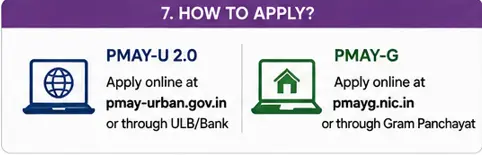
Use this simple starting point.
Step 1: Check Your Official Jurisdiction
Ask:
Does my residence fall under an urban or rural administrative jurisdiction?
This is the first filter.
Step 2: If You Are in an Urban Area
Check PMAY-U 2.0 eligibility.
You should review:
- Household income
- Pucca house ownership
- Previous housing scheme benefits
- Selected PMAY-U 2.0 vertical
Step 3: If You Are in a Rural Area
Check whether your household is covered by the applicable PMAY-G beneficiary identification process.
Review:
- Housing condition
- Existing beneficiary records
- Awaas+ and applicable survey status
- Local verification process
Step 4: If You Are Near an Urban-Rural Boundary
Contact the relevant local authority before taking further action.
Do not submit duplicate applications under both schemes.
Simple Decision Guide
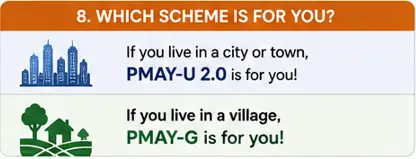
Choose PMAY-U 2.0 as the Relevant Scheme to Check If:
- Your household falls within an eligible urban jurisdiction.
- You meet the applicable EWS, LIG or MIG conditions.
- Your family does not own a pucca house anywhere in India, subject to scheme rules.
- You meet the other PMAY-U 2.0 eligibility conditions.
- The relevant PMAY-U 2.0 vertical matches your housing requirement.
Check PMAY-G Eligibility If:
- Your household falls within a rural jurisdiction.
- You are houseless or living in a qualifying kutcha housing situation.
- Your household meets the applicable beneficiary identification and exclusion criteria.
- Your name is covered through the applicable official beneficiary identification process.
PMAY-U vs PMAY-G Comparison Table
| Feature | PMAY-U 2.0 | PMAY-G |
|---|---|---|
| Primary area | Urban | Rural |
| Main objective | Affordable housing support in urban areas | Pucca housing for eligible rural households |
| Current phase | 2024–2029 | FY 2024-25 to 2028-29 |
| Income categories | EWS, LIG and MIG | Not based primarily on PMAY-U income slabs |
| Main eligibility basis | Urban jurisdiction, income category and housing-related conditions | Rural jurisdiction, housing deprivation and beneficiary identification process |
| Pucca house condition | Family should not own a pucca house anywhere in India, subject to scheme rules | Focuses on eligible houseless households and qualifying households living in kutcha houses |
| Application structure | Different processes based on four verticals | Beneficiary identification through the applicable rural process |
| Major assistance type | Construction, purchase, rent or home loan interest subsidy | Financial assistance for construction of a pucca house |
| Basic unit assistance | Depends on the applicable PMAY-U 2.0 vertical | ₹1.20 lakh in plains and ₹1.30 lakh in specified hilly/NE areas under the current approved structure |
Can the Same Family Receive Benefits Under Both Schemes?
You should not assume that the same family can freely receive housing benefits under both schemes.
The PMAY-U 2.0 guidelines provide for system linkage with PMAY-G to avoid duplication of beneficiaries.
In addition, PMAY-U 2.0 has restrictions concerning families that have availed housing benefits under government housing schemes during the relevant preceding period.
Therefore:
Do not apply under both schemes simply to increase your chances of receiving government assistance.
Always check the applicable jurisdiction and eligibility first.
Common Mistakes People Make
Mistake 1: Choosing Based on the Amount of Money
Do not compare the schemes only by the headline assistance amount.
The benefit structure, eligibility and purpose are different.
The scheme applicable to you depends on your circumstances.
Mistake 2: Assuming Every Village Resident Gets PMAY-G
PMAY-G has a beneficiary identification process.
Living in a village alone does not automatically establish eligibility.
Mistake 3: Assuming Every City Resident Gets PMAY-U
PMAY-U 2.0 also has income, housing ownership, and other eligibility conditions.
Urban residence alone is not enough.
Mistake 4: Applying Under Both Schemes
The schemes have systems and verification mechanisms intended to avoid duplicate beneficiaries.
Do not create duplicate applications without understanding your jurisdiction.
Mistake 5: Using an Old YouTube Video as Your Only Source
Both schemes are government programmes with evolving implementation processes.
Always check the latest official information before applying.
Frequently Asked Questions
Q1. Which is better: PMAY-U or PMAY-G?
Neither scheme is universally better.
PMAY-U 2.0 is designed for eligible urban beneficiaries, while PMAY-G is designed for eligible rural households.
The correct scheme depends mainly on your jurisdiction and eligibility.
Q2. Can I apply for PMAY-U if I live in a village?
Usually, the relevant scheme depends on your official jurisdiction.
If your area falls under rural jurisdiction, PMAY-G may be the relevant scheme. If it falls under an officially covered urban jurisdiction, PMAY-U 2.0 may apply.
Check with the relevant authority if your location is near an urban boundary.
Q3. Can I apply for PMAY-G if I live in a city?
PMAY-G is designed for rural areas.
Urban residents should generally check whether PMAY-U 2.0 is the applicable housing scheme for their jurisdiction.
Q4. Does PMAY-G have an income limit like PMAY-U?
PMAY-G beneficiary identification is based primarily on housing deprivation and exclusion criteria rather than the EWS, LIG, and MIG income categories used in PMAY-U 2.0.
Q5. Can I receive benefits under both PMAY-U and PMAY-G?
You should not assume that you can.
The official PMAY-U 2.0 guidelines provide for system linkage with PMAY-G to avoid duplication, and eligibility restrictions may apply.
Q6. What if my area is between a city and a village?
Check the official jurisdiction.
The PMAY-U 2.0 FAQ specifically states that the applicable benefit between PMAY-G and PMAY-U 2.0 depends on jurisdiction.
Q7. How much assistance is available under PMAY-G?
Under the currently approved structure, unit assistance is ₹1.20 lakh in plain areas and ₹1.30 lakh in specified North Eastern and hilly areas. Additional toilet assistance of ₹12,000 is available through convergence with SBM-G under the applicable framework.
Final Takeaway
The easiest way to understand PMAY-U vs PMAY-G is this:
PMAY-U 2.0 is primarily for eligible urban families. PMAY-G is primarily for eligible rural households.
But your location alone is not the final answer.
You must also check the specific eligibility rules.
Before applying:
- Confirm whether your residence falls under urban or rural jurisdiction.
- Check the relevant scheme’s eligibility conditions.
- Do not submit applications under both schemes without understanding the rules.
- Use official government portals and local authorities for confirmation.
My recommendation is straightforward:
First, determine your official jurisdiction. Only then spend time checking documents and starting an application.
Related Benefitomics Guides
PMAY-U 2.0
- PMAY-U 2.0 Guide (2026): Eligibility, Benefits, Housing Options & How to Apply
- PMAY-U 2.0 Eligibility 2026: Who Can Apply and Who Is Not Eligible?
- PMAY-U 2.0 Documents Required: Complete Checklist
- PMAY-U 2.0 Application Status: How to Check
- PMAY-U 2.0 Rejected? Reasons & What to Do
- PMAY-U 2.0 BLC Guide
- PMAY-U 2.0 AHP Guide
- PMAY-U 2.0 ARH Guide
- PMAY-U 2.0 ISS Guide
PMAY-G
A dedicated PMAY-G guide should be consulted for the latest beneficiary survey, eligibility identification, and rural application process.