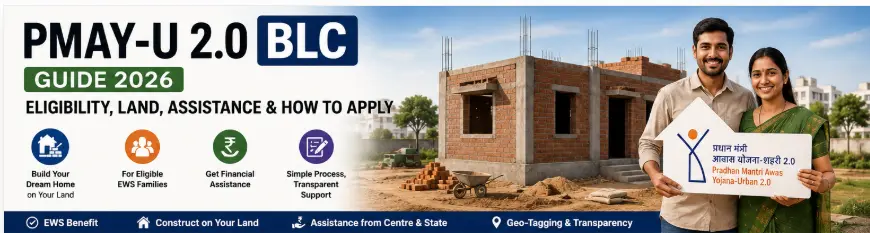
PMAY-U 2.0 BLC: Quick Answer
PMAY-U 2.0 BLC stands for Beneficiary-Led Construction. It is the PMAY-U 2.0 option for eligible EWS families who want to construct a new pucca house on their own available land.
The basic idea is simple: instead of getting a house through an affordable housing project, an eligible family constructs its own house on eligible land with assistance under the scheme.
The official PMAY-U 2.0 FAQ specifically describes BLC as assistance to eligible EWS families for constructing new houses on their own available vacant land.
But there is an important point many websites miss:
Having land does not automatically make you eligible for BLC.
You still have to satisfy the overall PMAY-U 2.0 eligibility conditions, and your application and land documents have to go through the required verification process.
What Is PMAY-U 2.0 BLC?
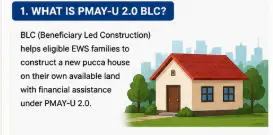
BLC means Beneficiary-Led Construction.
Under this vertical, an eligible EWS family can construct a new house on available land rather than purchasing a completed house from an affordable housing project.
PMAY-U 2.0 is being implemented for five years from 1st September 2024 to 2029, and BLC is one of its four verticals alongside AHP, ARH, and ISS.
The four options are:
| PMAY-U 2.0 vertical | Main purpose |
|---|---|
| BLC | Construction of a new house by an eligible beneficiary |
| AHP | Affordable housing through eligible projects |
| ARH | Affordable rental housing |
| ISS | Interest subsidy linked to eligible home loans |
So if you already have suitable land and want to construct your own house, BLC is the PMAY-U 2.0 vertical you should investigate first.
Who Is Eligible for PMAY-U 2.0 BLC?
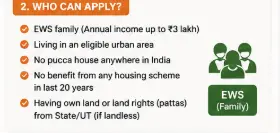
The BLC vertical is specifically intended for EWS families.
The official PMAY-U 2.0 FAQ says eligible EWS families can receive assistance to construct new houses on their own available vacant land.
You also need to satisfy the wider PMAY-U 2.0 conditions.
In general, the beneficiary family must:
- Belong to the applicable EWS category
- Live in an eligible urban area
- Not own a pucca house anywhere in India
- Satisfy the previous housing-benefit conditions
- Have eligible land available for construction, or potentially receive land rights under the provision for landless beneficiaries
- Provide the required documents
- Complete the required verification process
The official scheme defines a beneficiary family as husband, wife, and unmarried sons and/or unmarried daughters.
What Is the Income Limit for BLC?
The important point here is that BLC is for EWS beneficiaries.
Under the standard PMAY-U 2.0 classification, EWS means an annual household income of up to ₹3 lakh.
| Category | Annual household income | BLC |
|---|---|---|
| EWS | Up to ₹3 lakh | Applicable |
| LIG | Above ₹3 lakh to ₹6 lakh | Not under BLC |
| MIG | Above ₹6 lakh to ₹9 lakh | Not under BLC |
Don’t confuse this with the Interest Subsidy Scheme, which covers EWS, LIG and MIG households subject to its separate conditions.
For BLC, the relevant category is EWS.
Do You Need Your Own Land for BLC?
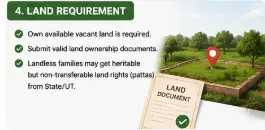
Normally, BLC is based on construction on the beneficiary’s available land.
The official PMAY-U 2.0 FAQ says beneficiaries applying under BLC need to approach the ULB, implementing agency, or Unified Web Portal with necessary documents, including proof of ownership of the land.
This means land documentation is not a minor formality.
It is an important part of the BLC application.
Before applying, you should therefore check whether you have valid documents establishing your right to the land on which the house is proposed to be constructed.
What If You Are Landless?
This is where PMAY-U 2.0 BLC becomes more interesting.
Being landless does not automatically mean that BLC is impossible.
The official FAQ provides a specific provision under which States/UTs may provide heritable but non-transferable land rights, or pattas, to eligible landless beneficiaries at their own expense. Such beneficiaries can then become eligible under the BLC vertical.
However, don’t interpret this as:
“The Government will give every landless applicant a plot.”
That is not what the rule says.
The provision depends on the State/UT and its implementation arrangements.
So if you are landless, contact your concerned Urban Local Body or implementing agency and ask whether this provision is being implemented in your area.
Can Someone With a Rented House Apply for BLC?
Simply living in a rented house does not make you eligible for BLC.
The important questions are:
- Are you an eligible EWS family?
- Do you satisfy the PMAY-U 2.0 house-ownership condition?
- Do you have eligible land on which the new house can be constructed?
- Do you satisfy the other scheme requirements?
If you are renting a house but own eligible vacant land, your situation is different from someone who owns no land at all.
The application and documents will determine whether you qualify.
Can You Apply If You Already Own a Pucca House?
Generally, no.
PMAY-U 2.0 eligibility requires eligible families to have no pucca house in the name of the applicant or any member of the beneficiary family anywhere in India.
This is why checking only your current address can be misleading.
For example:
You live in a rented house in Odisha.
But your family already owns a pucca house in another State.
You should not assume that you qualify for BLC simply because you currently live in rented accommodation.
The house-ownership condition applies across India.
What Kind of House Can Be Constructed Under BLC?
The PMAY-U 2.0 FAQ states that houses supported under the BLC/AHP vertical can have a carpet area of up to 45 square metres.
That is approximately 484 square feet of carpet area.
Remember that carpet area is not the same thing as the total plot area or necessarily the total built-up area.
So don’t interpret the 45 sq. m. figure as saying that your land itself must be only 45 sq. m.
The requirement concerns the supported house.
How Much Assistance Is Available Under BLC?
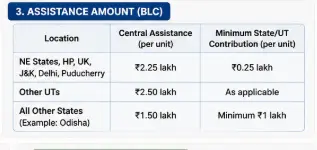
This is an area where you should be careful with online articles because there is not one identical Central assistance amount for every State and Union Territory.
The current PMAY-U 2.0 FAQ gives the following structure for BLC and AHP:
| Location | Central Government assistance | Minimum State/UT contribution |
|---|---|---|
| Assam, Arunachal Pradesh, Meghalaya, Manipur, Mizoram, Nagaland, Tripura, Sikkim, Himachal Pradesh, Uttarakhand, J&K, Puducherry and Delhi | ₹2.25 lakh per unit | ₹0.25 lakh per unit |
| Other Union Territories | ₹2.50 lakh per unit | As applicable under the scheme |
| Other States | ₹1.50 lakh per unit | Minimum ₹1 lakh per unit |
This distinction matters.
So an article saying simply “PMAY-U 2.0 BLC gives ₹2.50 lakh to everyone” would be misleading.
The Central assistance depends on the applicable State/UT category.
Your actual assistance can also depend on the approved project, State/UT contribution, and scheme implementation.
What About Odisha?
Odisha falls under the “all other States” category in the PMAY-U 2.0 assistance table.
Therefore, the current FAQ lists:
Central Government assistance: ₹1.50 lakh per unit
and
Minimum State Government assistance: ₹1 lakh per unit
for the BLC/AHP category applicable to Odisha.
That gives a minimum combined contribution structure of ₹2.50 lakh per unit, subject to the applicable scheme conditions and implementation.
This is especially useful for readers searching from Odisha because the amount should not be confused with the higher Central assistance applicable to certain northeastern and hill States or other Union Territories.
Is the BLC Money Paid All at Once?
Don’t expect the entire assistance to simply appear in your bank account immediately after application.
PMAY-U 2.0 uses a project- and construction-stage-based implementation process.
The official guidelines provide criteria for the release of Central assistance under BLC, including sanctioning of beneficiaries/projects and subsequent requirements.
Construction progress also has to be monitored.
This is why geo-tagging becomes important.
What Is Geo-Tagging in PMAY-U 2.0 BLC?
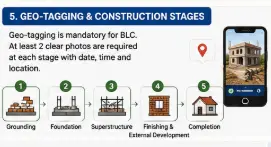
Geo-tagging means capturing photographs of the construction at specified stages along with location and time information.
The PMAY-U 2.0 FAQ describes geo-tagging as capturing photographs of construction stages with embedded latitude, longitude, date, time and stage information to monitor progress and support fund release.
The standard stages include:
- Grounding
- Foundation
- Superstructure
- Finishing and external development
- Completion
This is not just a photography exercise.
The purpose is to establish that the house is actually progressing at the approved location and construction stage.
Is Geo-Tagging Mandatory for BLC?
Yes.
The official PMAY-U 2.0 FAQ states that geo-tagging is mandatory for AHP/BLC projects for monitoring and fund release.
The guidelines also connect stage-wise geo-tagging with monitoring and release of funds.
So if your BLC application is approved, don’t ignore instructions regarding construction-stage photographs and geo-tagging.
Who Does the Geo-Tagging?
The official FAQ explains that geo-tagging of BLC houses is to be carried out through the designated process and mobile application by designated field functionaries or officials of the implementing agency/ULB.
The FAQ also provides for beneficiaries to geo-tag progress through applicable modalities, after which the ULB or implementing agency monitors and approves the captured geo-tagging status.
This means you should follow the instructions given by your local implementing authority.
Don’t simply upload random photographs yourself unless the official process tells you to do so.
How Many Photographs Are Required?
The current PMAY-U 2.0 FAQ says that at least two clear photographs per stage are required, with additional photographs possible where needed.
The photographs should capture:
- Latitude
- Longitude
- Date
- Time
- Construction stage
The photographs should also clearly show the actual construction progress.
This helps prevent a situation where the location or stage cannot be verified.
What Happens If Geo-Tagging Is Not Completed?
This is serious.
The official PMAY-U 2.0 FAQ states that funds will not be released without the prescribed geo-tagging stages being captured for AHP/BLC projects according to the scheme requirements.
So don’t think of geo-tagging as something you can complete whenever convenient.
If your application has been sanctioned, follow the construction and geo-tagging instructions provided by the implementing authority.
What Documents Are Required for PMAY-U 2.0 BLC?
The exact document list can vary according to the State, ULB, and applicant’s circumstances.
However, the official PMAY-U 2.0 FAQ identifies important documents including:
- Aadhaar card
- Bank account details
- Eligibility undertaking
- Land ownership documents for BLC
- Other documents specified by the State/UT/ULB/implementing agency
You may also need supporting documents related to income, family details, or special categories depending on your circumstances.
For BLC, land ownership documentation is particularly important.
BLC Application Process
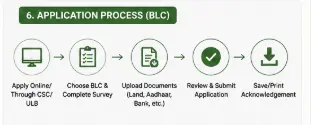
If you appear eligible, the broad application process is:
Step 1: Check PMAY-U 2.0 Eligibility
Confirm that your family meets the EWS and other eligibility conditions.
Step 2: Confirm Your Land Position
Make sure you have eligible available land and valid ownership documentation.
If you are landless, ask your State/UT or ULB about the land-rights provision.
Step 3: Select BLC
When completing the PMAY-U 2.0 application, select Beneficiary-Led Construction only if BLC genuinely matches your situation.
The official portal allows eligible beneficiaries to choose one of the four PMAY-U 2.0 verticals.
Step 4: Complete Aadhaar Authentication
Follow the portal’s Aadhaar authentication process.
Step 5: Complete the Beneficiary Survey
Enter your personal, family, household, address, and bank information accurately.
Step 6: Upload Required Documents
Upload your land ownership documents and other documents requested by the application.
Step 7: Review the Application
Check your name, Aadhaar, family details, income, land details, bank account, and address.
Step 8: Submit the Application
Complete the declaration and submit the application.
Step 9: Keep the Application Record
Save or print the submitted application.
Step 10: Wait for Verification
Your application must go through the applicable verification and approval process.
The PMAY-U 2.0 FAQ says beneficiaries can apply through the Unified Web Portal, CSCs, or the concerned ULB/Municipality.
Where Can You Apply for BLC?

You have three main routes:
Online: Through the Unified PMAY-U 2.0 Web Portal.
CSC: Through a Common Service Centre.
Local authority: Through the concerned Urban Local Body or Municipality.
The official FAQ specifically lists these channels.
If you use a CSC, don’t simply hand over your documents and walk away.
Ask the operator to show you the information being entered.
You are responsible for ensuring that your application contains correct information.
Can You Build Any Type of House With BLC Assistance?
No.
The assistance is linked to the PMAY-U 2.0 housing requirements.
The supported house must be for residential use.
The official FAQ states that a house constructed under PMAY-U 2.0 is for residential purposes and should not be used for other activities. It also states that beneficiaries should not sell, transfer, sublease, or rent out the house for five years from the date of completion.
This is an important condition.
The assistance is not intended to create a property that can immediately be sold or rented for profit.
Can You Sell the PMAY-U 2.0 BLC House?
The official FAQ states that beneficiaries should not sell, transfer, sublease, or rent out a house constructed under PMAY-U 2.0 for five years from the date of completion.
So if your plan is:
“I’ll take the assistance, construct the house and sell it immediately.”
That is not consistent with the scheme conditions.
Can You Rent Out the BLC House?
The same five-year restriction applies to renting out or sub-leasing the PMAY-U 2.0 house.
Therefore, BLC should be approached as a housing benefit for the eligible family, not as a short-term investment opportunity.
What If Your Land Is in a Different Place?
This is a situation where you should not guess.
BLC is tied to an eligible urban area and the proposed construction site.
If your residence is in one city but the land is somewhere else, don’t assume that the land automatically qualifies simply because you own it.
The local implementing authority will need to determine whether the proposed site and beneficiary circumstances meet the applicable PMAY-U 2.0 requirements.
Before submitting the application, verify the issue with the concerned ULB or implementing agency.
What If the Land Documents Have a Problem?
Don’t submit a questionable document simply to get the application moving.
If the ownership record is unclear, there is a family dispute, the land is jointly owned, mutation is incomplete or the name on the document does not correspond with the applicant’s circumstances, resolve the issue or obtain clarification from the appropriate authority first.
BLC is fundamentally connected with construction on eligible available land.
The official FAQ specifically requires land ownership proof for BLC applications.
PMAY-U 2.0 BLC vs AHP
This is one of the easiest ways to understand the difference.
| Feature | BLC | AHP |
|---|---|---|
| Full form | Beneficiary-Led Construction | Affordable Housing in Partnership |
| Main beneficiary | EWS | EWS |
| Basic idea | Build your own house | Obtain house through eligible project |
| Land | Available land is important | Project land |
| Construction | Beneficiary-led | Eligible housing project |
| Geo-tagging | Yes | Yes |
| Best suited for | Eligible EWS family with suitable land | Eligible EWS beneficiary seeking affordable project housing |
If you already have suitable land and want to build your own house, BLC is the more natural option to investigate.
If you don’t want to construct your own house and an eligible affordable housing project is available, AHP may be more relevant.
PMAY-U 2.0 BLC vs ISS
Don’t confuse these two.
BLC is about constructing a house under the beneficiary-led construction component.
ISS is about interest subsidy on eligible home loans.
ISS is available to eligible EWS, LIG, and MIG households subject to its separate conditions, whereas BLC is specifically for eligible EWS families.
So someone with a home loan should not automatically select BLC just because they are buying or constructing a house.
The correct vertical depends on the circumstances.
Common PMAY-U 2.0 BLC Mistakes
Mistake 1: Thinking BLC is available to everyone
It isn’t.
BLC is specifically for eligible EWS families.
Mistake 2: Applying without land documents
Land ownership proof is an important BLC requirement.
Mistake 3: Assuming rented-house status is enough
You still have to satisfy the complete eligibility conditions.
Mistake 4: Ignoring family house ownership
The pucca-house condition applies to the beneficiary family.
Mistake 5: Treating the assistance as a lump-sum personal loan
PMAY-U 2.0 assistance is connected with the approved housing project and implementation process.
Mistake 6: Ignoring geo-tagging
Construction progress must be monitored through the prescribed geo-tagging process.
Mistake 7: Assuming the amount is identical across India
Central and State/UT contributions vary according to the applicable category.
Mistake 8: Planning to rent or sell immediately
The scheme has a five-year restriction on sale, transfer, sub-leasing, and renting after completion.
PMAY-U 2.0 BLC Checklist

Before applying, check these items:
☐ I fall under the EWS category.
☐ I live in an eligible urban area.
☐ My beneficiary family does not own a pucca house anywhere in India.
☐ I have checked previous housing benefits.
☐ I have eligible available land.
☐ My land ownership documents are available.
☐ My Aadhaar details are correct.
☐ My bank account details are correct.
☐ I have the required eligibility undertaking.
☐ I understand that BLC is for construction of a new house.
☐ I understand the applicable house-size requirement.
☐ I understand that geo-tagging will be required.
☐ I understand that submission does not guarantee approval.
☐ I understand the five-year restriction after completion.
Frequently Asked Questions
Q1. What is PMAY-U 2.0 BLC?
PMAY-U 2.0 BLC stands for Beneficiary-Led Construction. It assists eligible EWS families in constructing a new house on their own available vacant land.
Q2. Who can apply for PMAY-U 2.0 BLC?
Eligible EWS families living in urban areas can apply, subject to the scheme’s conditions, including the requirement relating to pucca-house ownership and other eligibility criteria.
Q3. What is the income limit for BLC?
BLC is intended for EWS families. Under the standard PMAY-U 2.0 classification, EWS means annual household income up to ₹3 lakh.
Q4. Is land mandatory for BLC?
BLC requires available land for construction, and the application requires land ownership proof. Landless beneficiaries may potentially receive heritable but non-transferable land rights from the State/UT under the scheme’s specific provision.
Q5. How much assistance is available under BLC?
The Central assistance differs according to the State/UT category. For many States, including Odisha, the current FAQ lists ₹1.50 lakh per unit from the Central Government, with a minimum ₹1 lakh State contribution.
Q6. What is the maximum house size under BLC?
The PMAY-U 2.0 FAQ states that houses supported under BLC/AHP can have a carpet area of up to 45 square metres.
Q7. Is geo-tagging required for BLC?
Yes. Geo-tagging is mandatory for BLC/AHP projects under PMAY-U 2.0 for monitoring and fund release.
Q8. Can a landless person get BLC?
Potentially. States/UTs may provide heritable but non-transferable land rights to eligible landless beneficiaries, making them eligible under BLC. This depends on State/UT implementation.
Q9. Can I sell the BLC house after construction?
The official FAQ states that beneficiaries should not sell, transfer, sublease, or rent out a PMAY-U 2.0 house for five years from the date of completion.
Q10. Can I apply for BLC through a CSC?
Yes. The official PMAY-U 2.0 FAQ lists CSCs among the application channels, along with the Unified Web Portal and concerned ULBs/Municipalities.
Q11. Does applying for BLC guarantee assistance?
No. Application submission does not by itself guarantee the benefit. The application must go through the applicable verification and approval process.
Final Takeaway
PMAY-U 2.0 BLC is the option to look at if you are an eligible EWS urban family and want to construct a new house on available land.
The basic formula is:
EWS family + eligible urban area + no pucca house + eligible land + correct documents + successful verification
The land requirement is one of the biggest differences between BLC and the other PMAY-U 2.0 options.
And don’t make the mistake of looking only at the assistance amount.
Before applying, first establish that:
you are eligible, your land is acceptable, your documents are in order, and BLC is actually the right vertical for you.
Then complete the application through the official PMAY-U 2.0 portal, CSC, or the concerned ULB.
Once the house is sanctioned and construction begins, follow the prescribed construction stages and geo-tagging requirements carefully. The Government’s current PMAY-U 2.0 system is actively tracking BLC projects, and the Ministry’s 2026 material specifically highlights acceleration of geo-tagging, documentation, land and eligibility verification, and completion of BLC houses
Main Guide
PMAY-U 2.0 Guide 2026: Eligibility, Benefits, Housing Options & How to Apply
PMAY-U 2.0 Eligibility 2026: Who Can Apply and Who Is Not Eligible?
PMAY-U 2.0 Eligibility 2026: Who Can Apply and Who Is Not Eligible?
PMAY-U 2.0 Documents Required
PMAY-U 2.0 Application Status: How to Check
PMAY-U 2.0 Rejected? Reasons & What to Do
PMAY-U vs PMAY-G: Which Housing Scheme Applies to You?