
Finding a house in an urban area is difficult for many families, especially when property prices are far beyond their savings and income.
Under Pradhan Mantri Awas Yojana-Urban 2.0 (PMAY-U 2.0), the Affordable Housing in Partnership (AHP) vertical is designed to increase the supply of affordable homes constructed through public and private sector partnerships.
But AHP works differently from the BLC vertical.
Under BLC, an eligible beneficiary constructs a house on available land. Under AHP, housing projects are developed by public or private agencies, and eligible beneficiaries may apply for houses under the scheme.
This guide explains PMAY-U 2.0 AHP eligibility, affordable housing projects, financial assistance, project allotment and how the application process works in 2026.
Important: Selecting a PMAY-U 2.0 vertical is a significant step. The official portal states that once a vertical is selected, it cannot later be changed. An application also does not itself guarantee approval or allotment; eligibility must be verified by the relevant authorities.
What Is PMAY-U 2.0 AHP?
Affordable Housing in Partnership (AHP) is one of the four verticals under PMAY-U 2.0.
The four verticals are:
- Beneficiary Led Construction (BLC)
- Affordable Housing in Partnership (AHP)
- Affordable Rental Housing (ARH)
- Interest Subsidy Scheme (ISS)
Under the AHP vertical, affordable houses are constructed through partnerships involving public agencies or private agencies. The current AHP Standard Operating Procedure describes the vertical as providing Central Assistance to eligible EWS beneficiaries for ownership of pucca houses constructed through such partnerships.
In simple words:
You are not applying for money to build your own house under AHP. You are applying within a system where affordable housing projects are developed and eligible beneficiaries can seek allotment or purchase under the applicable AHP model.
PMAY-U 2.0 AHP at a Glance
| Feature | PMAY-U 2.0 AHP |
|---|---|
| Full name | Affordable Housing in Partnership |
| Purpose | Affordable ownership housing in urban areas |
| Main project developers | Public agencies and private agencies |
| House carpet area | Generally 30 to 45 sq. m. |
| Main beneficiary focus | EWS beneficiaries for Central Assistance |
| Project allotment | Through the applicable transparent process |
| Application route | Unified Web Portal, CSC or concerned ULB |
| Project types | Public-sector and private-sector AHP models |
The latest AHP Standard Operating Procedure listed by the official PMAY-U website is dated April 2026.
Who Can Apply for PMAY-U 2.0 AHP?
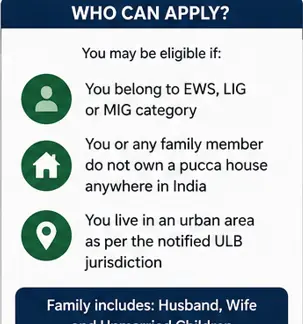
Before looking for an affordable housing project, first understand the basic PMAY-U 2.0 eligibility framework.
Basic PMAY-U 2.0 Eligibility Conditions
The official scheme framework states that eligible families must generally meet conditions relating to:
1. Urban residence
PMAY-U 2.0 applies to eligible beneficiaries within covered urban areas.
The scheme covers statutory towns and other notified urban and planning areas covered under the scheme framework.
2. No pucca house anywhere in India
A key eligibility condition is that the beneficiary family should not own a pucca house anywhere in the country in the name of the beneficiary or an eligible family member.
The beneficiary family is generally defined as:
- Husband
- Wife
- Unmarried children
The exact verification is carried out by the concerned authorities.
3. Previous government housing benefits
A person who has received benefits under a government housing scheme within the previous 20 years may not be eligible under PMAY-U 2.0.
This is an important condition that applicants should check carefully before applying.
4. Aadhaar-linked verification
The scheme requires beneficiary identification and verification through Aadhaar or Aadhaar Virtual ID integration as provided under the scheme guidelines.
What Are the Income Categories?
PMAY-U 2.0 broadly defines income groups as follows:
| Category | Annual Household Income |
|---|---|
| EWS | Up to ₹3 lakh |
| LIG | Above ₹3 lakh up to ₹6 lakh |
| MIG | Above ₹6 lakh up to ₹9 lakh |
However, AHP-specific Central Assistance is primarily described in the current official AHP guidance for eligible EWS beneficiaries. Some housing projects themselves may contain a mix of EWS, LIG and MIG housing categories.
Therefore, do not assume that every person within a general PMAY-U 2.0 income category will automatically receive the same AHP benefit. Your eligibility depends on the applicable project and verification process.
Who Gets Preference Under the Scheme?
The scheme provides preference to several vulnerable and special groups, including:
- Widows
- Single women
- Persons with disabilities
- Senior citizens
- Transgender persons
- SC and ST beneficiaries
- Minorities
- Other weaker and vulnerable sections
The scheme also gives special focus to certain groups, including Safai Karmis, identified street vendors, eligible artisans, Anganwadi workers, construction workers and residents of slums or chawls, among others identified during implementation.
Preference does not mean automatic allotment.
Applicants must still meet the relevant eligibility conditions and complete the required verification process.
How Does PMAY-U 2.0 AHP Work?
The AHP vertical operates through two broad models.
Model 1: Public Sector Housing Projects
Under this model, public sector agencies and parastatals construct affordable housing projects.
Project information can include details such as:
- Location
- Approximate price
- Project timeline
- Housing layout
- Other relevant project details
Prospective beneficiaries may be able to review available project information and choose a preferred project through the applicable process.
How Are Houses Allotted?
The official FAQ states that houses in AHP projects should be allotted to identified eligible beneficiaries through a transparent procedure approved at the State level.
This means you should not assume that submitting an application immediately guarantees a house.
Your eligibility must be verified, and the allotment process depends on the approved procedure applicable to the project.
Model 2: Private Sector AHP Projects
Private developers can also participate in AHP under the applicable PMAY-U 2.0 framework.
However, not every private housing project automatically qualifies.
Eligible projects must go through the prescribed approval process and can become whitelisted projects under PMAY-U 2.0.
What Is a Whitelisted Project?
A whitelisted project is a private housing project that meets the relevant scheme conditions and receives the required approvals before being listed on the Unified Web Portal.
The official PMAY-U 2.0 FAQ explains that such projects may include:
- Projects exclusively for EWS housing, or
- Eligible mixed housing projects meeting the scheme requirements
Approval involves scrutiny and approvals through the prescribed Urban Local Body, State-level and Central-level process.
Important for Home Buyers
Do not assume that any project advertised as “PMAY eligible” by a developer is automatically an approved PMAY-U 2.0 AHP project.
Check whether the project is actually listed or approved through the official PMAY-U 2.0 system.
That verification is particularly important before making a booking or paying money.
PMAY-U 2.0 AHP House Size
According to the current AHP Standard Operating Procedure, AHP houses generally have:
- Minimum carpet area: 30 square metres
- Maximum carpet area supported under the current AHP framework: 45 square metres
Projects are also expected to include basic civic infrastructure such as:
- Water
- Sanitation
- Sewerage
- Roads
- Electricity
Project facilities and implementation details can vary according to the approved project.
How Much Financial Assistance Is Available Under AHP?
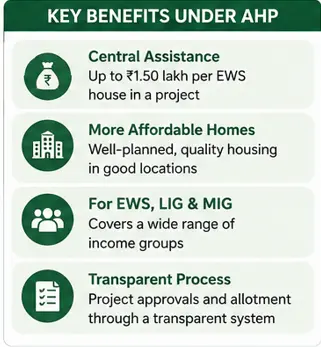
The amount of Central and State assistance can depend on the State or Union Territory and the applicable AHP model.
According to the official PMAY-U 2.0 FAQ, the funding pattern for BLC and AHP includes:
| Location Category | Central Assistance | Minimum State Contribution |
|---|---|---|
| North-Eastern States, Himachal Pradesh, Uttarakhand, J&K, Puducherry and Delhi | ₹2.25 lakh per unit | ₹0.25 lakh |
| Other Union Territories | ₹2.50 lakh per unit | As applicable |
| Other States | ₹1.50 lakh per unit | ₹1 lakh |
The final financial structure applicable to a beneficiary can depend on the relevant project, State or UT and implementation arrangements.
Do Not Treat This as Cash You Automatically Receive
This is an important distinction.
Under AHP, assistance is connected with the applicable housing project and scheme implementation model.
The assistance is not necessarily equivalent to unrestricted cash directly handed to every applicant.
For private-sector AHP projects, the official system provides for Redeemable Housing Vouchers (RHV) for eligible EWS beneficiaries under the applicable process.
What Are Redeemable Housing Vouchers?
Redeemable Housing Vouchers, commonly referred to as RHVs, are a form of Central Assistance under the private-sector AHP framework.
Eligible EWS beneficiaries may use them according to the applicable scheme process for purchasing houses in approved or whitelisted projects.
The exact process, eligibility verification and project availability should be checked through the official Unified Web Portal and concerned authorities.
How to Find a PMAY-U 2.0 AHP Housing Project
Before applying, the practical question is:
Is there an AHP project available in my city?
Project availability can vary significantly between cities and States.
Follow these steps.
Step 1: Visit the Official PMAY-U 2.0 Portal
Go to the official PMAY-U 2.0 system and look for the available beneficiary application and project information.
Step 2: Check Your Eligibility
Review the relevant eligibility conditions before choosing the AHP vertical.
Be especially careful about:
- Your household income category
- Whether your family owns a pucca house
- Previous government housing benefits
- Urban jurisdiction
- The specific AHP project requirements
Step 3: Look for Available Projects
Where project information is available, check:
- City and location
- Type of housing
- Approximate cost
- Eligibility category
- Project status
- Application procedure
Do not select a project solely because it is near your preferred location.
Check whether you meet the eligibility requirements.
Step 4: Choose the Correct PMAY-U 2.0 Vertical
This step is extremely important.
The official eligibility system warns that once a vertical is selected, it cannot later be changed.
For example:
- You own eligible land and want to construct a house → BLC may be relevant.
- You want to obtain a house within an affordable housing project → AHP may be relevant.
- You need rental accommodation → ARH may be relevant.
- You are purchasing or constructing a house using a qualifying home loan → ISS may be relevant.
Choose only after understanding which vertical fits your actual situation.
How to Apply for PMAY-U 2.0 AHP
The official PMAY-U 2.0 system provides several application routes.
Eligible beneficiaries may apply through:
- The Unified Web Portal
- A Common Service Centre (CSC)
- The concerned Urban Local Body or Municipality
The application is subsequently subject to verification by the relevant authorities.
Step-by-Step Application Process
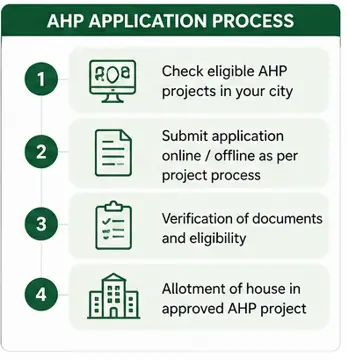
Step 1: Start Your Application
Open the official PMAY-U 2.0 application system.
Read the instructions carefully before beginning.
Step 2: Complete Identity Verification
Enter the required personal details and complete the applicable Aadhaar-based verification process.
Ensure that your information matches your official records.
Step 3: Enter Family Details
Provide the required details relating to your beneficiary family.
Incorrect family information can create problems during verification.
Step 4: Enter Income and Housing Information
You may need to provide information relating to:
- Household income
- Current residence
- Existing house ownership
- Previous housing benefits
Do not provide estimated or incorrect information.
Government authorities can verify the details.
Step 5: Select the Appropriate Vertical
Choose Affordable Housing in Partnership (AHP) only if it is suitable for your circumstances.
Remember that the official system states that the selected vertical cannot later be changed.
Step 6: Select the Preferred Project, Where Available
If the system provides eligible AHP project options, review them carefully.
Consider:
- Location
- House size
- Project cost
- Your financial capacity
- Eligibility requirements
Step 7: Submit the Application
Review every detail before submitting.
Keep a record of:
- Application number
- Registered mobile number
- Any acknowledgement received
Step 8: Wait for Verification
Submitting the form does not automatically mean that:
- You are eligible
- A house is approved
- A house has been allotted
The concerned authorities must verify the application.
Documents You May Need
The exact document requirements can vary according to the applicable State, ULB and application process.
Official PMAY-U 2.0 guidance refers to documents such as:
- Aadhaar or applicable identity details
- Bank account details
- Required undertaking regarding eligibility
- Other documents specified by the concerned authorities
Additional documents may be requested depending on the verification process.
Before Applying, Keep These Ready
As a practical preparation checklist:
- Aadhaar details
- Active mobile number
- Bank account information
- Income-related documents, if required
- Address information
- Relevant declarations or undertakings
Do not upload false or altered documents.
How Are AHP Houses Allotted?
A common misunderstanding is:
“If I apply under AHP, I will automatically get a flat.”
That is not correct.
AHP housing depends on:
- Availability of approved projects
- Beneficiary eligibility
- Project-specific requirements
- Verification
- The approved allotment procedure
The official FAQ states that allotment should be conducted through a transparent procedure approved at the appropriate State level.
Therefore, an application is only the beginning of the process.
Can You Sell a PMAY-U 2.0 AHP House?
The official FAQ states that AHP houses have a mandatory lock-in period of at least five years from the date of possession.
During this period, the beneficiary cannot sell the house under the applicable scheme conditions.
This is an important point to understand before applying.
AHP housing is intended to support genuine housing needs, not short-term property speculation.
How Long Can an AHP Project Take to Complete?
The official PMAY-U 2.0 FAQ states that AHP projects are generally expected to be completed within:
- 24 to 36 months after receiving statutory approvals
Projects using eligible innovative technologies with Technology Innovation Grant support have a shorter stated completion expectation of:
- 18 to 24 months after the required approvals
Actual project completion can still depend on implementation and other circumstances.
Important: Check the Actual Project Before Paying Money
If you are considering an AHP-related housing project, do not make a financial decision based only on:
- A social media advertisement
- A developer’s claim
- A broker’s statement
- A WhatsApp message
Before paying any booking amount, verify:
- Is the project officially approved or whitelisted under the applicable PMAY-U 2.0 framework?
- Is your category eligible for the benefit?
- What is the actual sale price?
- How much assistance, if any, applies to your case?
- What amount must you pay yourself?
- What is the payment schedule?
- Is the project currently available for beneficiary selection?
The government benefit does not automatically mean that the house will be free.
You must understand the complete financial obligation before committing to a purchase.
PMAY-U 2.0 AHP vs BLC: Which One Is Different?
| Feature | AHP | BLC |
|---|---|---|
| Main purpose | Obtain a house through an affordable housing project | Construct a house on available land |
| Construction | Public or private agency | Beneficiary-led |
| Land ownership | Not the same requirement as BLC | Beneficiary generally needs eligible land |
| Housing type | Project-based housing | Individual house construction |
| Typical beneficiary focus | EWS ownership housing under AHP assistance | EWS families constructing houses |
| Application | Portal/CSC/ULB and applicable project process | Portal/CSC/ULB with land documentation |
If you already own suitable vacant land, BLC may be more relevant.
If you do not have land but want to obtain an affordable house in an eligible project, AHP may be the relevant option.
Always check the specific eligibility rules before selecting the vertical.
Common Mistakes to Avoid
1. Assuming Every Private Project Is Approved
A private developer may advertise affordable housing, but that does not automatically make the project a PMAY-U 2.0 AHP whitelisted project.
Verify through official sources.
2. Selecting AHP Without Checking Project Availability
AHP is project-based.
Check whether an applicable project exists in your city or area.
3. Assuming Your Application Guarantees a House
Application, verification, approval and allotment are different stages.
4. Ignoring Previous Government Housing Benefits
Previous housing assistance can affect eligibility.
Answer the application questions truthfully.
5. Confusing PMAY-U 2.0 With Older PMAY Rules
PMAY has evolved over time.
Do not rely solely on old articles, YouTube videos or previous scheme rules.
For AHP, use the latest official information, particularly the current AHP Standard Operating Procedure.
Frequently Asked Questions
Q1. Who can apply for PMAY-U 2.0 AHP?
PMAY-U 2.0 has general eligibility requirements relating to urban residence, income category, absence of a pucca house and previous housing benefits. Under the current AHP framework, Central Assistance is focused on eligible EWS beneficiaries, while project composition and other conditions can vary.
Q2. Can I apply for an AHP house if I do not own land?
Yes, the AHP vertical is different from BLC and is designed around project-based affordable housing. Not owning land does not automatically prevent consideration under AHP, provided you meet the relevant eligibility and project requirements.
Q3. Is PMAY-U 2.0 AHP available in every city?
Project availability can vary by State, UT, and city. You should check the official portal and the concerned Urban Local Body for available projects.
Q4. What is a whitelisted AHP project?
It is a private-sector housing project that has gone through the prescribed scrutiny and approval process under the PMAY-U 2.0 framework and is listed on the Unified Web Portal.
Q5. Is the AHP house free?
No. A government housing benefit should not automatically be understood as a free house. The total cost and contribution of the beneficiary depend on the applicable project and scheme arrangements.
Q6. Can I sell an AHP house immediately?
No. The official PMAY-U 2.0 FAQ states that AHP houses have a minimum five-year lock-in period from the date of possession.
Q7. Can I apply through a CSC?
Yes. Official PMAY-U 2.0 information states that eligible beneficiaries may apply through the Unified Web Portal, Common Service Centres or the concerned ULB or Municipality.
Final Takeaway
PMAY-U 2.0 AHP is not simply a cash assistance scheme for buying any flat you choose.
It is a project-based affordable housing vertical under which eligible beneficiaries can seek ownership housing developed through public or private sector partnerships.
Before applying, first check:
- Whether you meet the PMAY-U 2.0 eligibility conditions
- Whether an applicable AHP project is available
- Whether the project is officially approved or whitelisted
- The actual cost you must pay
- The applicable beneficiary contribution
- The verification and allotment process
The most important step is to use the current official PMAY-U 2.0 information rather than relying on outdated PMAY articles.
For the latest scheme guidance and the current AHP Standard Operating Procedure, check the official PMAY-U guidelines page. The official portal also provides application and beneficiary information through the PMAY-U 2.0 Unified Web Portal.
Related Benefitomics guides:
- [PMAY-U 2.0 Guide (2026): Eligibility, Benefits, Housing Options & How to Apply]
- [PMAY-U 2.0 Eligibility 2026: Who Can Apply and Who Is Not Eligible?]
- [PMAY-U 2.0 BLC Guide 2026: Eligibility, Land Requirement & How to Apply]
- [PMAY-U 2.0 Affordable Rental Housing Guide]
- [PMAY-U 2.0 Interest Subsidy Scheme Guide]