

If you are planning to install rooftop solar at home, the PM Surya Ghar subsidy 2026 can significantly reduce the upfront cost of the system.
For a standard residential installation, the Central Financial Assistance (CFA) is ₹30,000 per kW for the first 2 kW and ₹18,000 for the additional 1 kW. This means the maximum central subsidy for an individual residential rooftop solar system is ₹78,000 for 3 kW or more.
But there is an important point: ₹78,000 is not a flat subsidy for every household. The amount depends mainly on the solar capacity eligible for CFA.
This guide explains the PM Surya Ghar subsidy in simple terms, including the subsidy calculation, 1 kW/2 kW/3 kW examples, special-category rates, and how the subsidy is received.
PM Surya Ghar Subsidy 2026: Quick Answer
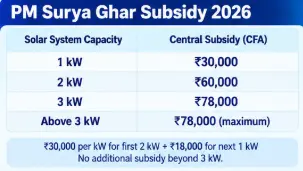
For a residential rooftop solar system, the standard CFA is:
| Solar system capacity | Central subsidy |
|---|---|
| 1 kW | ₹30,000 |
| 2 kW | ₹60,000 |
| 3 kW | ₹78,000 |
| Above 3 kW | ₹78,000 maximum |
The calculation is based on ₹30,000/kW for the first 2 kW, plus ₹18,000 for the additional capacity up to 3 kW. There is no additional residential CFA beyond 3 kW.
So, if you install a 5 kW system, you do not receive ₹1.5 lakh as central subsidy. The CFA remains capped at ₹78,000.
How Does the PM Surya Ghar Subsidy Work?
The subsidy is officially called Central Financial Assistance (CFA).
The basic calculation is:
- First 2 kW: ₹30,000 per kW
- Additional 1 kW: ₹18,000
- Capacity beyond 3 kW: no additional CFA
For example:
1 kW system
₹30,000 × 1 = ₹30,000 subsidy
2 kW system
₹30,000 × 2 = ₹60,000 subsidy
3 kW system
₹30,000 × 2 + ₹18,000 × 1 = ₹78,000 subsidy
The official guidelines also give examples for systems between these capacities. A 1.5 kW system, for example, would qualify for ₹45,000 CFA under the standard rate, while a 2.5 kW system would qualify for ₹69,000.
PM Surya Ghar Subsidy Calculator: Simple Examples

You can use this table to get a quick idea of the central subsidy.
| Installed capacity | Calculation | Approx. CFA |
|---|---|---|
| 1 kW | 1 × ₹30,000 | ₹30,000 |
| 1.5 kW | 1.5 × ₹30,000 | ₹45,000 |
| 2 kW | 2 × ₹30,000 | ₹60,000 |
| 2.5 kW | ₹60,000 + ₹9,000 | ₹69,000 |
| 3 kW | ₹60,000 + ₹18,000 | ₹78,000 |
| 4 kW | Capped at 3 kW | ₹78,000 |
| 5 kW | Capped at 3 kW | ₹78,000 |
Important: These are the central CFA amounts under the scheme. Your actual project cost will depend on the system, vendor, installation requirements, and other applicable charges.
Why Does the Subsidy Stop at 3 kW?
One common misunderstanding is that the government pays ₹30,000 for every kW installed.
That is not how the scheme works.
The higher CFA applies only to the first 2 kW. An additional 1 kW receives ₹18,000. Capacity beyond 3 kW does not receive additional central CFA.
For example, suppose you install a 4 kW rooftop solar system.
You might initially calculate:
₹30,000 × 4 = ₹1,20,000
But that would be incorrect.
The eligible calculation stops at 3 kW:
₹60,000 + ₹18,000 = ₹78,000
Therefore, ₹78,000 is the maximum central residential CFA, even if the system is larger than 3 kW.
Is ₹78,000 Subsidy Available for Everyone?
No.
The ₹78,000 figure represents the maximum central CFA for a qualifying residential rooftop solar system of 3 kW or more.
You still need to meet the scheme’s eligibility requirements and follow the prescribed application, installation and verification process.
The scheme is aimed at residential consumers with grid-connected electricity connections. The government stated in July 2026 that residential consumers across India, including rural households, can avail themselves of the scheme by applying through the National Portal.
For the complete eligibility conditions, see our guide:
Internal link: PM Surya Ghar Eligibility 2026: Who Can Apply and Who Cannot?
What If You Install More Than 3 kW?
You can install a larger rooftop solar system if it suits your electricity requirements and property.
However, the central subsidy does not increase beyond ₹78,000.
For example:
- 3 kW → ₹78,000 CFA
- 4 kW → ₹78,000 CFA
- 5 kW → ₹78,000 CFA
- 6 kW → ₹78,000 CFA
The additional capacity may still make financial sense for a household with higher electricity consumption, but you should not assume that the government will provide additional central subsidy for those extra kW.
What Is the Subsidy for Special Category States?
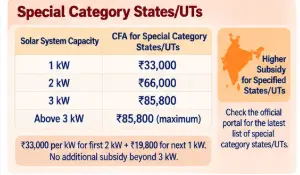
The scheme provides higher CFA rates for specified special category states/UTs.
Under the applicable guidelines, the rates are:
- First 2 kW: ₹33,000/kW
- Additional 1 kW: ₹19,800/kW
- Beyond 3 kW: No additional CFA
That means a qualifying 3 kW system in a special-category area can receive up to:
₹33,000 × 2 + ₹19,800 = ₹85,800
The official guidelines distinguish these rates from the standard ₹30,000/₹18,000 rates.
Because state/UT treatment can depend on the applicable government classification and scheme rules, check the National Portal before calculating your expected subsidy.
Does the Government Pay the Full Solar Installation Cost?
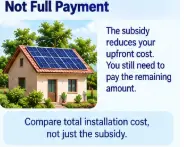
No.
The PM Surya Ghar subsidy is financial assistance toward the eligible rooftop solar system. It does not mean the government pays the entire installation bill.
Suppose your eligible solar project costs ₹1.50 lakh and you receive ₹78,000 CFA.
Your remaining cost would broadly be:
₹1,50,000 − ₹78,000 = ₹72,000
The actual amount you pay can differ because the final project cost depends on the vendor quotation, system specifications and other applicable costs.
This is why it is better to compare the final price after subsidy, rather than choosing a system simply because it offers the maximum subsidy.
When Is the PM Surya Ghar Subsidy Paid?
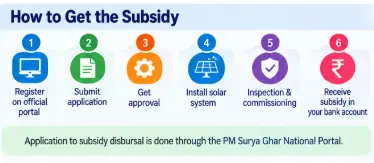
The subsidy process is linked to the National Portal, installation, and verification.
In general, the process involves:
- Registering on the PM Surya Ghar National Portal.
- Submitting the rooftop solar application.
- Receiving the required approvals.
- Selecting an eligible/registered vendor.
- Installing the rooftop solar system.
- Completing inspection and commissioning requirements.
- Completing the subsidy/CFA redemption process.
- Receiving the eligible CFA through the prescribed process.
The government has stated that the process from application to CFA disbursal is online through the National Portal. With correct credentials and documentation, the average processing time after the redemption request has been reported at around 15 days, although this should not be treated as a guaranteed payment timeline for every application.
Does the Subsidy Come Directly to Your Bank Account?
Under the National Portal mechanism, the CFA is transferred to the consumer’s bank account after successful installation and verification, subject to the applicable process and conditions.
This is one reason it is important to enter your bank and consumer details correctly when applying.
A small mistake in account information or documentation can create unnecessary delays.
Can You Get a State Government Subsidy Too?
This is an area where you should be careful.
The ₹78,000 figure refers to the central CFA under PM Surya Ghar. State or local incentives, if available, may follow separate rules.
Do not automatically assume that every state provides an additional subsidy on top of the central CFA.
Before making a financial decision, check:
- Your DISCOM
- Your state renewable-energy agency, where applicable
- The PM Surya Ghar National Portal
- The vendor’s official quotation
This helps avoid relying on outdated subsidy figures circulating on social media or old websites.
How Much Solar Capacity Should You Install?
The maximum subsidy is not necessarily a reason to install a 3 kW system.
Your system size should also make sense for your electricity consumption, available roof space and future requirements.
For example:
- A household with relatively low electricity consumption may not need a large system.
- A household using multiple air conditioners or other high-load appliances may benefit from a larger system.
- A household with higher consumption may choose more than 3 kW, but the central CFA still remains capped at ₹78,000.
The official scheme material also provides indicative system capacities based on average monthly consumption. For example, households using 0–150 units per month are associated with suitable capacities of around 1–2 kW, while 150–300 units are associated with around 2–3 kW.
These are useful guidelines, not a substitute for checking your actual electricity usage and site conditions.
Does PM Surya Ghar Mean You Will Get 300 Free Units Every Month?

Not exactly.
The scheme’s objective is to help households generate rooftop solar power and reduce their electricity bills, with the government describing the programme in terms of up to 300 units of electricity per month.
But this should not be interpreted as a guaranteed monthly government credit of 300 units for every household.
Actual electricity generation depends on factors such as:
- Solar system capacity
- Sunlight availability
- Roof orientation and shading
- Weather
- Household electricity consumption
- Net-metering/billing arrangements
Some households may therefore see very low or even zero electricity bills in particular billing periods, while others may continue to have some electricity charges.
As of 22 July 2026, the government reported 39,72,447 rooftop solar systems installed under the scheme, benefiting 48,02,717 households.
Common Mistakes When Calculating PM Surya Ghar Subsidy
1. Assuming ₹30,000 is paid for every kW
It isn’t.
The ₹30,000/kW rate applies to the first 2 kW. The next eligible 1 kW gets ₹18,000.
2. Expecting more than ₹78,000 for a larger system
A 5 kW system does not receive ₹1.50 lakh central CFA.
The residential central CFA is capped at ₹78,000 under the standard rate.
3. Confusing system price with subsidy
The subsidy is not the same thing as the total cost of the solar installation.
4. Choosing a system only because of the subsidy
A larger system may cost more without providing a proportional increase in central subsidy.
5. Using old subsidy information
Solar policy information can change. Always verify the applicable amount on the official portal before paying a vendor.
How to Check the PM Surya Ghar Subsidy Before Applying
Before you proceed, keep these five things ready:
1. Check your electricity consumption
Look at several recent electricity bills rather than relying on one month.
2. Decide the approximate system size
Consider your consumption, roof space and future electricity needs.
3. Check your eligibility
Make sure you meet the residential and electricity-connection requirements.
4. Compare the vendor quotation
Look at the final project cost, not just the advertised subsidy.
5. Apply through the official portal
Use the PM Surya Ghar National Portal for the official application process.
PM Surya Ghar Subsidy 2026 FAQs
Q1. How much subsidy is available for 1 kW solar?
The standard central CFA is ₹30,000 for a qualifying 1 kW residential rooftop solar system.
Q2. How much subsidy do I get for 2 kW solar?
The standard CFA is ₹60,000 for a qualifying 2 kW residential system.
Q3. What is the maximum PM Surya Ghar subsidy?
The standard maximum central residential CFA is ₹78,000, applicable up to 3 kW. There is no additional central CFA beyond 3 kW.
Q4. Can I get ₹78,000 subsidy for a 5 kW system?
A qualifying 5 kW residential system can still receive the maximum ₹78,000 central CFA, but the subsidy does not increase for the additional capacity above 3 kW.
Q5. Is PM Surya Ghar subsidy available in rural areas?
Yes. The government confirmed in July 2026 that residential consumers, including rural households with grid-connected electricity connections, can avail themselves of the scheme.
Q6. Is the subsidy automatically available after buying solar panels?
No. You need to follow the prescribed PM Surya Ghar application, vendor, installation, verification and CFA redemption process.
Final Takeaway
The PM Surya Ghar subsidy 2026 can provide substantial financial support for residential rooftop solar:
- 1 kW → ₹30,000
- 2 kW → ₹60,000
- 3 kW → ₹78,000
- Above 3 kW → maximum ₹78,000 central CFA
The key point is simple: don’t choose your solar system only to get the maximum subsidy. First look at your electricity consumption, roof conditions and long-term requirements. Then compare the complete installation cost after considering the applicable CFA.
PM Surya Ghar is designed to make rooftop solar more affordable, but the best system for your home is the one that matches your actual electricity needs.
Official Sources
- PM Surya Ghar National Portal
- MNRE – Grid-Connected Rooftop Solar Programme
- PM Surya Ghar CFA Guidelines
- PIB – PM Surya Ghar 2026 Update
Related PM Surya Ghar Guides
Explore our detailed guides to understand the PM Surya Ghar Muft Bijli Yojana, subsidy, eligibility, and application process:
Before calculating the subsidy, it is useful to understand the PM Surya Ghar Muft Bijli Yojana, including its eligibility, application process, and major benefits.
PM Surya Ghar Muft Bijli Yojana (2026): Eligibility, Subsidy, Cost & How to Apply. Main pillar post
How to Apply for PM Surya Ghar Muft Bijli Yojana Online
→ Your application guide. PM Surya Ghar Eligibility: Who Can Get the Solar Subsidy?
→ Your eligibility guide. How to Complete PM Surya Ghar Registration Online
→ Registration/process guide. PM Surya Ghar Solar Subsidy for 1 kW, 2 kW and 3 kW Systems
→ If you have or create a dedicated capacity/subsidy article. PM Surya Ghar Loan: Interest Rate, Eligibility and How to Apply
→ Your financing guide. PM Surya Ghar Subsidy Status: How to Check Your Subsidy Payment
→ Your subsidy-status guide. PM Surya Ghar in Odisha: Subsidy, Eligibility and Application Process
→ State-specific guide, particularly useful for your audience.