

PM Surya Ghar Muft Bijli Yojana
| Details | Information |
|---|---|
| Scheme | PM Surya Ghar: Muft Bijli Yojana |
| Purpose | Support residential rooftop solar installation |
| Target | Rooftop solar installations in one crore households |
| Main benefit | Central Financial Assistance for eligible residential consumers |
| Maximum standard CFA | Up to ₹78,000 for eligible systems under the published structure |
| Who can benefit | Residential consumers with a grid-connected electricity connection, subject to scheme conditions |
| Application | Through the National Portal |
| Official portal | PM Surya Ghar National Portal |
What Is PM Surya Ghar Muft Bijli Yojana?
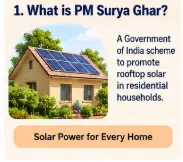
The PM Surya Ghar Muft Bijli Yojana is a Government of India programme that promotes rooftop solar systems for residential households.
The scheme aims to help households generate electricity from solar panels installed on their rooftops. Eligible residential consumers can receive Central Financial Assistance, subject to the applicable scheme rules and installation process.
The scheme has an objective of supporting rooftop solar installations in one crore households. Government information also refers to the potential for households to receive up to 300 units of free electricity per month through rooftop solar.
However, there is an important point to understand.
The scheme does not mean that every household will automatically receive 300 free units of electricity every month from the government.
Your actual savings depend on factors such as:
- Solar system capacity
- Electricity generated by the system
- Sunlight availability
- Roof conditions
- Your household’s electricity consumption
- Applicable DISCOM and electricity billing arrangements
Who Can Apply for PM Surya Ghar Muft Bijli Yojana?
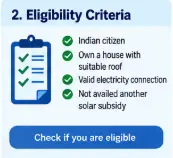
According to government information, the basic eligibility conditions include:
- The applicant must be an Indian citizen.
- The household should own a house with a suitable roof for installing solar panels.
- The household must have a valid electricity connection.
- The household must not have already availed another subsidy for solar panels.
Government information released in 2026 also states that residential consumers across the country with a grid-connected electricity connection from their local DISCOM can avail scheme benefits by applying through the National Portal, subject to the scheme framework.
Important: Check Your Individual Situation
Eligibility can become more complicated in situations involving:
- Jointly owned houses
- Apartments
- Rented properties
- Shared electricity connections
- Existing rooftop solar systems
- Previous solar subsidies
Do not rely on a general article alone if your situation is unusual. Check the official portal and your DISCOM requirements.
How Much Subsidy Is Available from Central Govt?
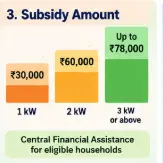
Under the published subsidy structure for residential rooftop solar, the commonly stated Central Financial Assistance is:
| Rooftop Solar Capacity | Standard CFA Amount |
|---|---|
| 1 kW | ₹30,000 |
| 2 kW | ₹60,000 |
| 3 kW or above | Up to ₹78,000 |
The Central Government subsidy under PM Surya Ghar is up to ₹78,000 for a qualifying residential system of 3 kW or more. However, some States provide additional financial assistance. For example, Odisha currently provides State assistance that takes the combined subsidy to ₹1.38 lakh for a 3 kW system. The total benefit therefore depends on your State/UT and applicable rules.
The scheme provides CFA based on the applicable benchmark-cost framework, with assistance capped at 3 kW under the published structure.
A Very Important Point About the ₹78,000 Subsidy
Not every applicant automatically receives ₹78,000.
The actual benefit depends on factors including:
- Eligibility under the scheme
- Installed system capacity
- Compliance with the official process
- Successful installation
- Verification and commissioning
- Applicable scheme conditions
Before making any payment to a vendor, confirm the subsidy applicable to your particular installation through the official process.
State Government Subsidy
Odisha — much higher total subsidy
For Odisha, the current official Odisha State Finance Commission report gives the following Central + State assistance under PM Surya Ghar:
| Solar capacity | Central subsidy | Odisha State subsidy | Total subsidy |
|---|---|---|---|
| 1 kW | ₹30,000 | ₹25,000 | ₹55,000 |
| 2 kW | ₹60,000 | ₹50,000 | ₹1,10,000 |
| 3 kW | ₹78,000 | ₹60,000 | ₹1,38,000 |
The Odisha report specifically says the State provides an additional ₹25,000 for a 1 kWp plant, and its table shows ₹25,000/kW for the first two kW and ₹10,000 for the third kW.
So for Odisha, the figure we should use in the Benefitomics article is:
Up to ₹1.38 lakh total subsidy for a 3 kW residential rooftop solar system.
This is considerably higher than the ₹78,000 Central CFA alone.
There is also a January 2025 Odisha State Financial Assistance notification referenced by the State Level Bankers’ Committee, which describes ₹25,000 for each of the first two kW and ₹10,000 for the third kW, up to ₹60,000 in State assistance.
So for Odisha state
If you install:
- 1 kW → ₹55,000 total
- 2 kW → ₹1,10,000 total
- 3 kW → ₹1,38,000 total
- Above 3 kW → Central CFA remains ₹78,000 + Odisha State assistance capped at ₹60,000 = ₹1,38,000, subject to the applicable scheme conditions.
West Bengal State government subsidy
The Government of West Bengal’s own PM Surya Ghar scheme page, updated 26 June 2026, currently lists only the Central Financial Assistance:
| Solar capacity | Central CFA |
|---|---|
| 1 kW | ₹30,000 |
| 2 kW | ₹60,000 |
| 3 kW | ₹78,000 |
| Above 3 kW | ₹78,000 |
The West Bengal government page does not list an additional State residential subsidy on that page.
I also checked current WBSEDCL information. WBSEDCL is implementing PM Surya Ghar for residential consumers and continues to direct consumers toward the National Portal.
Therefore, I would currently write West Bengal as ₹78,000 maximum Central subsidy, rather than inventing a State top-up.
That’s an important distinction:
Odisha: up to ₹1.38 lakh total (Central + State).
West Bengal: ₹78,000 Central CFA currently listed by the State Government; I could not verify an additional current residential State subsidy from an official WB source.
I would not say “West Bengal has no State subsidy whatsoever” because policies can change and there may be separate programmes. The safer Benefitomics wording is that the current West Bengal PM Surya Ghar information published by the State Government lists the Central CFA and does not state an additional residential State subsidy.
Where to check your State/UT
There is an excellent official MNRE National Portal page listing the DISCOM/State portals for every State and UT:
Official MNRE State/DISCOM Portal List — PM Surya Ghar
This is the link I recommend putting in the Benefitomics article.
It lists the relevant portal for states including Odisha, West Bengal, Gujarat, Maharashtra, Karnataka, Tamil Nadu, Kerala, Rajasthan, Uttar Pradesh, Bihar, Delhi, etc.
You can select your State/UT and electricity distribution company (DISCOM) and go to the appropriate portal.
Also keep the main National Portal
How Much Does a Rooftop Solar System Cost?
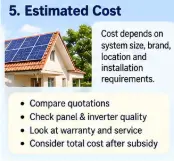
There is no single fixed price for rooftop solar across India.
The total cost can vary depending on:
- System capacity
- Solar panel specifications
- Inverter type
- Vendor
- City or State
- Roof design
- Installation complexity
- Additional electrical work
For this reason, you should be careful when you see advertisements claiming a single fixed price for a solar system.
The Better Way to Compare Costs
Ask each vendor for a detailed written quotation showing:
- Total system capacity
- Solar panel specifications
- Inverter details
- Total installation cost
- Taxes and other charges
- Additional work, if required
- Warranty information
- Expected eligible subsidy
- Your estimated final payment
Do not choose a vendor based only on the lowest advertised price.
A separate detailed guide on PM Surya Ghar solar system cost and subsidy calculation should explain this topic in greater detail.
How to Apply for PM Surya Ghar Muft Bijli Yojana
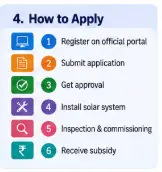
The application process begins through the official National Portal.
Here is the broad process.
Step 1: Register on the National Portal
Visit the official portal and begin registration.
You will generally need to select:
- Your State
- Your electricity distribution company or DISCOM
Government information states that consumers begin the application process through the National Portal after selecting their State and electricity distribution company.
Step 2: Submit the Required Application Details
Enter the information requested during the application process.
Your electricity consumer details are important because the rooftop solar system will be connected to your residential electricity connection under the applicable procedure.
Step 3: Wait for the Required Approval
Follow the process and approvals shown through the portal and the applicable DISCOM procedure.
Do not assume that every application follows the same timeline.
DISCOM procedures and technical requirements may affect the next steps.
Step 4: Select a Vendor
The National Portal is designed to help consumers with information related to system size, benefits and vendor-related details.
When comparing vendors, check:
- Equipment specifications
- Total quotation
- Warranty
- Installation experience
- Service support
Do not choose a vendor simply because they promise the highest subsidy or the lowest price.
Step 5: Install the Rooftop Solar System
After following the required approval process, the rooftop solar system is installed.
Keep copies of:
- Quotation
- Invoice
- Equipment specifications
- Warranty documents
- Installation records
Step 6: Complete the Required Post-Installation Process
After installation, the required details and documents must be submitted according to the applicable process.
Step 7: Verification and Commissioning
The system goes through the applicable verification and commissioning process.
The DISCOM plays an important role in this stage.
Step 8: Receive the Applicable Subsidy
After successful installation and verification under the scheme process, the applicable Central Financial Assistance is processed according to the official framework. The MNRE rooftop solar programme information states that the consumer pays the balance amount after the applicable subsidy/CFA process and successful installation and verification.
What Does “Up to 300 Units of Free Electricity” Really Mean?
This phrase causes a lot of confusion.
The scheme aims to help households generate electricity through rooftop solar, with the government stating an objective of providing up to 300 units of free electricity per month to households through the programme.
But your actual financial benefit depends on how your system performs.
A solar system does not produce the same amount of electricity every day.
Generation can be affected by:
- Weather
- Seasonal sunlight
- Panel orientation
- Shade
- Roof location
- System capacity
Your electricity consumption also matters.
Therefore, do not assume:
“I will automatically get exactly 300 units free every month.”
The practical outcome depends on solar generation and the applicable electricity billing arrangements.
How Much Solar Capacity Do You Need?
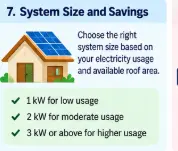
Choosing the largest possible system is not always the right decision.
Your ideal system size should broadly depend on:
- Monthly electricity consumption
- Annual electricity consumption
- Available roof area
- Shade on the roof
- Daytime electricity usage
- Future electricity requirements
Check Your Previous Electricity Bills
A practical starting point is to review your electricity bills from the previous 12 months.
This gives you a better understanding of your normal consumption pattern.
Do not select a system size based on one unusually high summer bill or one unusually low month.
A separate guide on choosing the right rooftop solar system size can help you understand the difference between 1 kW, 2 kW, and 3 kW systems.
Can You Take a Loan for Rooftop Solar?
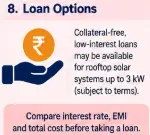
Yes, financing options may be available for eligible households.
Government information has referred to collateral-free, low-interest loan products for residential rooftop solar systems up to 3 kW, subject to lender terms and applicable conditions.
However, do not take a loan simply because a vendor tells you that the EMI will be low.
Before borrowing, compare:
- Interest rate
- Processing charges
- Loan tenure
- Monthly EMI
- Total interest payable
- Prepayment rules
A subsidy can reduce your upfront cost, but a high-cost loan can still make the overall investment expensive.
Main Benefits of PM Surya Ghar Muft Bijli Yojana
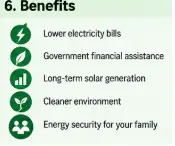
1. Lower Electricity Expenses
A properly sized rooftop solar system can reduce the amount of electricity you need to purchase from the grid.
The actual saving depends on electricity generation and household consumption.
2. Central Financial Assistance
Eligible residential consumers can receive government financial assistance under the applicable scheme framework.
3. Long-Term Solar Electricity Generation
A rooftop solar system can generate electricity over many years, although performance and output depend on equipment quality, maintenance and environmental conditions.
4. Reduced Dependence on Grid Electricity
During periods when the solar system generates electricity, your household may rely less on electricity purchased from the grid.
5. Environmental Benefits
Rooftop solar can help increase the use of renewable energy and reduce dependence on conventional electricity generation.
What Documents May Be Required?
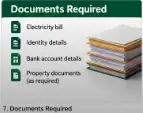
The exact requirements can vary according to the official portal and DISCOM process.
Information commonly relevant during the process may include:
- Electricity consumer number
- Electricity connection details
- Mobile number
- Bank account details
- Identity information as required
- Address or property information where applicable
Do not depend only on a generic checklist.
Always follow the document requirements displayed during your actual application.
A separate PM Surya Ghar Documents Required guide can provide a more detailed checklist.
Common Mistakes to Avoid
Mistake 1: Thinking the Solar System Is Completely Free
The scheme provides financial assistance.
It does not mean every rooftop solar system is completely free.
You may still have to pay a significant part of the installation cost.
Mistake 2: Paying a Vendor Without Understanding the Official Process
A vendor’s sales promise is not a substitute for the official scheme process.
Start by understanding the application procedure.
Mistake 3: Choosing the Cheapest Quotation
The lowest price may not provide the best long-term value.
Check equipment quality, warranty and after-sales service.
Mistake 4: Installing a System Without Considering Electricity Usage
The system should suit your actual electricity needs.
A larger system is not automatically the best financial choice.
Mistake 5: Ignoring Roof Condition
If your roof requires major repairs, address that issue before installation.
Removing and reinstalling panels later can create additional costs.
Mistake 6: Assuming the Subsidy Will Be Credited Immediately
Subsidy processing is linked to the applicable installation, verification and scheme procedures.
Follow your application status through the official process.
Who Should Think Carefully Before Applying?
PM Surya Ghar can be beneficial, but rooftop solar is not automatically the right decision for every household.
Take more time to evaluate your decision if:
- Your roof receives significant shade
- Your roof needs major repairs
- You plan to move soon
- You are not the property owner
- Your electricity consumption is very low
- You need a loan but have not calculated the total borrowing cost
The subsidy should not be the only reason for buying a solar system.
Consider your long-term electricity needs and the condition of your property.
Before You Apply: A Simple Checklist
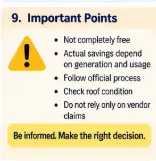
Before spending money, do these things:
- Review your electricity bills for the last 12 months.
- Check whether your roof has sufficient usable and relatively shade-free space.
- Begin with the official PM Surya Ghar portal.
- Understand the approval process applicable to your DISCOM.
- Compare detailed quotations from suitable vendors.
- Confirm the system specifications and warranty.
- Understand the expected subsidy process before making your final financial decision.
Final Verdict
The PM Surya Ghar Muft Bijli Yojana can make residential rooftop solar more affordable for eligible Indian households.
But do not make the decision simply because you see advertisements promising “free electricity” or a ₹78,000 subsidy.
First check:
- Whether you are eligible
- Whether your roof is suitable
- How much electricity your household uses
- What system size may suit your needs
- The complete installation cost
- The applicable subsidy process
- Whether financing makes financial sense
For the right household, rooftop solar can potentially reduce long-term electricity expenses. But it is still a significant financial and technical decision, so comparing costs and following the official process is important.
PM Surya Ghar Muft Bijli Yojana: Frequently Asked Questions
Q1. Who can apply for PM Surya Ghar Muft Bijli Yojana?
Basic eligibility includes being an Indian citizen, owning a house with a suitable roof, having a valid electricity connection, and meeting the applicable scheme conditions.
Q2. How much subsidy can I get under PM Surya Ghar?
Under the published structure, the standard CFA is ₹30,000 for 1 kW, ₹60,000 for 2 kW and up to ₹78,000 for 3 kW or higher, subject to applicable conditions.
Q3. Is PM Surya Ghar completely free?
No. Eligible households can receive financial assistance, but they may still need to pay part of the rooftop solar installation cost.
Q4. How do I apply online?
You can begin through the official PM Surya Ghar National Portal by selecting your State and electricity distribution company.
Q5. Can tenants apply?
Do not assume automatic eligibility. Property ownership, rooftop access and electricity connection arrangements can affect the application. Check the official process for your specific situation.
Q6. Will I get exactly 300 free units every month?
Not necessarily. Actual savings depend on solar electricity generation, your household’s consumption and the applicable billing arrangements.
Q7. Can I take a loan for rooftop solar?
Financing options may be available. Compare interest rates, fees, and total borrowing costs before taking a loan.
Official Resources
MNRE Rooftop Solar Programme Information
What to Read Next: PM Surya Ghar Detailed Guides
If you want to understand a particular part of PM Surya Ghar Muft Bijli Yojana in more detail, these supporting guides may help:
- PM Surya Ghar Eligibility 2026: Who Can Apply and Who Cannot?
Understand the eligibility rules, electricity connection requirements, rural households, rented homes, and other important conditions. - PM Surya Ghar Subsidy 2026: How Much Subsidy Can You Get?
Check the Central subsidy, State/UT assistance, 1 kW, 2 kW, and 3 kW calculations, and how much you may actually receive. - PM Surya Ghar Apply Online 2026: Step-by-Step Application Guide
A practical walkthrough of registration, application, DISCOM approval, vendor selection and installation. - PM Surya Ghar Solar System Cost 2026: 1 kW, 2 kW and 3 kW Price
Understand the approximate installation cost and how the subsidy can reduce your upfront expense. - PM Surya Ghar Documents Required 2026: Complete Checklist
Find out which documents and details you should keep ready before applying. - PM Surya Ghar Application Status 2026: How to Check Online
Learn how to track your application, installation and subsidy-related status. - PM Surya Ghar Subsidy Not Received? Reasons and What to Do
Understand common reasons for subsidy delays and the steps you can take to resolve them. - PM Surya Ghar Loan 2026: Interest Rate, EMI and Eligibility
Learn about available financing options and how a solar loan can reduce the upfront burden. - How to Choose the Right Rooftop Solar System Size for Your Home
Learn how to choose between 1 kW, 2 kW, 3 kW or a larger system based on electricity consumption and roof conditions.