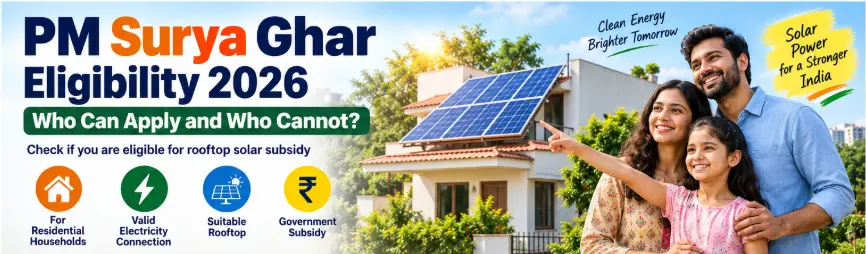
If you are thinking about installing rooftop solar under PM Surya Ghar Muft Bijli Yojana, the first question should not be “How much subsidy will I get?”
It should be:
“Am I actually eligible?”
The basic eligibility is fairly simple, but some situations can be confusing. For example, people often ask about rented houses, rural households, apartments, existing solar systems and previous subsidies.
Here is a practical explanation of PM Surya Ghar eligibility 2026, based on the latest government information available.
PM Surya Ghar Eligibility 2026: Quick Answer
The PM Surya Ghar scheme is a demand-driven programme for residential consumers with a grid-connected electricity connection from their local DISCOM. Eligible consumers can apply for rooftop solar through the National Portal. The scheme is available across the country, including rural households.
The basic eligibility conditions published by the government include:
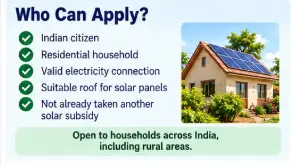
- The applicant/household must be an Indian citizen.
- The house should have a suitable roof for installing solar panels.
- The household must have a valid electricity connection.
- The household must not have already availed another subsidy for solar panels.
However, there is an important distinction between being a residential electricity consumer who can apply and qualifying for Central Financial Assistance (CFA) for a particular rooftop solar installation.
So let’s look at the conditions one by one.
Who Can Apply for PM Surya Ghar in 2026?
1. Residential Electricity Consumers Can Apply
The latest government information describes PM Surya Ghar as a demand-driven scheme under which residential consumers across India with a grid-connected electricity connection from their local DISCOM can avail the scheme benefits by applying through the National Portal.
This is an important point.
The scheme is not restricted only to people living in major cities.
Rural households can also benefit if they meet the applicable requirements. The Ministry of New and Renewable Energy specifically reported in July 2026 that the scheme includes rural households.
In simple terms
If you have a residential electricity connection with your local DISCOM and your home is suitable for rooftop solar, you may be able to apply.
Your final eligibility and installation process still have to follow the applicable portal and DISCOM requirements.
2. You Need a Valid Electricity Connection
A valid electricity connection is one of the most important requirements.
The rooftop solar system is connected to the household’s existing electricity connection under the applicable grid-connected rooftop solar process.
Therefore, you should have a valid electricity consumer connection with the relevant DISCOM.
Government information specifically lists a valid electricity connection among the eligibility conditions.
What should you check?
Keep your latest electricity bill handy and check:
- Consumer number
- Name of the consumer
- DISCOM name
- Connection details
- Address
You will need the relevant consumer information when beginning the application.
3. Your House Must Have a Suitable Roof
Having a house is not enough by itself.
There needs to be a suitable location where the rooftop solar system can be installed.
Government information describes the requirement as owning a house with a roof suitable for installing solar panels.
The broader MNRE criteria also state that a consumer tagged to a particular residential power connection of the local DISCOM can install a rooftop solar system on a roof, terrace, balcony or elevated structure, subject to the applicable requirements.
So the practical question is not simply:
“Do I have a roof?”
It is:
“Do I have a suitable and usable location for the approved rooftop solar installation?”
4. Rural Households Can Apply
This is worth highlighting because many people still assume PM Surya Ghar is mainly an urban scheme.
It is not.
The latest government update from July 2026 states that all residential consumers in the country, including rural households, having a grid-connected electricity connection with the local DISCOM can avail the scheme benefits by applying through the National Portal.
Therefore, living in a village does not automatically make you ineligible.
What matters is whether your residential electricity connection and proposed rooftop solar installation meet the applicable requirements.
5. You Should Not Have Already Taken Another Solar Subsidy
Another important condition is that the household must not have already availed another subsidy for solar panels.
This prevents the same household from improperly claiming overlapping government assistance for the same purpose. The government’s published eligibility information specifically includes this condition.
If you have previously received a solar subsidy, do not simply assume that you can claim the PM Surya Ghar subsidy again.
Check your specific situation through the official portal or the concerned DISCOM.
What About Rented Houses?

This is one of the questions where you should be careful.
The published basic eligibility information refers to owning a house with a suitable roof.
Therefore, a tenant should not assume that paying the electricity bill automatically makes them eligible for the residential CFA.
If you live in a rented property, several things may matter:
- Who owns the property?
- Who holds the electricity connection?
- Who has permission to use the roof?
- Can the solar installation legally be connected to the residential connection?
- Does the proposed arrangement satisfy the applicable DISCOM and scheme requirements?
Our practical advice
If you are a tenant, check your specific case before paying a vendor or signing an installation agreement.
Do not rely on a vendor’s verbal statement that “you will definitely get the subsidy.”
What If the Electricity Connection Is in Someone Else’s Name?
This situation can occur in families.
For example:
- The house belongs to the parents.
- The electricity connection is in the father’s name.
- The son or daughter wants to install the solar system.
Do not assume that ownership and electricity-consumer details can simply be mixed without checking.
The PM Surya Ghar process is connected to the residential electricity connection and the concerned DISCOM. The National Portal uses consumer and DISCOM information during the application process.
If your ownership and electricity records do not match, first check the applicable procedure with your DISCOM.
Can People Living in Apartments Apply?
This requires a slightly different approach.
Individual apartment residents may not have an independent roof that they can use for a private rooftop installation.
The scheme framework also provides for Group Housing Societies (GHS), Residential Welfare Associations (RWA), and similar arrangements for common facilities, including EV charging, subject to the applicable capacity and CFA rules.
So apartment residents should not automatically conclude:
“I don’t have an individual roof, so PM Surya Ghar has nothing for me.”
The appropriate arrangement depends on the housing society, electricity connection, and applicable scheme provisions.
Can You Apply If You Already Have Solar Panels?
This is another area where you should be careful.
Having an existing solar installation does not automatically answer the question of eligibility.
What matters is:
- What type of system you already have
- Whether it received a government subsidy
- Whether it is connected to the relevant residential electricity connection
- Whether you are proposing an additional system
- What the current scheme rules permit
If you have already received a solar subsidy, the basic government eligibility information says the household should not have availed another subsidy for solar panels.
Therefore, check your particular case before assuming that an additional subsidised installation is permitted.
Does Your Income Matter for PM Surya Ghar Eligibility?
The basic published eligibility criteria do not make household income the central condition for residential consumers to apply.
The current government description focuses on residential consumers with a grid-connected electricity connection and the applicable rooftop solar installation requirements.
This is different from many welfare schemes where an income limit determines basic eligibility.
However, your income and financial position can still matter when you consider how to pay for the solar system, especially if you are considering a loan.
So keep these two questions separate:
Eligibility: Can I participate in the scheme?
Affordability: Can I comfortably pay my share of the installation cost?
They are not the same thing.
Is There an Income Limit for the ₹78,000 Subsidy?
The standard residential CFA structure is based primarily on rooftop solar capacity and applicable benchmark costs rather than a simple household-income cutoff.
Under the published structure, the standard CFA is:
| Solar Capacity | Standard CFA |
|---|---|
| 1 kW | ₹30,000 |
| 2 kW | ₹60,000 |
| 3 kW | Up to ₹78,000 |
| Above 3 kW | No additional CFA beyond the applicable cap |
The scheme framework provides CFA for the first 2 kW and additional CFA for the next 1 kW, with no additional CFA beyond 3 kW under the standard structure.
So ₹78,000 should not be described as an income-based subsidy.
It is linked to the applicable rooftop solar capacity and scheme rules.
Can a Farmer Apply?

Yes, if the person is applying as an eligible residential electricity consumer for rooftop solar under PM Surya Ghar.
Being a farmer does not by itself prevent a person from using the residential rooftop solar scheme.
However, do not confuse PM Surya Ghar with PM-KUSUM, which has separate provisions for agricultural solar applications.
PM Surya Ghar is focused on residential rooftop solar.
Can a Government Employee Apply?
Being a government employee does not by itself make a residential consumer ineligible.
The scheme is aimed at eligible residential consumers rather than a particular employment category.
Therefore, if you are a government employee and have a qualifying residential electricity connection and suitable installation location, you can check your eligibility through the official process.
Can a Senior Citizen Apply?
Yes, age by itself is not listed as a basic exclusion condition in the published eligibility criteria.
A senior citizen with an eligible residential electricity connection can therefore check eligibility in the same way as other residential consumers.
The important requirements remain the applicable residential connection, rooftop installation and scheme conditions.
Who Cannot Usually Claim the Residential PM Surya Ghar Subsidy?
It is better to phrase this carefully.
Rather than saying that a particular person is permanently banned, we should say that the following situations do not meet the basic published residential CFA conditions or require additional verification.
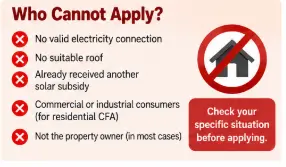
1. A Person Without a Valid Residential Electricity Connection
A valid electricity connection is a basic requirement.
2. A Household With No Suitable Installation Location
If there is no suitable roof or other permitted installation location, the proposed rooftop solar system may not be feasible.
3. A Household That Has Already Taken Another Solar Subsidy
The published eligibility conditions specifically mention this restriction.
4. A Commercial or Industrial Consumer Seeking Residential CFA
The residential CFA is for the residential sector.
The July 2026 government update makes an important distinction: rooftop solar can also be installed on government and commercial buildings, but central financial assistance is not provided to those categories under this residential CFA component.
Therefore, do not assume that a commercial electricity connection qualifies for the same residential subsidy.
5. Someone Trying to Claim Subsidy Outside the Official Process
The scheme is implemented through the National Portal, and the applicable installation and verification process must be followed.
PM Surya Ghar Eligibility: Simple Self-Check
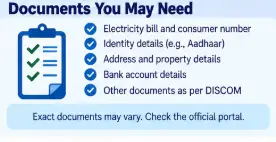
Before starting your application, ask yourself these questions:
Question 1
Do I have a residential grid-connected electricity connection?
If yes, continue.
Question 2
Is the connection with my local DISCOM?
If yes, continue.
Question 3
Do I have a suitable location for rooftop solar installation?
If yes, continue.
Question 4
Have I already received another solar subsidy?
If yes, check the rules before proceeding.
Question 5
Do my electricity-consumer and property details make sense for the proposed installation?
If there is a mismatch, check with your DISCOM before spending money.
Question 6
Am I applying through the official PM Surya Ghar process?
If yes, proceed with the application according to the portal instructions.
PM Surya Ghar Eligibility vs Subsidy Eligibility
This distinction is important.
Someone may be interested in rooftop solar and may have a residential electricity connection, but the CFA is still subject to the applicable scheme requirements.
Think of it this way:
Residential electricity connection → Application → Approved process → Eligible installation → Verification → Applicable CFA
The subsidy is not simply handed over because you own a house.
MNRE states that the consumer pays the balance amount after deducting the applicable subsidy/CFA, following successful installation and verification through the prescribed process.
How to Confirm Your Eligibility
The safest approach is to use the official PM Surya Ghar National Portal.
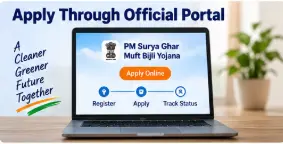
You can begin by selecting your State and electricity distribution company and entering the required consumer information. The government says the National Portal provides information such as appropriate system sizes and other scheme-related information.
If there is a problem with your electricity connection, property details, or DISCOM process, contact the concerned DISCOM rather than relying only on a private solar vendor.
Common PM Surya Ghar Eligibility Mistakes
Mistake 1: “I Own a House, So I Automatically Get ₹78,000”
Not necessarily.
The subsidy is subject to the applicable scheme and installation requirements.
Mistake 2: “I Live in a Village, So I Cannot Apply”
Incorrect.
The current government information specifically includes rural residential households.
Mistake 3: “I Pay the Electricity Bill, So I Must Be Eligible”
Not necessarily.
Property ownership, connection details and the applicable scheme requirements also matter.
Mistake 4: “The Vendor Said I Am Eligible, So I Can Pay”
Do not rely solely on a sales representative.
Verify the application and subsidy process through the official portal.
Mistake 5: “₹78,000 Means My Solar System Will Cost Me ₹78,000 Less No Matter What”
The actual CFA depends on the applicable scheme structure and eligible capacity.
Your total installation cost also depends on the system, vendor, and installation requirements.
Frequently Asked Questions
Q1. Who is eligible for PM Surya Ghar in 2026?
PM Surya Ghar is a demand-driven scheme under which residential consumers across India with a grid-connected electricity connection from their local DISCOM can apply for rooftop solar benefits, subject to the applicable scheme requirements.
Q2. Can rural households apply for PM Surya Ghar?
Yes. The latest government information specifically states that rural households are included in the scheme.
Q3. Is there an income limit?
The basic residential eligibility conditions do not specify a simple household-income cutoff as the main eligibility test. The scheme focuses on residential electricity connections and applicable rooftop solar requirements.
Q4. Can a tenant apply?
Do not assume eligibility. The published basic criteria refer to owning a house with a suitable roof, so tenants should verify their specific property, electricity connection and installation arrangement before applying.
Q5. Can an apartment resident apply?
Apartment residents should check whether an individual or group-housing arrangement applies. The scheme framework includes provisions for GHS/RWAs for certain common facilities, subject to applicable conditions.
Q6. Can someone with an existing solar system apply?
It depends on the existing installation and whether a previous solar subsidy was received. The published eligibility criteria specifically say the household should not have already availed another subsidy for solar panels.
Q7. Can a farmer apply?
A farmer can check eligibility for PM Surya Ghar when applying as an eligible residential electricity consumer. Agricultural solar applications under PM-KUSUM are a separate matter.
Q8. Can government employees apply?
Yes, employment category by itself is not listed as a basic exclusion condition. The person must meet the applicable residential scheme requirements.
Q9. Is ₹78,000 available to every eligible household?
No. The standard CFA structure is linked to eligible rooftop solar capacity, with the standard maximum reaching ₹78,000 at 3 kW or above.
Final Takeaway
PM Surya Ghar eligibility in 2026 is broader than many people assume.
The scheme is available to residential consumers across India, including rural households, provided they have the required grid-connected residential electricity connection and meet the applicable rooftop solar and scheme conditions.
Before applying, don’t focus only on the headline subsidy.
First check:
- Your electricity connection
- Your DISCOM
- Your property and rooftop situation
- Whether you have previously received a solar subsidy
- Your proposed system size
- The applicable installation process
And most importantly, verify your individual case through the official PM Surya Ghar portal before paying a vendor.
That small step can prevent a much bigger problem later.
Official Sources
MNRE – Grid Connected Rooftop Solar Programme
MNRE – PM Surya Ghar Operational Guidelines
Related PM Surya Ghar Guides
Explore our detailed guides to understand the PM Surya Ghar Muft Bijli Yojana, subsidy, eligibility and application process:
Before calculating the subsidy, it is useful to understand the PM Surya Ghar Muft Bijli Yojana, including its eligibility, application process and major benefits. Main Pillar post.
- PM Surya Ghar Subsidy 2026: How Much Subsidy Can You Get?
→ Link to your current supporting post. - How to Apply for PM Surya Ghar Muft Bijli Yojana Online
→ Your application guide. - PM Surya Ghar Eligibility: Who Can Get the Solar Subsidy?
→ Your eligibility guide. - How to Complete PM Surya Ghar Registration Online
→ Registration/process guide. - PM Surya Ghar Solar Subsidy for 1 kW, 2 kW and 3 kW Systems
→ If you have or create a dedicated capacity/subsidy article. - PM Surya Ghar Loan: Interest Rate, Eligibility and How to Apply
→ Your financing guide. - PM Surya Ghar Subsidy Status: How to Check Your Subsidy Payment
→ Your subsidy-status guide. - PM Surya Ghar in Odisha: Subsidy, Eligibility and Application Process
→ State-specific guide, particularly useful for your audience.