
IIf you are planning to install rooftop solar under PM Surya Ghar, understanding the PM Surya Ghar Solar System Cost 2026 can help you estimate your investment before applying. The first question is usually simple:
“How much will a solar system actually cost after the PM Surya Ghar subsidy?”
The answer depends on the system size, equipment, installation conditions, location, and vendor.
For 2026, current market guides put a typical residential rooftop solar system at roughly ₹55,000–₹75,000 per kW before subsidy, but actual quotations can vary considerably.
So, instead of giving you one number and calling it the “official price”, this guide separates the government subsidy from the market cost of installing the system.
That distinction is important.
PM Surya Ghar Solar System Cost 2026: 1 kW, 2 kW and 3 kW
Here is an indicative 2026 picture:
| System | Indicative market cost before subsidy | Central subsidy | Approx. cost after central subsidy* |
|---|---|---|---|
| 1 kW | ₹55,000–₹70,000 | ₹30,000 | ₹25,000–₹40,000 |
| 2 kW | ₹1.10–₹1.40 lakh | ₹60,000 | ₹50,000–₹80,000 |
| 3 kW | ₹1.60–₹2.10 lakh | ₹78,000 | ₹82,000–₹1.32 lakh |
*These are indicative calculations, not government-fixed prices or quotations. Actual vendor prices vary by location, equipment, roof, installation requirements, taxes, and other factors. Current 2026 market guides show ranges in this general area.
What Is the PM Surya Ghar Subsidy?
The central subsidy is officially called Central Financial Assistance (CFA).
For eligible residential rooftop solar systems, the standard central support is:
- ₹30,000 per kW for the first 2 kW
- ₹18,000 for the third kW
- Maximum standard central CFA: ₹78,000
That means:
1 kW
₹30,000 subsidy
2 kW
₹60,000 subsidy
3 kW
₹78,000 subsidy
The government has confirmed these standard amounts under PM Surya Ghar.
1 kW Solar System Cost Under PM Surya Ghar
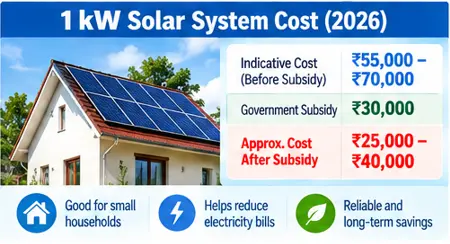
A 1 kW rooftop solar system is suitable for a household with relatively modest electricity consumption.
Current 2026 market estimates put a 1 kW installed system at roughly ₹55,000–₹70,000 before subsidy.
After the ₹30,000 central subsidy:
₹55,000 – ₹30,000 = ₹25,000
and
₹70,000 – ₹30,000 = ₹40,000
So the indicative post-subsidy cost is around:
₹25,000–₹40,000
But remember that this is an estimate, not a guaranteed price.
A vendor may quote more or less depending on the equipment and installation conditions.
2 kW Solar System Cost Under PM Surya Ghar
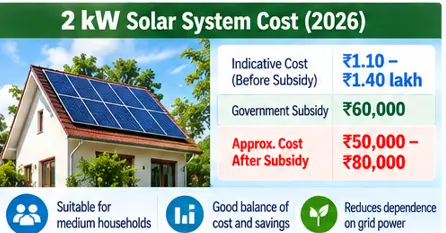
A 2 kW system is a common option for a household with higher electricity consumption.
Current 2026 market guides put the installed cost at approximately ₹1.10 lakh to ₹1.40 lakh before subsidy.
The central subsidy is:
₹60,000
Therefore:
₹1.10 lakh − ₹60,000 = ₹50,000
₹1.40 lakh − ₹60,000 = ₹80,000
Indicative post-subsidy cost: ₹50,000–₹80,000
One current 2026 market guide, for example, estimates a 2 kW system at around ₹1.16 lakh installed, illustrating why actual quotations can sit inside or outside a broad market range.
3 kW Solar System Cost Under PM Surya Ghar
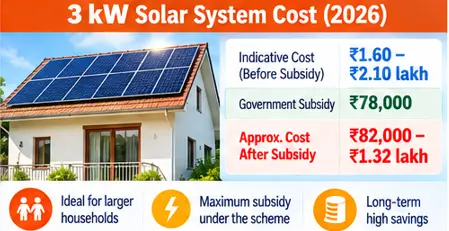
A 3 kW system receives the maximum standard central subsidy.
The central subsidy is:
₹78,000
Current 2026 market estimates put the installed cost around ₹1.60 lakh–₹2.10 lakh, although some vendors quote outside this range depending on specifications and location.
After subtracting ₹78,000:
₹1.60 lakh − ₹78,000 = ₹82,000
₹2.10 lakh − ₹78,000 = ₹1.32 lakh
Indicative post-subsidy cost: ₹82,000–₹1.32 lakh
A current 2026 market guide gives a narrower example of approximately ₹1.74 lakh installed for a 3 kW system, again showing why consumers should compare actual written quotations rather than relying on a single online price.
Does the Government Fix the Solar System Price?
PM Surya Ghar Solar System Cost 2026 is not fixed by the government and it is not as one universal retail price for every household.
This is an important point.
The government specifies the subsidy/CFA structure and applicable requirements, while the actual price you pay for a rooftop solar installation depends on the vendor, equipment and site.
Two households may therefore receive different quotations for a similar system size.
The final price can be affected by:
- Solar panel brand
- Panel technology
- Inverter
- Mounting structure
- Roof type
- Cable length
- Installation difficulty
- Safety equipment
- Labour
- Transportation
- GST
- Net-metering-related work
- Additional state-level support or requirements
What Is Included in a Rooftop Solar System?
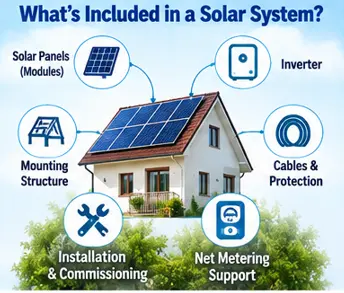
When comparing a quotation, don’t look only at the number of solar panels.
A typical grid-connected rooftop system can include:
Solar panels
These convert sunlight into electricity.
Solar inverter
The inverter converts the electricity generated by the panels into a form suitable for use in the household and grid connection.
Mounting structure
This holds the panels securely on the roof.
Cables and electrical protection
The system needs appropriate cabling, switches, protection devices, and related equipment.
Earthing and safety equipment
Proper electrical safety is an important part of installation.
Installation and commissioning
The vendor may include labour, testing, and related installation work.
Why Does One Vendor Quote More Than Another?
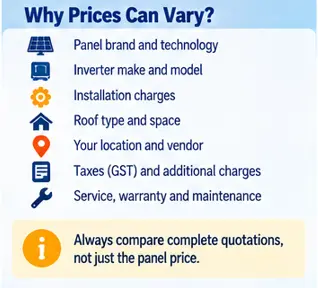
This is where many buyers make a mistake.
Suppose one vendor quotes:
₹1.60 lakh
and another quotes:
₹2.00 lakh
That does not automatically mean the second vendor is overcharging.
The two systems could have different:
- Panel brands
- Panel wattages
- Inverter brands
- Mounting structures
- Warranty terms
- Cable specifications
- Protection equipment
- Installation standards
- After-sales service
Therefore, compare the complete bill of materials and service terms, not just the headline price.
How Much Roof Space Do You Need?
The space requirement depends on the panel wattage, layout, roof design, and required spacing.
As a rough practical guide, a household should have a reasonably large shadow-free roof area for a residential rooftop installation.
Your vendor should assess the actual roof before finalizing the system design.
Do not choose a system based only on available square feet from an online article.
Which Solar System Size Should You Choose?
Don’t automatically choose 3 kW simply because it gets the maximum subsidy.
Instead, look at:
- Your monthly electricity consumption
- Your electricity bill
- Your available roof area
- Your daytime electricity usage
- Your future electricity needs
- Your budget
- The system’s expected generation
For example, a household with low electricity consumption may not need a 3 kW system simply because the subsidy is higher.
The right size makes sense for your actual electricity needs and site.
What About the “300 Units Free Electricity” Claim?
This needs some explanation.
PM Surya Ghar aims to enable households to generate enough rooftop solar electricity to support consumption of up to around 300 units per month.
It does not mean the government deposits money equivalent to 300 units into your account every month.
Actual electricity generation depends on:
- Solar system size
- Sunlight
- Weather
- Roof orientation
- Shading
- Equipment performance
- Household consumption
- Grid interaction
So treat “300 units” as a scheme objective, not a guaranteed monthly generation figure for every household.
Can You Get More Than ₹78,000 Subsidy?
The standard central subsidy is capped at ₹78,000 for residential systems under the normal 3 kW CFA structure.
However, some states may provide additional support depending on their own policies.
Therefore, if you are calculating the final amount you have to pay, check:
Central CFA + applicable state support + actual vendor quotation
rather than assuming every household receives the same total benefit.
PM Surya Ghar Solar System Cost: Example
Let’s say a vendor quotes:
3 kW system = ₹1,80,000
Central subsidy:
₹78,000
Simple calculation:
₹1,80,000 − ₹78,000 = ₹1,02,000
So the indicative net cost would be:
₹1,02,000
But this is only an example.
Your actual quotation could be different.
Also remember that subsidy processing and payment follow the scheme’s prescribed procedure. Don’t assume that the vendor will automatically reduce the invoice by the full subsidy amount unless the specific arrangement clearly says so.
How to Compare Solar Quotes
Before choosing a vendor, ask for an itemized quotation.
Check these 10 things:
- Panel manufacturer
- Panel model and wattage
- Total installed capacity
- Inverter brand/model
- Mounting structure specification
- Cable and protection details
- Installation charges
- Warranty
- Maintenance/service terms
- Taxes and any additional charges
Also check whether the vendor is eligible/registered under the applicable scheme and DISCOM process.
Is PM Surya Ghar Solar Worth Considering?
That depends on your household.
The financial benefit can be meaningful when a suitable rooftop system reduces your electricity purchases over time.
But don’t judge the investment only from the subsidy.
Consider:
Total installation cost − subsidy + expected electricity savings + maintenance + financing cost
That gives you a more realistic picture.
Frequently Asked Questions
Q1. What is the PM Surya Ghar Solar System Cost 2026??
Indicative 2026 market estimates are around ₹55,000–₹70,000 for 1 kW, ₹1.10–₹1.40 lakh for 2 kW and ₹1.60–₹2.10 lakh for 3 kW before the central subsidy. Actual prices vary by vendor and location.
Q2. How much is the subsidy for 1 kW?
The standard central subsidy is ₹30,000 for 1 kW.
Q3. How much is the subsidy for 2 kW?
The standard central subsidy is ₹60,000 for 2 kW.
Q4. How much is the subsidy for 3 kW?
The standard central subsidy is ₹78,000 for 3 kW.
Q5. Is a 3 kW solar system free under PM Surya Ghar?
No. The government subsidy reduces the eligible cost; it does not mean the complete solar installation is free.
Q6. Does a 3 kW system always cost ₹1.74 lakh?
No. ₹1.74 lakh is only an example of a current market estimate. Vendor quotations can vary significantly.

Final Takeaway
The PM Surya Ghar solar system cost in 2026 depends on much more than the size of the system.
As a broad market guide, you may see:
- 1 kW: ₹55,000–₹70,000 before subsidy
- 2 kW: ₹1.10–₹1.40 lakh before subsidy
- 3 kW: ₹1.60–₹2.10 lakh before subsidy
The standard central subsidy is ₹30,000, ₹60,000 and ₹78,000 respectively.
The most important step is therefore not finding the cheapest quotation. It is finding a properly specified system from an eligible vendor at a reasonable total cost, and then calculating your actual out-of-pocket amount after the applicable subsidy.
Sources of Data
Official PM Surya Ghar National Portal
MNRE Grid-Connected Rooftop Solar Programme
Related PM Surya Ghar Guides
- PM Surya Ghar Muft Bijli Yojana: Complete Guide
- PM Surya Ghar Subsidy 2026: How Much Subsidy Can You Get?
- PM Surya Ghar Eligibility 2026: Who Can Apply and Who Cannot?
- PM Surya Ghar Apply Online: Step-by-Step Application Guide
- PM Surya Ghar Subsidy Status: How to Check Your Payment
- PM Surya Ghar Loan: Interest Rate, Eligibility and Application
- PM Surya Ghar in Odisha: Subsidy, Eligibility and Application Guide