
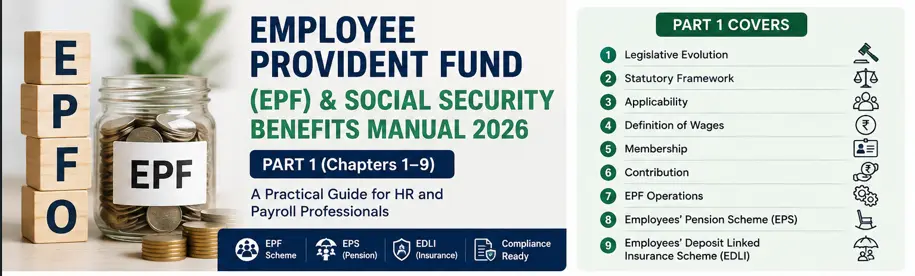
Understanding the Evolution of Provident Fund Law in India
At a Glance
After reading this chapter, you will understand:
- Why India introduced a provident fund system.
- How provident fund law evolved over the last century.
- Why the EPF & MP Act, 1952 became one of India’s most significant labour laws.
- How the Labour Codes changed the statutory framework.
- Why HR professionals should understand this transition before handling EPF compliance.
Why This Chapter Matters
Ask any new HR Executive what EPF means, and the usual answer is, “It is a 12% deduction from an employee’s salary.”
Technically, that answer is not wrong. Practically, it is incomplete.
In every organisation, EPF influences far more than monthly salary deductions. It affects employee onboarding, payroll processing, salary structuring, contractor compliance, statutory inspections, retirement benefits, labour disputes and even merger or acquisition due diligence.
Many HR professionals become comfortable processing monthly PF contributions without understanding how the law reached its present form. As a result, they know what to do but often struggle to explain why the law requires a particular action.
This chapter provides that foundation. Before discussing contributions, wages, UAN, withdrawals or compliance, it is important to understand how India’s provident fund law evolved and why the Labour Codes have changed the legal framework.
The Beginning of Provident Fund Law in India
Provident fund is not a new concept in India. The earliest legal recognition came through the Provident Funds Act, 1925, which primarily protected government provident funds and certain public sector employees. It was never intended to provide a universal retirement savings system for industrial workers.
During the early years after Independence, industrialisation expanded rapidly. Large numbers of workers were employed in factories, mines, plantations and engineering establishments. While industries were growing, there was no uniform statutory mechanism to ensure long-term retirement savings for employees in the private sector.
Employers followed different practices. Some maintained private provident funds, while many offered no retirement savings at all. Employee protection depended largely on the employer’s internal policy rather than a statutory obligation.
The Government recognised that retirement security could not depend solely on individual employers. A uniform legal framework became necessary.
Birth of the EPF & MP Act, 1952
The Employees’ Provident Funds Act, 1952 (later renamed the Employees’ Provident Funds and Miscellaneous Provisions Act, 1952) introduced a statutory provident fund system for covered establishments.
The Employees’ Provident Fund Organisation (EPFO) administers the statutory provident fund, pension and insurance framework for covered establishments and members. The official EPFO website provides the current statutory and operational resources for employers and members.
Unlike voluntary retirement savings, the Act imposed a legal obligation on employers and employees to contribute towards a retirement fund in accordance with the prescribed rates and conditions.
Over time, the law expanded beyond provident fund alone. Additional social security schemes such as the Employees’ Pension Scheme (EPS) and the Employees’ Deposit Linked Insurance Scheme (EDLI) were introduced under the same legislative framework.
As industries evolved, the Act also expanded to cover additional establishments, categories of employees and specialised compliance requirements.
For more than seven decades, this Act remained one of the cornerstones of India’s organised sector social security system.
The three principal schemes historically administered under the EPF & MP Act are the Employees’ Provident Fund Scheme, Employees’ Pension Scheme and Employees’ Deposit Linked Insurance Scheme.
Why the Law Needed to Change
Although the EPF Act served employees well, India’s labour law framework gradually became increasingly fragmented.
Different labour laws used different definitions for terms such as:
- Wages
- Employee
- Employer
- Establishment
This created practical difficulties for employers.
For example, an allowance excluded from wages under one labour law might be treated differently under another. Payroll professionals were often required to maintain different interpretations for different statutes.
Compliance also became increasingly document-intensive, with separate registrations, returns and procedural requirements under multiple labour laws.
Recognising these challenges, the Government initiated labour law reforms with the objective of consolidating numerous Central labour laws into four Labour Codes.
The Labour Code Era
One of the most significant reforms was the enactment of the Code on Social Security, 2020.
Instead of creating an entirely new social security philosophy, the Code consolidated and modernised several existing social security laws, including the legal framework relating to provident fund.
For HR professionals, this transition is more than a legislative change. It affects terminology, compliance interpretation, wage structuring and future policy implementation.
Although many operational principles continue through notified schemes, professionals can no longer rely only on the wording of the EPF & MP Act while interpreting current compliance obligations.
Understanding both the historical law and the present framework has therefore become essential.
Why HR Professionals Should Understand the Transition
Many organisations still use documents prepared years ago.
Appointment letters.
Salary structures.
HR manuals.
Standing orders.
Payroll SOPs.
Internal compliance checklists.
Some of these documents continue to refer to provisions of the EPF & MP Act, 1952 without reflecting subsequent legislative developments.
Similarly, many judicial decisions delivered over the past several decades continue to interpret provisions of the earlier Act. These decisions remain relevant, but they must now be read in the context of the present statutory framework.
For this reason, an HR professional should understand both:
- the historical legal position; and
- the current compliance framework.
This manual adopts that approach throughout.
Benefitomics Insight
One of the biggest mistakes organisations make is assuming that labour law compliance begins with payroll processing. In reality, compliance begins much earlier—with the design of employment contracts, salary structures, appointment letters and HR policies. Payroll merely reflects decisions that have already been taken by HR and management.
Transition Timeline
| Year | Development | Practical Significance |
|---|---|---|
| 1925 | Provident Funds Act enacted | Protected specified provident funds; not a universal employee social security law. |
| 1952 | Employees’ Provident Funds Act enacted | Introduced statutory provident fund obligations for covered establishments. |
| 1971 | EDLI Scheme introduced | Added insurance protection linked to provident fund membership. |
| 1995 | Employees’ Pension Scheme introduced | Replaced the Family Pension Scheme and created a structured pension framework. |
| 2020 | Code on Social Security enacted | Consolidated multiple social security laws into a single code. |
| 21 November 2025 | Labour Code implementation (as per this manual’s framework) | Shifted the legal and compliance landscape for employers, HR and payroll professionals. |
From the HR Desk
In my experience, junior HR professionals often begin learning EPF by memorising contribution percentages and portal procedures. That approach works only until the first unusual situation arises—such as salary restructuring, contractor disputes, retrospective wage revisions or an EPFO inspection.
An HR professional who understands the legislative evolution of provident fund law finds it much easier to interpret new circulars, explain compliance decisions to management and respond confidently during inspections.
Understanding the law is not about memorising sections. It is about understanding why the law developed in its present form.
Chapter Summary
The remaining chapters of this manual build on this foundation and focus on practical implementation rather than theoretical discussion.
Provident fund law in India evolved from a limited protection framework to a comprehensive statutory social security system.
The EPF & MP Act, 1952 established mandatory provident fund obligations for covered establishments.
Over time, the framework expanded through the Employees’ Pension Scheme and the Employees’ Deposit Linked Insurance Scheme.
Labour law reforms led to the Code on Social Security, creating a new statutory framework for employee social security.
HR professionals should understand both the historical law and the current framework because many organisational documents, court decisions and compliance practices continue to refer to the earlier legislation.
Chapter 2: Legislative Evolution
Transition from the EPF & MP Act, 1952 to the Code on Social Security
What Every HR & Payroll Professional Should Understand After the Labour Code Implementation
At a Glance
After reading this chapter, you will understand:
- Why the Government consolidated labour laws into four Labour Codes.
- How the Code on Social Security changed the legal framework governing provident fund.
- Which EPF concepts continue without major change.
- Which areas require HR and payroll teams to review existing practices.
- Why organisations should update HR manuals, salary structures and compliance documentation instead of relying solely on older references.
Why This Chapter Matters
One of the most common misconceptions after the implementation of the Labour Codes is that the EPF law has been completely replaced.
In practice, the position is more nuanced.
Many HR professionals continue to refer to the Employees’ Provident Funds & Miscellaneous Provisions Act, 1952 because appointment letters, HR manuals, payroll software, internal SOPs and even court decisions still use the terminology of the earlier law.
At the same time, compliance professionals are expected to understand the present framework under the Code on Social Security and the notified schemes.
Ignoring either framework creates unnecessary confusion.
This chapter bridges that gap.
Why Were the Labour Codes Introduced?
For decades, employers complied with multiple Central labour laws.
Each law had its own:
- definitions
- registration requirements
- compliance procedures
- authorities
- returns
- terminology
Even experienced HR professionals often faced practical difficulties because the same salary component could be interpreted differently under different labour laws.
The objective of the Labour Codes was not merely to combine statutes into a single document. The larger objective was to create a more uniform legal framework, simplify compliance and reduce conflicting interpretations across labour legislation.
For HR teams, the most significant impact is the movement towards uniformity, particularly in the definition of wages and the overall approach to social security compliance.
Historical Position
Before the Labour Code Implementation
For more than seventy years, provident fund compliance was primarily governed by the Employees’ Provident Funds & Miscellaneous Provisions Act, 1952 along with:
- Employees’ Provident Fund Scheme
- Employees’ Pension Scheme
- Employees’ Deposit Linked Insurance Scheme
- EPFO notifications
- EPFO circulars
- Judicial precedents
Most HR policies, payroll manuals and appointment letters prepared before the Labour Codes were drafted with this legal framework in mind.
Consequently, many organisations continue to use references such as “Section 6 of the EPF Act” or “EPF & MP Act, 1952” in internal documents.
These references do not become historically irrelevant overnight, but they should now be understood in the context of the current legal framework.
Current Position
After the Labour Code Implementation
The Code on Social Security consolidates several social security laws into a unified legislative framework.
From a practical HR perspective, this does not mean that every existing EPF process changes immediately.
Monthly activities such as:
- employee enrolment
- UAN management
- Electronic Challan-cum-Return (ECR)
- contribution remittance
- claim processing
- KYC verification
continue through the EPFO administrative system.
However, employers should gradually align their HR documentation, compliance manuals and payroll interpretation with the present legal framework.
Comparison at a Glance
| Subject | Earlier Position | Current Position | Practical HR Impact |
|---|---|---|---|
| Governing law | EPF & MP Act, 1952 | Code on Social Security with notified schemes | HR manuals and compliance references should be reviewed. |
| Wage interpretation | Multiple definitions under different labour laws | Greater emphasis on a uniform wage definition across Labour Codes | Salary structuring requires careful review. |
| Compliance philosophy | Individual labour laws | Integrated labour code framework | Compliance teams should adopt a unified approach. |
| HR documentation | References to earlier Acts | Progressive transition to Labour Code terminology | Existing templates should be updated over time. |
| Payroll interpretation | Act-specific understanding | Cross-code interpretation | Payroll teams should coordinate closely with HR and legal teams. |
Benefitomics HR Note
Earlier Practice
Many organisations deliberately kept Basic Pay at a lower level by distributing salary into multiple allowances. This approach reduced provident fund, gratuity and bonus liabilities in several situations.
Position After the Labour Codes
The introduction of a more uniform statutory approach to wages has changed the discussion. HR should not assume that every existing salary structure remains legally sustainable. Before revising compensation packages, organisations should review the interaction between the Code on Wages, the Code on Social Security, the applicable schemes and relevant judicial principles.
A salary structure designed five years ago may not be appropriate today.
Legacy Reference
During audits or while reviewing older records, HR professionals will frequently encounter documents referring to:
- Section 6 of the EPF & MP Act, 1952
- Paragraphs of the EPF Scheme
- Older EPFO circulars
- Judicial decisions interpreting the earlier legislation
Do not discard these references.
Instead, read them together with the present statutory framework and the latest notifications wherever applicable.
Understanding the historical context often helps in interpreting current compliance obligations and resolving disputes relating to earlier periods.
Practical HR Implementation
The transition to the Labour Codes is not limited to legal departments.
HR teams should review:
- Appointment letter templates.
- Employment contracts.
- Salary structure formats.
- HR policy manuals.
- Payroll SOPs.
- Contractor compliance clauses.
- Vendor onboarding documents.
- Internal compliance checklists.
Wherever references to older legislation continue, assess whether they require revision or explanatory notes.
This exercise should be undertaken systematically rather than waiting for an inspection or legal dispute.
Payroll Perspective
Before implementing any revised salary structure, payroll should verify:
✓ Whether the revised wage structure aligns with current legal principles.
✓ Whether retrospective revisions create additional PF liability.
✓ Whether arrears require supplementary ECR.
✓ Whether revised wages affect pension calculations where applicable.
✓ Whether payroll software has been configured to reflect updated salary components correctly.
Payroll compliance begins before the salary is processed—not after.
Compliance Alert
One of the biggest compliance risks is assuming that an old salary structure automatically remains legally compliant after changes in the statutory framework.
Before restructuring compensation, organisations should evaluate the impact on:
- Provident Fund
- Gratuity
- Bonus
- Leave Encashment
- Cost to Company (CTC)
- Payroll compliance
A salary revision is not merely a payroll exercise. It is also a statutory compliance exercise.
Benefitomics Insight
Many organisations are still asking the wrong question.
The question is no longer:
“Should PF be deducted?”
That answer is usually straightforward.
The more important question is:
“How should wages be structured so that the organisation remains legally compliant while maintaining transparency and consistency across all labour law obligations?”
That is where future EPF disputes are likely to arise.
From the HR Desk
Over the years, I have noticed that HR professionals often spend considerable time learning EPFO portal procedures but comparatively little time reviewing the legal assumptions behind their payroll practices.
Portal processes change.
Circulars change.
Software changes.
But the principles governing statutory compliance remain the foundation of every decision.
Understanding the transition from the EPF Act to the Code on Social Security helps HR professionals evaluate existing practices instead of simply continuing them because “this is how we have always done it.”
Chapter Summary
- The Labour Codes introduced a unified approach to labour legislation rather than merely renaming existing laws.
- HR and payroll professionals should understand both the earlier EPF framework and the current statutory framework.
- Existing HR documentation should be reviewed to ensure consistency with current legal terminology and compliance requirements.
- Salary structuring deserves fresh evaluation in light of the evolving approach to wages.
- Historical court decisions remain valuable but should be interpreted alongside the present legal framework.
- The next chapter explains Coverage and Applicability, which determines when an establishment becomes liable for EPF compliance and which employees are covered.
Chapter 3: Statutory Framework
When Does an Employer Become Legally Liable for EPF Compliance?
At a Glance
After reading this chapter, you will be able to:
- Determine whether an establishment is covered under EPF.
- Understand when EPF liability begins.
- Identify employees who must be enrolled.
- Distinguish statutory coverage from voluntary coverage.
- Avoid common mistakes during establishment registration.
- Handle practical situations involving employee strength and contractor manpower.
Why This Chapter Matters
One of the first questions every HR professional faces in a new organisation is:
“Does EPF apply to us?”
Surprisingly, the answer is not always straightforward.
Many employers assume that EPF becomes applicable only after appointing twenty permanent employees. Others believe contract labour should not be counted. Some delay registration because the workforce fluctuates every month.
These assumptions often become the reason for notices, inspections and retrospective contribution demands.
Coverage is not merely an administrative formality. It is the starting point of every EPF obligation. Once an establishment becomes legally covered, almost every subsequent compliance requirement—employee enrolment, contribution, ECR filing and record maintenance—follows automatically.
For this reason, every HR manager should first determine whether the establishment is covered before processing a single salary.
Statutory Position
The applicability of provident fund is governed by the statutory provisions relating to the coverage of establishments under the applicable law and the notified schemes.
Broadly, EPF applies to:
- factories engaged in notified industries;
- establishments employing the prescribed number of employees;
- establishments voluntarily opting for coverage; and
- other categories notified by the Central Government.
The exact legal provision should always be read together with the applicable scheme and subsequent notifications.
Which Establishments Are Normally Covered?
In practice, EPF commonly applies to:
- Manufacturing units
- Engineering companies
- Construction companies
- Hospitals
- Educational institutions
- Hotels
- IT companies
- Logistics companies
- Security agencies
- Consultancy organisations
- Commercial establishments notified under the law
The nature of business alone does not decide coverage. HR should examine the legal provisions applicable to the establishment and its employee strength.
Employee Threshold
The most commonly discussed threshold is 20 employees.
However, this should not be treated as a simple headcount exercise.
Before concluding that the establishment has fewer than twenty employees, HR should examine:
- permanent employees;
- temporary employees;
- probationers;
- trainees (where legally treated as employees);
- contract labour engaged in connection with the establishment, wherever legally includible;
- employees working across different branches of the same establishment, where applicable.
A wrong employee count is one of the most common reasons for disputes during EPFO inspections.
Practical Example
ABC Engineering employs:
- 15 permanent employees
- 4 probationers
- 6 contract workers engaged in production
The HR department assumes that only permanent employees should be counted and therefore does not obtain EPF registration.
During an inspection, the authorities examine the nature of engagement, supervision and statutory records. If the contract workers are legally eligible for the purpose of coverage, the establishment may be treated as coverable from the relevant date, resulting in retrospective compliance obligations.
The lesson is simple.
Never decide coverage merely by looking at the permanent employee register.
Once Covered, Does EPF Stop Applying?
This is one of the most frequently misunderstood issues.
Suppose an establishment employed 24 employees and obtained EPF registration.
A few months later, employee strength falls to 16.
Can the employer surrender the registration and discontinue compliance?
In normal circumstances, no.
Once an establishment comes within the statutory framework, coverage generally continues even if employee strength subsequently falls below the original threshold, unless the law specifically provides otherwise.
Many employers mistakenly stop compliance after reducing manpower and later face demands for unpaid contributions.
Voluntary Coverage
Some establishments may choose to come under the EPF framework voluntarily, even if they are not otherwise required to do so.
This option is generally adopted when:
- management wishes to provide statutory retirement benefits;
- clients require PF compliance as a contractual condition;
- organisations want a uniform employee benefits policy; or
- businesses expect employee strength to increase shortly.
Voluntary coverage creates statutory responsibilities similar to compulsory coverage. It should therefore be considered only after understanding the long-term compliance implications.
International Workers
Organisations employing expatriates or employees covered under Social Security Agreements should not assume that domestic EPF rules apply in exactly the same manner.
International worker compliance involves additional considerations relating to eligibility, contribution and withdrawal.
Because this subject is specialised, it is discussed separately in the chapter on Membership and International Workers.
Excluded Employees
Not every individual working in an establishment is automatically required to become an EPF member.
The concept of an excluded employee is governed by the applicable scheme and should be examined carefully before onboarding a new employee.
Incorrect classification can result in:
- delayed enrolment;
- contribution disputes;
- inspection observations; and
- employee grievances.
A detailed discussion on excluded employees appears in Chapter 4.
Benefitomics HR Note
One of the most common mistakes made by growing organisations is waiting until the twentieth employee joins before preparing for EPF registration.
By the time HR begins collecting Aadhaar, PAN, bank details, nomination forms and KYC documents, salary processing has already started.
A better practice is to begin compliance preparation as soon as the organisation approaches the statutory threshold. This avoids unnecessary delays and employee dissatisfaction during onboarding.
Practical HR Implementation
Before concluding whether EPF applies, HR should verify:
✓ Current employee strength
✓ Branch-wise employee strength
✓ Contract labour engagement
✓ Nature of establishment
✓ Existing EPFO registration status
✓ Previous business restructuring
✓ Acquisition or merger history
✓ Vendor agreements involving manpower deployment
Coverage should always be verified through documentary records rather than assumptions.
Compliance Checklist
Before applying for EPFO registration, confirm that:
□ PAN of the establishment is available.
□ GST registration details are consistent.
□ Incorporation documents are updated.
□ Authorised signatory details are available.
□ Digital Signature Certificate (DSC) is ready, where required.
□ Employee master data has been verified.
□ Joining dates are correctly recorded.
□ Salary records are available.
Inspection Note
During an inspection relating to coverage, authorities may examine:
- Attendance Register
- Wage Register
- Salary Sheets
- Muster Roll
- Appointment Letters
- Contractor Agreements
- Labour Licence
- Bank Payment Records
- Balance Sheet
- Profit & Loss Account
- GST Records
- ESI Records
- Employee Master Data
These documents help establish the actual employee strength and the nature of employment.
Common Mistakes
The following mistakes frequently lead to disputes:
- Counting only permanent employees.
- Ignoring contract labour without legal examination.
- Delaying registration after crossing the threshold.
- Incorrect classification of trainees.
- Assuming coverage ends when employee strength falls.
- Maintaining incomplete employee records.
- Treating different units separately without examining functional integration.
Benefitomics Insight
Coverage is not decided by payroll software.
It is decided by facts.
Employee strength, nature of work, supervision, organisational structure and statutory interpretation together determine whether an establishment is legally covered.
Many disputes arise because HR relies on assumptions instead of examining the legal position and supporting records.
From the HR Desk
During compliance reviews, I have often found organisations spending considerable time discussing contribution percentages while overlooking the more fundamental question of whether all eligible employees have been correctly brought under the EPF framework.
In practice, most long-term disputes begin much earlier than payroll processing. They begin when coverage is assessed incorrectly or when employee records are incomplete. Once the foundation is wrong, every monthly compliance cycle carries the same error forward.
My advice to every HR professional is simple: determine coverage correctly before processing the first salary. It is far easier to establish compliance at the beginning than to defend retrospective liabilities years later.
Chapter Summary
- Coverage is the starting point of every EPF obligation.
- The employee threshold should be assessed carefully after considering all legally relevant categories of workers.
- Once covered, an establishment generally continues to remain covered even if employee strength later falls.
- Voluntary coverage creates the same statutory responsibilities as compulsory coverage.
- Proper documentation is essential to establish compliance during inspections.
- The next chapter explains the definitions that determine PF liability, particularly “Employee”, “Employer”, “Basic Wages” and “Excluded Employee”.
Chapter 4: Applicability
Definitions That Decide EPF Liability
At a Glance
After reading this chapter, you will understand:
- Which statutory definitions influence day-to-day EPF compliance.
- Why incorrect interpretation creates contribution disputes.
- How courts interpret certain key expressions.
- Which definitions HR should verify before employee onboarding.
- Common mistakes that result in EPFO notices.
Why This Chapter Matters
One of the biggest misconceptions among HR professionals is that definitions are relevant only for lawyers.
In reality, almost every EPF dispute begins with a definition.
Questions such as:
- Is this person an employee?
- Is a trainee covered?
- Is contract labour covered?
- What constitutes wages?
- Who is an excluded employee?
- Who is responsible for PF when manpower is supplied through a contractor?
All these questions are answered by correctly interpreting statutory definitions.
An incorrect understanding at the beginning usually results in incorrect payroll processing, contribution disputes and inspection objections later.
For that reason, this chapter deserves much more attention than most HR professionals give it.
1. Employee
Statutory Position
The law defines an employee broadly to include persons employed directly or indirectly in connection with the work of an establishment, whether employed by the principal employer or through a contractor, subject to the applicable provisions of the law and the Scheme.
The intention behind this broad definition is to prevent employers from avoiding statutory liability simply by changing the mode of engagement.
Practical HR Interpretation
Many HR executives still ask:
“Is he on our payroll?”
That is often the wrong question.
The better question is:
“Is he working in connection with the establishment under circumstances that attract EPF coverage?”
Whether the salary is paid directly or through a contractor does not always determine EPF liability.
The actual nature of engagement is equally important.
Practical Example
A manufacturing company appoints 40 housekeeping personnel through an outsourced contractor.
The contractor pays wages.
The workers wear the company’s uniform.
They work only inside the factory.
Their attendance is verified by company supervisors.
Can HR simply say,
“They are not our employees.”
Not necessarily.
For EPF purposes, the actual relationship and statutory obligations must be examined carefully.
HR Desk
During audits, I have often noticed HR teams maintaining two separate employee lists:
- Company employees
- Contractor employees
That is perfectly acceptable for administration.
However, for statutory compliance, HR should also identify workers whose engagement creates obligations under labour laws, irrespective of who prepares the salary sheet.
2. Employer
Why This Definition Matters
The employer is not merely the person who signs appointment letters.
The employer is the person or authority responsible for ensuring statutory compliance.
From a compliance perspective, responsibility cannot always be delegated simply because payroll has been outsourced or manpower is supplied through contractors.
Practical HR Implementation
Whenever payroll activities are outsourced,
HR should clearly define:
- Who deducts PF?
- Who deposits PF?
- Who files ECR?
- Who maintains records?
- Who responds to EPFO notices?
- Who handles inspections?
Ambiguity in responsibility often leads to compliance failures.
Compliance Alert
Outsourcing payroll does not outsource statutory liability.
The employer remains responsible for ensuring compliance with applicable legal obligations.
3. Basic Wages
This is probably the most litigated definition under provident fund law.
Entire salary structures have been challenged because of the interpretation of these two words.
For that reason, Basic Wages deserves a separate chapter.
This chapter only introduces the concept.
A detailed discussion appears in Chapter 5 – Wages under the Labour Codes.
Benefitomics Insight
If there is one definition every HR Manager should understand thoroughly, it is Basic Wages.
Most major EPF disputes over the last decade have centred around wage composition rather than contribution percentages.
4. Excluded Employee
One of the first questions asked during recruitment is:
“Is PF deduction compulsory for this employee?”
The answer depends on whether the employee qualifies as an excluded employee under the applicable Scheme.
Incorrect classification results in:
- delayed enrolment;
- contribution disputes;
- employee complaints;
- inspection observations.
Never decide excluded employee status based on salary alone.
Always examine the relevant statutory provisions.
Practical HR Example
A candidate joins with previous EPF membership.
The salary on joining exceeds the statutory wage ceiling.
Can HR decide not to deduct PF merely because the salary exceeds the ceiling?
This issue should be examined carefully under the applicable provisions relating to existing members and excluded employees.
A wrong decision at the time of joining often becomes difficult to correct later.
5. International Worker
This definition affects only a limited number of organisations.
However, companies employing expatriates or operating across multiple jurisdictions should understand that international worker compliance follows specialised rules.
Do not apply domestic EPF assumptions without examining the relevant provisions and any applicable Social Security Agreement.
Common Definition Mistakes
In practice, EPFO disputes frequently arise because employers:
- treat all trainees as automatically outside PF;
- ignore contract labour while assessing liability;
- misunderstand excluded employee provisions;
- confuse salary structure with statutory wage definitions;
- rely on old practices without reviewing current legal developments.
Most of these issues originate from incorrect interpretation rather than incorrect calculation.
Practical HR Implementation
Before onboarding a new employee, HR should verify:
✓ Previous PF membership.
✓ Wage structure.
✓ UAN availability.
✓ Nature of employment.
✓ Contractor engagement, where applicable.
✓ Excluded employee status.
✓ International worker status, if relevant.
A five-minute verification at the time of joining can prevent years of compliance issues.
Inspection Note
During inspections involving employee classification, authorities commonly examine:
- Appointment letters.
- Attendance records.
- Wage registers.
- Contractor agreements.
- Muster rolls.
- Bank payment records.
- UAN details.
- Form 11.
- Employment contracts.
Documentation often determines whether the employer’s classification is accepted.
Benefitomics Commentary
Many organisations believe that EPF compliance begins with contribution calculation.
In reality, compliance begins much earlier.
It begins with asking the right questions during recruitment.
Every incorrect employee classification eventually reaches payroll.
Every payroll error eventually reaches statutory compliance.
Every compliance error eventually reaches inspection.
The safest approach is to resolve classification issues before the employee becomes part of the monthly payroll cycle.
HR Audit Questions
Before finalising employee onboarding, ask:
- Has previous PF membership been verified?
- Is Form 11 complete?
- Has UAN been collected or generated?
- Has excluded employee status been verified?
- Is the worker engaged through a contractor?
- Has the salary structure been reviewed?
- Is there any international worker implication?
From the HR Desk
New HR professionals often spend considerable time learning portal navigation and payroll software.
Those skills are important, but software only processes the information entered into it.
If the employee is classified incorrectly at the time of joining, the software faithfully repeats that mistake every month.
Good EPF compliance begins with correct classification, not correct data entry.
Chapter Summary
- Definitions are the foundation of EPF compliance.
- Incorrect interpretation leads to payroll errors, contribution disputes and inspection observations.
- “Employee”, “Employer” and “Excluded Employee” require careful practical interpretation.
- “Basic Wages” deserves separate treatment because of its significance in litigation and payroll.
- HR should resolve classification issues during onboarding rather than after statutory notices are received.
- The next chapter examines Wages under the Labour Codes, the most important topic in modern EPF compliance.
Chapter 5: Definition of Wages
Wages Under EPF
The Most Litigated Subject in Payroll & PF Compliance
At a Glance
After reading this chapter, you will understand:
- Why wage interpretation creates most EPF disputes.
- Difference between salary, CTC, and PF wages.
- Meaning of Basic Wages.
- Which allowances commonly become disputed.
- Impact of the Labour Codes on salary structuring.
- Practical payroll treatment.
- HR precautions before salary revision.
Why This Chapter Matters
Ask an HR Executive,
“What is the PF contribution rate?”
Most will immediately answer,
“Twelve percent.”
Now ask another question.
“Twelve percent of what?”
That is where uncertainty begins.
In practice, provident fund disputes rarely arise because employers forget the contribution percentage. They arise because employers and enforcement authorities differ on which salary components should be included while calculating provident fund contributions.
Two organisations may pay the same Cost to Company (CTC), yet their provident fund liability may differ because the salary has been structured differently.
Understanding wages is therefore not merely a payroll exercise. It is the foundation of statutory compliance.
Salary, CTC and PF Wages Are Not the Same
One of the biggest mistakes made by newly recruited HR professionals is assuming that every salary component automatically attracts PF contribution.
It does not.
Similarly, Cost to Company (CTC) is not equal to wages for EPF purposes.
Nor is Gross Salary automatically equal to PF wages.
Every payroll professional should clearly distinguish between:
- Cost to Company
- Gross Salary
- Basic Pay
- Dearness Allowance
- Retaining Allowance (where applicable)
- PF qualifying wages
Failure to distinguish these concepts often results in incorrect payroll configuration.
Why “Basic Wages” Became the Centre of Litigation
For many years, organisations designed salary structures with multiple allowances.
Basic Pay remained comparatively low.
The remaining salary was distributed among:
- House Rent Allowance
- Conveyance Allowance
- Special Allowance
- Attendance Allowance
- Washing Allowance
- Education Allowance
- Uniform Allowance
- Meal Allowance
- Other allowances
The objective was often to optimise overall employment cost while remaining within the prevailing legal interpretation.
Over time, questions began to arise.
Should every allowance automatically remain outside PF?
Or should some allowances form part of PF wages because they are paid uniformly to all employees?
This issue eventually reached the higher judiciary and fundamentally changed the discussion on provident fund wages.
Judicial Interpretation Changed the Conversation
Earlier, many employers focused primarily on the name of an allowance.
Today, courts look beyond the label.
The more important question is:
Why is the allowance being paid?
If an allowance is paid:
- regularly,
- uniformly,
- ordinarily, and
- to almost every employee,
merely calling it “Special Allowance” may not determine its treatment.
The actual nature of the payment becomes more important than its title.
This principle has had a significant impact on salary structuring across industries.
Benefitomics Insight
Changing the name of a salary component does not necessarily change its legal character.
Authorities and courts generally examine the substance of the payment rather than the wording used in the salary slip.
Labour Codes and the New Discussion on Wages
The introduction of the Code on Wages brought a more uniform statutory approach to the definition of wages across labour legislation.
For HR and payroll professionals, this has shifted the discussion from isolated salary components to the overall structure of remuneration.
The objective is not merely to determine PF contribution.
The same wage structure may also influence:
- Gratuity
- Bonus
- Leave Encashment
- Retrenchment Compensation
- Other statutory benefits
For this reason, salary restructuring should no longer be viewed only from the perspective of provident fund.
It should be reviewed from the perspective of overall labour law compliance.
Earlier Position vs Current Approach
| Issue | Earlier Practice | Current HR Approach |
|---|---|---|
| Salary Structuring | Heavy use of allowances | Greater emphasis on legal sustainability |
| Focus | Contribution percentage | Correct wage determination |
| Payroll | Monthly calculation | Compliance-oriented salary design |
| Litigation | Component names | Nature and universality of payment |
| HR Role | Payroll processing | Compliance review before salary design |
Practical Payroll Example
Employee
Basic Pay : ₹18,000
HRA : ₹9,000
Special Allowance : ₹11,000
Transport Allowance : ₹2,000
Gross Salary : ₹40,000
A payroll executive should not automatically assume that only Basic Pay attracts provident fund.
The first exercise should be to examine:
- Why each allowance is paid.
- Whether it is universally paid.
- Whether it varies according to work performed.
- Whether judicial principles affect its treatment.
- Whether the salary structure aligns with current legal requirements.
Payroll software calculates according to configuration.
The responsibility for configuring it correctly lies with HR and payroll professionals.
Practical HR Implementation
Before approving a revised salary structure, HR should verify:
✓ Has the wage structure been reviewed from a labour law perspective?
✓ Does the revised structure remain consistent across PF, gratuity and bonus?
✓ Are identical allowances being treated differently without justification?
✓ Has the payroll team reviewed the configuration?
✓ Has management understood the long-term compliance implications?
Salary restructuring should never be treated as only a compensation exercise.
It is equally a statutory compliance exercise.
Compliance Alert
One of the most expensive assumptions an employer can make is:
“If we rename the allowance, PF will not apply.”
Modern litigation has repeatedly shown that nomenclature alone does not determine statutory liability.
Salary structures should always be capable of withstanding legal scrutiny.
HR Decision Table
| Situation | HR Action |
|---|---|
| Annual salary revision | Review impact on PF wages before implementation. |
| Introduction of a new allowance | Examine its purpose and consistency with statutory principles. |
| Uniform allowance paid to all employees | Assess whether judicial interpretation may affect PF liability. |
| Payroll software update | Verify wage mapping before salary processing. |
| Internal salary restructuring | Obtain HR, payroll and legal review before rollout. |
Common Employer Mistakes
During audits, the following mistakes are frequently noticed:
- Treating every allowance as automatically excluded.
- Copying salary structures from other organisations.
- Revising salary without reviewing PF implications.
- Depending entirely on payroll software.
- Ignoring judicial developments.
- Not documenting the rationale behind salary components.
Most disputes originate from salary design rather than payroll calculation.
Inspection Note
During wage-related inspections, authorities commonly examine:
- Salary Registers
- Wage Sheets
- Appointment Letters
- Increment Letters
- Payroll Reports
- ECR
- Ledger Accounts
- Bank Statements
- Bonus Records
- Attendance Records
- HR Policy on Compensation
- Salary Structure Templates
The objective is to understand how wages have actually been structured and paid.
HR Case Study
A company introduced a “Performance Support Allowance” several years ago.
Although the name suggested a performance-linked payment, every employee received exactly the same amount every month irrespective of attendance, productivity or performance.
During a compliance review, HR realised that the allowance had gradually become a fixed salary component.
The organisation reviewed its wage structure, documented the purpose of each allowance and aligned payroll practices with current legal principles before the next statutory audit.
The lesson was simple.
An allowance should not be judged only by its name but by the way it is actually paid.
Benefitomics Commentary
The future of PF compliance is no longer about contribution rates.
It is about wage architecture.
HR professionals who understand wage design will rarely struggle with PF calculations.
Those who ignore wage design often spend years defending contribution disputes that could have been avoided when the salary structure was originally approved.
HR Audit Questions
Before approving any salary structure, ask:
- Why has this allowance been introduced?
- Is it paid uniformly?
- Does its purpose justify separate treatment?
- Has payroll mapped it correctly?
- Have recent judicial principles been considered?
- Would this salary structure withstand an EPFO inspection?
If the answer to any question is uncertain, review the structure before implementation.
From the HR Desk
One lesson I learnt early in my career is that salary structures should never be designed only by looking at take-home salary or annual CTC.
Every allowance added today becomes tomorrow’s compliance responsibility.
A good salary structure is not the one that appears attractive in the offer letter.
A good salary structure remains legally sustainable during an EPFO inspection, an internal audit and, if necessary, judicial scrutiny.
That is the standard every HR professional should aim for.
Chapter Summary
- Wage determination is the most disputed area of EPF compliance.
- Salary, CTC and PF wages are different concepts and should never be used interchangeably.
- The legal character of an allowance depends on its substance, not merely its name.
- Salary structuring should be reviewed in the context of the Labour Codes and judicial interpretation.
- Payroll configuration should always follow legal analysis, not precede it.
- Well-designed salary structures reduce long-term compliance and litigation risks.
Chapter 6: Membership
Employee Onboarding Under EPF
Membership, UAN & Digital Compliance
At a Glance
After reading this chapter, you will understand:
- Who should become an EPF member.
- What HR should verify before enrolling an employee.
- How UAN simplifies PF administration.
- Common onboarding mistakes.
- Digital compliance requirements.
- Practical onboarding checklist.
Why This Chapter Matters
Most HR professionals think EPF compliance begins when payroll is processed.
It actually begins much earlier.
It begins on the employee’s first day of joining.
The quality of EPF compliance depends largely on the quality of employee onboarding.
If employee information is collected correctly, UAN is verified, KYC is completed and membership is created accurately, monthly payroll becomes relatively straightforward.
If mistakes occur during onboarding, those errors continue every month until they are corrected.
For this reason, a well-designed onboarding process is one of the most effective compliance controls in HR.
When Does EPF Membership Begin?
Once an employee becomes eligible under the applicable legal provisions, HR should initiate EPF enrolment without unnecessary delay.
Membership is not a benefit that employees may choose to accept or reject where statutory coverage applies.
It is part of the employer’s compliance responsibility.
The objective of HR should therefore be to complete enrolment before the employee enters the regular payroll cycle.
What HR Should Verify Before Enrolment
Before creating or linking EPF records, verify:
- Full name as per Aadhaar.
- Date of Birth.
- Father’s or spouse’s name where required.
- Mobile number.
- Aadhaar.
- PAN.
- Bank account details.
- Previous UAN.
- Previous EPF membership.
- Date of Joining.
- Employment category.
Many future correction requests arise because basic information was not verified during onboarding.
Universal Account Number (UAN)
The Universal Account Number (UAN) has changed the way EPF records are maintained.
Instead of creating an entirely new identity whenever an employee changes jobs, the UAN provides a common identity across employments.
From the employee’s perspective, UAN simplifies account management.
From the employer’s perspective, it improves continuity of statutory records.
However, its effectiveness depends on accurate onboarding.
An incorrect UAN is not merely a data entry mistake.
It can delay transfers, claims, KYC updates and exit formalities.
Benefitomics Insight
Many HR professionals believe that generating a UAN completes EPF onboarding.
It does not.
A UAN without proper KYC, previous service linkage and correct joining details often creates more problems than it solves.
Successful onboarding is not about generating numbers.
It is about creating accurate employee records.
Existing UAN or New UAN?
One of the first questions during recruitment should be:
“Have you worked in an EPF-covered establishment earlier?”
If the answer is yes,
HR should verify the existing UAN before initiating any further action.
Creating multiple UANs for the same employee is one of the most common operational errors.
Correcting duplicate UANs later consumes considerable time and often delays transfer claims.
Digital KYC
KYC is no longer a routine documentation exercise.
It directly affects:
- online claims;
- account transfers;
- profile corrections;
- nomination updates;
- pension processing.
Before confirming employee onboarding, verify that KYC details are consistent across all statutory records.
Differences in name, date of birth or Aadhaar frequently result in claim rejections.
Practical HR Example
An employee joins with an existing UAN.
The appointment letter records the employee’s name as:
Rahul Kumar
Aadhaar records:
Rahul Kumar Sharma
Payroll processes salary.
PF contribution is deposited.
Six months later, the employee submits an online transfer request.
The request fails because identity details do not match.
The issue could have been avoided by verifying documents during onboarding instead of after payroll processing.
Practical HR Implementation
Every joining checklist should include:
✓ Aadhaar verification
✓ PAN verification
✓ Previous UAN verification
✓ Form 11
✓ Bank details
✓ Nomination
✓ KYC completion
✓ Date of Joining verification
✓ Salary structure review
✓ Employee category verification
This checklist should be completed before the employee appears in the first payroll.
Common Onboarding Mistakes
The following errors frequently create compliance issues:
- Creating a duplicate UAN.
- Ignoring previous EPF membership.
- Incorrect Date of Joining.
- Aadhaar mismatch.
- Name mismatch.
- PAN mismatch.
- Incomplete KYC.
- Delay in member registration.
- Wrong wage details.
- Incorrect employee classification.
Almost all these issues originate from inadequate document verification.
Payroll Perspective
Before generating the first month’s payroll, payroll should confirm:
- Has EPF membership been completed?
- Has the correct UAN been linked?
- Has KYC been verified?
- Is the employee eligible for contribution?
- Has the salary structure been reviewed?
The payroll cycle should never become the starting point for employee verification.
Inspection Note
During inspections, authorities may examine:
- Employee master records.
- Form 11.
- UAN records.
- Aadhaar details.
- Joining reports.
- Appointment letters.
- Salary registers.
- Attendance records.
- KYC status.
- Digital records maintained through the EPFO portal.
Proper onboarding documentation demonstrates systematic compliance.
HR Decision Table
| Situation | HR Action |
|---|---|
| Employee has previous UAN | Verify and link the existing UAN. |
| Employee never worked under EPF | Initiate new member registration. |
| Aadhaar mismatch | Resolve before payroll processing where possible. |
| Name differs across documents | Correct documentary inconsistency before statutory filings. |
| Previous employer has not updated Date of Exit | Coordinate with the employee and previous employer before transfer processing. |
Compliance Alert
Do not assume that portal acceptance confirms legal accuracy.
Many onboarding mistakes remain unnoticed until:
- transfer requests,
- withdrawal claims,
- inspections,
- pension applications,
- or employee complaints.
Correcting errors later usually requires more effort than preventing them during onboarding.
HR Audit Questions
Before closing the joining process, ask:
- Has the employee disclosed previous EPF membership?
- Has UAN been verified?
- Is Aadhaar linked?
- Has Form 11 been obtained?
- Is the salary structure correctly mapped?
- Has KYC been completed?
- Has the employee been included in the correct payroll cycle?
From the HR Desk
One lesson I have learnt over the years is that most EPF problems do not begin with complicated legal provisions.
They begin with simple onboarding mistakes.
An incorrect date, a duplicate UAN, an unverified Aadhaar or an overlooked Form 11 may appear insignificant on the joining day. Months later, those same mistakes delay transfers, create employee dissatisfaction and require repeated corrections.
Good HR is not about correcting errors efficiently.
Good HR is about designing processes that prevent those errors from occurring in the first place.
Chapter Summary
- EPF compliance begins with employee onboarding, not payroll.
- Proper verification of identity, previous membership and UAN is essential.
- Duplicate UANs and KYC errors are among the most common operational issues.
- A structured onboarding checklist significantly reduces future compliance problems.
- Payroll should process contributions only after employee records have been verified.
- The next chapter explains EPF Contributions, including statutory liability, calculation methodology, higher contributions, wage ceilings, interest and practical payroll illustrations.
CHAPTER 7: EPF Contributions
Contribution Liability, Payroll Treatment & Compliance
At a Glance
After reading this chapter, you will understand:
- Who is responsible for EPF contributions.
- How employee and employer contributions are determined.
- Wage ceiling and higher contribution.
- Payroll treatment in common situations.
- Interest and damages for delayed payment.
- Common payroll mistakes that result in compliance issues.
Why This Chapter Matters
For many payroll executives, EPF contribution means entering a percentage in the payroll software and generating the Electronic Challan-cum-Return (ECR).
In reality, contribution management is much more than a monthly calculation.
Every salary revision, arrear payment, leave without pay, retrospective increment, employee exit or contractor bill has the potential to affect EPF contributions.
A mistake in contribution calculation does not remain confined to one salary month. It can continue unnoticed for years until it is identified during an audit, employee grievance or EPFO inspection.
Understanding contribution liability is therefore one of the most important responsibilities of every HR and payroll team.
Statutory Contribution Structure
Under the applicable statutory framework, both the employer and the employee are generally required to contribute at the prescribed rate on PF qualifying wages.
From the employer’s contribution, a specified portion is allocated towards the Employees’ Pension Scheme (EPS), subject to the applicable wage ceiling and statutory provisions, while the balance is credited to the Employees’ Provident Fund (EPF).
The contribution mechanism should always be read together with the applicable Scheme, notifications and any subsequent amendments.
A detailed discussion on EPS appears in Chapter 8.
Who Is Responsible for Depositing Contributions?
Employee contribution is deducted from salary.
Employer contribution is borne by the employer.
However, the responsibility for depositing both contributions with the EPFO rests on the employer.
The employer cannot avoid liability merely because employee deductions have already been made.
Once salary is processed, the statutory obligation extends to timely remittance, accurate reporting through ECR and proper maintenance of contribution records.
Wage Ceiling and Higher Contribution
The statutory wage ceiling determines the extent to which mandatory contributions are required in certain situations.
However, many organisations voluntarily contribute on wages higher than the statutory ceiling as part of their employment policy or contractual commitment.
Before deciding to contribute on higher wages, management should evaluate:
- long-term financial impact;
- consistency across employee categories;
- pension implications;
- administrative feasibility; and
- future employee expectations.
Once such a policy is adopted, arbitrary changes may create employee relations as well as compliance issues.
Benefitomics HR Note
A decision to contribute on higher wages should never be made casually during recruitment to satisfy an individual candidate.
It should be based on a documented company policy approved by management. Otherwise, HR may face difficult questions from other employees seeking identical treatment.
Contribution During Common Payroll Situations
Monthly payroll rarely follows an ideal pattern.
The following situations require special attention.
Salary Revision
If Basic Pay is revised prospectively, payroll should apply the revised contribution from the effective month.
If the revision is retrospective, examine:
- effective date;
- wage months affected;
- whether ECR has already been filed; and
- whether additional contribution is payable.
Arrear Payments
Whenever arrears affect PF qualifying wages, payroll should determine whether supplementary contribution is required.
Do not assume that arrears automatically become part of the current month’s wages.
Always identify the wage period to which the arrears relate.
Leave Without Pay (LOP)
Where salary is reduced because of leave without pay, contribution should be determined on the actual PF qualifying wages payable for that wage month, subject to the applicable legal provisions.
Payroll should maintain clear records supporting the wage calculation.
Mid-Month Joining
When an employee joins in the middle of the month, payroll should calculate contribution on the wages actually earned during that wage period.
The joining date should be accurately reflected in both payroll and statutory records.
Full & Final Settlement
Before processing the employee’s final settlement, verify:
- Date of Exit.
- Last contribution month.
- Pending arrears.
- Pending salary revision.
- Leave encashment treatment.
- Notice pay adjustment.
Many transfer and withdrawal problems arise because the final contribution month has not been reported correctly.
Payroll Illustration
Situation
Employee joins on 15 July.
Basic Pay: ₹20,000
House Rent Allowance: ₹8,000
Special Allowance: ₹7,000
Three days Leave Without Pay.
An increment effective from 1 July is approved in August.
Payroll Questions
Instead of asking only,
“What is the PF amount?”
Payroll should ask:
- Which wages qualify for PF?
- Does the increment require retrospective contribution?
- Has July ECR already been filed?
- Is supplementary contribution necessary?
- Which wage month is affected?
Correct payroll begins with the right questions.
Practical HR Implementation
Before approving payroll every month, HR should verify:
✓ New joiners included.
✓ Resigned employees updated.
✓ Wage revisions reflected.
✓ Arrear calculations verified.
✓ Leave without pay processed correctly.
✓ Contractor contribution statements received.
✓ Higher contribution cases reviewed.
✓ Previous month’s corrections completed.
Monthly payroll review should become part of the statutory compliance process rather than a routine accounting activity.
Compliance Alert
Delayed remittance of EPF contributions may attract statutory interest and damages in accordance with the applicable legal provisions.
Apart from financial liability, persistent defaults may result in recovery proceedings and, in appropriate cases, prosecution.
Contribution deducted from employees should never be retained beyond the statutory time limit.
Inspection Note
During contribution-related inspections, authorities commonly verify:
- Salary Register.
- Wage Register.
- Attendance Register.
- ECR.
- Monthly Challans.
- Bank payment records.
- Ledger accounts.
- Increment letters.
- Contractor wage sheets.
- Arrear statements.
- Payroll reports.
Consistency between payroll records and statutory filings is often examined carefully.
Why Employers Face Contribution Disputes
In practice, contribution disputes frequently arise because:
- PF qualifying wages are determined incorrectly.
- Salary revisions are implemented without reviewing past wage months.
- Contractor contributions are not monitored.
- Arrear wages are ignored.
- Payroll software is configured incorrectly.
- HR and payroll work independently without cross-verification.
Most disputes are procedural rather than mathematical.
Benefitomics Insight
A payroll system can calculate only what it has been instructed to calculate.
It cannot determine whether the salary structure is legally correct.
That responsibility always remains with HR and payroll professionals.
Never assume that a payroll report is legally compliant simply because the software generated it without errors.
HR Audit Questions
Before closing monthly payroll, ask:
- Have all eligible employees been included?
- Has every salary revision been considered?
- Have arrears been reviewed?
- Have contractor contributions been verified?
- Has the ECR been validated before submission?
- Are all deductions supported by payroll records?
- Has the previous month’s exception report been cleared?
From the HR Desk
One habit that has helped me throughout my career is never approving payroll solely on the basis of the salary register.
Before signing off, I review the exception list:
- Who joined?
- Who resigned?
- Who received an increment?
- Who was on long leave?
- Which employees received arrears?
- Which contractor submitted revised bills?
Those six questions often identify issues that would otherwise become statutory problems in the following months.
Payroll is not merely about processing salaries.
It is one of the most important monthly compliance exercises performed by the HR department.
Chapter Summary
- EPF contribution is a continuing statutory responsibility, not merely a monthly deduction.
- Employers remain responsible for timely deposit of both employer and employee contributions.
- Salary revisions, arrears, leave without pay and employee exits require careful payroll review.
- Payroll software supports compliance but cannot replace legal interpretation.
- A structured monthly payroll checklist significantly reduces contribution-related disputes.
- The next chapter explains the Employees’ Pension Scheme (EPS), including eligibility, contribution allocation, pension benefits and practical issues frequently faced by HR and employees.
CHAPTER 8 : Employees’ Pension Scheme (EPS)
Understanding Pension Rights Beyond the PF Balance

At a Glance
After reading this chapter, you will understand:
- How EPS differs from EPF.
- How pension contributions are funded.
- Who becomes a member of EPS.
- How pensionable service is determined.
- Practical HR issues relating to EPS.
- Common misconceptions about pension benefits.
Why This Chapter Matters
A surprisingly common question from employees is:
“My employer contributes 12% to PF. Why is the amount credited to my PF account less than 12%?”
The answer lies in the Employees’ Pension Scheme (EPS).
Many employees believe the employer’s entire contribution is deposited into their EPF account. In reality, the employer’s statutory contribution is divided between the Provident Fund and the Pension Scheme in accordance with the applicable legal provisions.
Unless HR understands this distinction, it becomes difficult to explain salary slips, EPF passbooks or retirement benefits to employees.
What Is the Employees’ Pension Scheme?
The Employees’ Pension Scheme was introduced to provide a defined pension benefit to eligible members after retirement and specified benefits to eligible family members in the event of the member’s death.
Unlike EPF, which builds an individual accumulation based on contributions and interest, EPS operates as a statutory pension scheme governed by separate rules.
The objective of EPF is wealth accumulation.
The objective of EPS is income replacement after retirement or financial support to eligible dependants.
Although both schemes operate under the same statutory framework, they serve different purposes.
How EPS Is Funded
Employees do not make a separate contribution towards EPS.
Instead, a prescribed portion of the employer’s statutory contribution is allocated to the Pension Scheme, subject to the applicable wage ceiling and statutory provisions.
The balance of the employer’s contribution continues to be credited to the employee’s Provident Fund account.
This distinction is important because employees often expect the entire employer contribution to appear in their PF passbook.
Benefitomics Insight
Whenever an employee asks,
“Where has part of my employer’s contribution gone?”
the answer is usually not that the contribution is missing.
It has been allocated to the statutory pension scheme in accordance with the applicable legal provisions.
Who Becomes a Member of EPS?
Membership of the Pension Scheme is linked to EPF membership and the applicable statutory conditions.
For HR professionals, the important point is not merely whether an employee joins EPF, but whether pension provisions apply in that particular case.
Whenever a new employee joins, HR should verify:
- previous EPF membership;
- previous EPS membership;
- wage ceiling implications;
- continuity of service; and
- any applicable statutory exclusions.
Incorrect assumptions at the joining stage may affect pension records many years later.
Pensionable Service
One of the biggest misconceptions among employees is that pension depends only on the total amount contributed.
It does not.
Pension entitlement depends on factors such as:
- pensionable service;
- pensionable salary;
- statutory eligibility conditions; and
- applicable provisions of the Scheme.
For this reason, continuity of employment records and accurate service history are extremely important.
Practical HR Example
An employee works:
- five years with Company A;
- four years with Company B;
- seven years with Company C.
Each employer has correctly deposited PF contributions.
However, if previous service records are not properly linked, the employee may face difficulties while claiming pension benefits after retirement.
The issue is not the contribution.
The issue is continuity of records.
Resignation Does Not Mean Pension Ends
Employees often believe that resigning from a company automatically ends all pension rights.
That is incorrect.
Resignation ends the employment relationship.
It does not automatically extinguish pension-related rights earned under the Scheme.
HR should therefore advise employees to preserve continuity of their service records whenever they change employment instead of treating every resignation as a fresh beginning.
Death of a Member
One of the most sensitive responsibilities of HR arises when an employee dies while in service.
Family members are usually unfamiliar with statutory procedures.
At such times, HR should guide the nominee or eligible family members regarding:
- available benefits;
- required documents;
- nomination records;
- claim procedure; and
- supporting statutory formalities.
Professional assistance during these situations reflects the organisation’s commitment to employee welfare and statutory compliance.
Practical HR Implementation
Whenever an employee joins or exits, HR should verify:
✓ Previous service history.
✓ UAN continuity.
✓ Pension records.
✓ Nomination details.
✓ KYC.
✓ Exit date.
✓ Transfer status.
Small administrative errors today may become pension disputes decades later.
Common Misconceptions
The following misunderstandings are frequently encountered:
- “My entire employer contribution goes to EPF.”
- “Pension depends only on contribution amount.”
- “Changing jobs means starting pension service again.”
- “Resignation cancels pension eligibility.”
- “Pension records update automatically.”
Most of these misconceptions arise because employees receive little information about EPS during onboarding.
Payroll Perspective
Payroll teams should ensure that:
- employer contributions are correctly allocated;
- wage ceilings are applied appropriately;
- statutory reporting remains consistent with the Scheme;
- contribution records match payroll data.
Allocation errors may create reconciliation issues later.
Inspection Note
During inspections relating to EPS, authorities may verify:
- Contribution records.
- Wage details.
- ECR.
- Salary registers.
- Joining dates.
- Exit dates.
- Transfer records.
- UAN history.
- Nomination details.
Accurate employee lifecycle records support smooth pension administration.
HR Decision Table
| Situation | HR Action |
|---|---|
| Employee joins with previous service | Verify continuity before creating records. |
| Employee resigns | Update Date of Exit and advise on transfer. |
| Employee retires | Assist with pension documentation and records. |
| Employee dies in service | Guide family members regarding statutory benefits and documentation. |
| Long service employee | Review pension records before retirement planning. |
Compliance Alert
Pension disputes often arise not because contributions were unpaid, but because service records are incomplete or inconsistent.
Always verify:
- Date of Joining.
- Date of Exit.
- UAN continuity.
- Previous employment details.
- Nomination records.
Correct records are as important as correct contributions.
Benefitomics Commentary
In many organisations, EPF receives far more attention than EPS because employees regularly check their PF balance.
Pension, however, becomes important only at retirement or after the death of a member.
By then, correcting historical records may be difficult.
That is why HR should treat pension documentation as an ongoing compliance responsibility rather than a retirement exercise.
HR Audit Questions
Before closing the employee file, ask:
- Is previous service correctly linked?
- Is UAN verified?
- Has nomination been completed?
- Are joining and exit dates accurate?
- Has the employee been informed about pension implications?
- Are service records complete?
From the HR Desk
In my experience, employees usually ask about pension only when they are approaching retirement or when a family member needs to claim benefits after an unfortunate event.
Unfortunately, that is also when old mistakes surface—missing service records, incorrect exit dates, incomplete nominations or unresolved transfer issues.
Good HR practice is to resolve these issues during employment, not at retirement.
A pension file should never become a retirement project.
It should be built correctly from the employee’s first day of service.
Chapter Summary
- EPF and EPS serve different statutory purposes.
- EPS provides pension benefits, whereas EPF builds retirement savings.
- Pension entitlement depends on statutory conditions, not merely contribution amounts.
- Accurate service history is essential for pension administration.
- HR should maintain complete employee records throughout the employment lifecycle.
- The next chapter explains the Employees’ Deposit Linked Insurance (EDLI) Scheme, the third component of the EPF framework.
CHAPTER 9: Employees’ Deposit Linked Insurance (EDLI)
Financial Protection for Employees’ Families

At a Glance
After reading this chapter, you will understand:
- What the EDLI Scheme is.
- Who is covered under the Scheme.
- When insurance benefits become payable.
- The role of HR in processing EDLI claims.
- Common documentation issues that delay settlement.
- Practical steps to support employees’ families.
Why This Chapter Matters
Most employees regularly check their Provident Fund balance.
Very few know that EPF membership also provides insurance protection through the Employees’ Deposit Linked Insurance (EDLI) Scheme.
Unfortunately, HR departments usually receive questions about EDLI only after the death of an employee.
At that stage, the family’s priority is not understanding the law. Their priority is receiving financial assistance quickly.
A well-informed HR team can make that process much easier.
For this reason, every HR professional responsible for statutory compliance should understand the basics of EDLI, even if claims arise only occasionally.
What Is EDLI?
The Employees’ Deposit Linked Insurance Scheme is a statutory insurance benefit linked with EPF membership.
Unlike EPF, it does not create an individual savings account.
Unlike EPS, it does not provide a monthly pension.
Its purpose is different.
It provides a lump-sum insurance benefit to the eligible nominee or family members if an employee dies while covered under the Scheme, subject to the applicable statutory provisions.
This financial assistance is intended to support the family during a difficult period.
Is EDLI payable only if an employee dies while on duty?
No.
This is one of the biggest misconceptions.
EDLI is not like compensation under the Employees’ Compensation Act, 1923.
The cause or place of death is generally not the deciding factor.
The important question is:
Was the employee an active EPF member and covered under the EDLI Scheme at the time of death (or otherwise eligible under the applicable EDLI provisions)?
Therefore, EDLI may be payable whether the employee dies:
- at the workplace,
- at home,
- in a road accident,
- due to illness,
- due to a heart attack,
- while on leave,
provided the conditions of the Scheme are satisfied. Recent amendments also widened protection for certain cases where death occurs after a non-contributory period, if the member remains on the rolls and other conditions are met.
Who Is Covered?
Employees who are covered under the EPF framework are generally covered under the EDLI Scheme, subject to the applicable legal provisions.
Separate enrolment is normally not required.
From an HR perspective, this means that maintaining accurate EPF records also supports EDLI administration.
Incorrect employee records can create avoidable delays during claim processing.
Who Receives the Benefit?
In the unfortunate event of an employee’s death while covered under the Scheme, the insurance benefit is generally payable to the eligible nominee or other eligible family members in accordance with the Scheme.
This is why nomination records are extremely important.
Many claim-related difficulties arise because nomination details are incomplete, outdated or inconsistent with family records.
Benefitomics Insight
Nomination is often treated as a routine joining form.
In reality, it becomes one of the most important documents after an employee’s death.
A properly completed nomination can significantly reduce delays in settling statutory claims.
HR’s Role After the Death of an Employee
When an employee dies in service, HR becomes the primary point of contact for the family.
Apart from expressing support, HR should guide the nominee regarding:
- available statutory benefits;
- claim forms;
- supporting documents;
- bank details;
- identity documents;
- nomination records; and
- submission procedure.
Many families are unfamiliar with EPFO procedures.
Professional guidance from HR can reduce confusion during an emotionally difficult time.
Practical HR Example
An employee dies unexpectedly while still in service.
The family approaches the organisation with only the death certificate.
HR discovers that:
- nomination records were never updated after marriage;
- Aadhaar details contain spelling differences;
- bank account information is incomplete.
Instead of submitting the claim immediately, HR first helps the family update the necessary records and collect supporting documents.
Although the process takes additional time, proper documentation prevents rejection or repeated queries from the authorities.
| Situation | EDLI Position |
|---|---|
| Employee dies due to heart attack at home while in service | Generally eligible, subject to Scheme conditions. |
| Employee dies in a road accident during personal travel | Generally eligible, subject to Scheme conditions. |
| Employee dies while on official duty | Generally eligible, subject to Scheme conditions. |
| Employee dies during approved leave while remaining in service | May be eligible, subject to Scheme conditions. |
| Employee dies after resignation and cessation of membership | Eligibility depends on the applicable provisions and timing; not automatically payable. |
How Much Insurance Is Payable?
The amount is not fixed for every employee.
It is calculated under the EDLI Scheme based on the prescribed formula, using the employee’s average monthly wages and average PF balance, subject to statutory limits.
Quick Reference (2026)
| Particular | Amount |
|---|---|
| Maximum EDLI insurance benefit | ₹7,00,000 |
| Minimum assurance benefit (where applicable under the Scheme) | ₹2,50,000 |
| Minimum benefit for certain employees dying before completing one year of continuous service (subject to the 2024 amendment conditions) | ₹50,000 |
Benefitomics HR Note
When an employee dies, family members often ask:
“Was the death on duty?”
From an EDLI perspective, that is usually not the first question HR should ask.
Instead, verify:
- Was the employee an active EPF member?
- Was the employee still in service or otherwise covered under the Scheme?
- Is there a valid nomination?
- Are EPF records and KYC complete?
- Have the latest contribution records been updated?
These questions determine how quickly the claim can be processed.
Benefitomics Insight
Many HR professionals confuse EDLI with Employees’ Compensation.
Remember the distinction:
| EDLI | Employees’ Compensation |
|---|---|
| Insurance linked to EPF membership | Compensation for employment injury or occupational disease |
| Death need not necessarily occur while performing duty | Death or injury must generally arise out of and in the course of employment |
| Paid through the EPFO framework | Paid by the employer under the Employees’ Compensation Act |
This comparison is extremely useful because HR executives often mix up the two schemes during discussions with employees and their families. It is a small addition, but it adds significant practical value to the manual.
Practical HR Implementation
Whenever an employee joins the organisation, HR should ensure:
✓ Nomination is completed.
✓ Family details are verified.
✓ Aadhaar details are consistent.
✓ Bank details are available.
✓ Personal records are updated whenever family circumstances change.
These simple steps make future claim processing significantly easier.
Common Mistakes
The following issues frequently delay EDLI claims:
- No nomination available.
- Outdated family details.
- Name mismatch across documents.
- Incorrect Aadhaar records.
- Missing bank details.
- Delay in obtaining supporting certificates.
- Failure to guide family members regarding statutory benefits.
Most of these problems can be prevented through proper employee record management.
Payroll Perspective
Payroll teams generally have limited involvement in EDLI claims.
However, payroll records remain important because they help establish:
- employment status;
- wage details;
- contribution history; and
- last working period.
HR and payroll should therefore coordinate whenever an EDLI claim is processed.
Inspection Note
During statutory inspections, authorities may verify:
- Employee master records.
- Nomination details.
- Contribution records.
- Salary registers.
- UAN records.
- KYC documents.
- Employment records.
Accurate record maintenance supports both compliance and claim settlement.
HR Decision Table
| Situation | HR Action |
|---|---|
| Employee joins | Obtain and verify nomination details. |
| Employee marries | Encourage revision of nomination, where required. |
| Employee updates personal records | Verify family details and supporting documents. |
| Death during service | Guide nominee regarding statutory claims and documentation. |
| Claim documentation incomplete | Help the family complete records before submission. |
Compliance Alert
An organisation cannot prevent every unfortunate event.
It can, however, prevent unnecessary hardship caused by poor documentation.
Keeping employee records updated is one of the simplest yet most valuable compliance practices.
Benefitomics Commentary
EDLI is often the least discussed component of the EPF framework because claims arise only in exceptional circumstances.
Ironically, it becomes the most important statutory benefit for the employee’s family when they need support most.
For HR professionals, this is a reminder that compliance is not only about filing returns or depositing contributions.
It is also about maintaining records that allow statutory benefits to reach families without avoidable delays.
HR Audit Questions
Before closing the employee file, ask:
- Has nomination been completed?
- Are family details current?
- Does Aadhaar match employment records?
- Are bank details available?
- Has the employee been informed about statutory benefits?
- Have recent personal changes been recorded?
From the HR Desk
During my career, I have learnt that families rarely know the difference between EPF, EPS and EDLI.
They approach the organisation expecting guidance.
The quality of HR support during those few weeks often leaves a lasting impression on the family.
A well-prepared HR department does more than process paperwork.
It helps families access benefits they are legally entitled to, with dignity and without unnecessary procedural delays.
Chapter Summary
- EDLI provides insurance protection linked to EPF membership.
- Eligible nominees or family members may receive benefits in accordance with the Scheme.
- Proper nomination and employee records are essential for smooth claim processing.
- HR plays a central role in guiding families through the documentation process.
- Good record management prevents many avoidable claim delays.
- The next chapter covers EPF Withdrawals, including advance claims, final settlement, housing, medical emergencies, education, marriage and retirement-related withdrawals in a practical, decision-oriented format.
Frequently Asked Questions (FAQs)
Q1. What is the Employees’ Provident Fund (EPF)?
The Employees’ Provident Fund (EPF) is a government-backed retirement savings scheme that helps eligible salaried employees build long-term financial security through regular monthly contributions made by both the employee and employer.
Q2. Who manages the EPF Scheme?
The EPF Scheme is administered by the Employees’ Provident Fund Organisation (EPFO) under the Ministry of Labour & Employment, Government of India.
Q3. Is EPF compulsory?
EPF is mandatory for eligible employees working in establishments covered under the applicable provisions of the EPF Act. Some employers also extend EPF benefits voluntarily as part of their employee welfare policies.
Q4. Who contributes to EPF?
Both the employee and the employer contribute towards the EPF account. These regular contributions, along with annual interest, help build the employee’s retirement corpus.
Q5. What is UAN?
The Universal Account Number (UAN) is a permanent identification number assigned to EPF members. It allows employees to manage their EPF accounts, transfer balances between jobs, and access various online EPFO services.
Q6. Can I withdraw EPF before retirement?
Yes. Eligible members may be allowed to make partial or full withdrawals under specific circumstances, such as retirement, unemployment, medical emergencies, home purchase, higher education, or marriage, subject to the applicable EPFO rules.
Q7. Should I withdraw or transfer my EPF after changing jobs?
In most cases, transferring your EPF account to your new employer is a better option than withdrawing the balance. This allows your retirement savings to continue growing through regular contributions and interest.
Q8. How can I check my EPF balance?
Employees can check their EPF balance through the EPFO Member Portal, UMANG app, or by viewing their EPF passbook after logging into their account.
Q9. Is EPF taxable?
EPF offers several tax benefits, but the tax treatment of contributions and withdrawals depends on the applicable provisions of the Income-tax Act. Employees should review the latest tax rules before making financial decisions.
Q10. What should I do if my employer is not depositing EPF contributions?
Employees should first verify their EPF passbook. If contributions are missing or delayed, they should contact their employer or HR department for clarification. If the issue remains unresolved, they may approach the EPFO through the available grievance mechanisms.
Q11. Does EDLI Cover Death Only During Duty?
One of the most common questions received by HR departments is whether EDLI insurance is available only when an employee dies while performing official duties.
The answer is no.
Unlike compensation under the Employees’ Compensation Act, which depends on whether the injury or death arose out of and in the course of employment, EDLI is a statutory life insurance benefit linked to EPF membership.
Part 1 Complete: What Comes Next?
You now have the statutory foundation of the EPF framework: applicability, wages, membership, contributions, EPF operations, the Employees’ Pension Scheme (EPS), and the Employees’ Deposit Linked Insurance Scheme (EDLI).
Part 1 explains the statutory framework and social-security benefits. Part 2 moves into the part every HR professional eventually has to deal with: claims, compliance, inspection, enforcement and litigation.
That is where Part 2 of this manual begins.
Continue to Part 2
EPF & EPFO Compliance Manual 2026 – Part 2
Withdrawals, Claims, Employer Compliance, Inspection, Labour Code, Litigation & HR Operations
In Part 2, we move from understanding the statutory benefits to managing EPF compliance in actual HR operations.
You will find practical guidance on:
- EPF withdrawal and claim situations
- Transfer and exit-related issues
- Employer compliance and monthly obligations
- ECR and statutory records
- EPFO inspection and documents commonly examined
- Contractor-related PF compliance
- Interest, damages and recovery
- Labour Code comparison
- Important judicial decisions
- Practical HR questions
- Compliance and audit checks
- HR operational risks and common employer mistakes
The first part explains the framework. The second part explains how to operate within it.
BENEFITOMICS | CONTINUE THE MANUAL
Part 2: EPF & EPFO Compliance, Claims & HR Operations
From withdrawal claims to EPFO inspections, employer compliance, litigation and practical HR controls.
Part 2 of this manual is being prepared and will continue from Chapter 10: EPF Withdrawal & Claims.
→ Continue to Part 2
Continue Reading
To understand employee benefits more comprehensively, explore these related guides:
- Employee Benefits in India – Complete Guide
- Employees’ State Insurance (ESIC) Guide
- Gratuity Guide
- National Pension System (NPS) Guide
- House Rent Allowance (HRA) Guide
- Statutory Bonus Guide
About the Author
This guide has been prepared by Farooque Akhtar, an HR professional with more than two decades of experience in payroll, statutory compliance, compensation & benefits, industrial relations and HR operations across project-based and engineering organisations.
The objective of this manual is to simplify complex labour laws into practical guidance that HR professionals can apply in day-to-day work.