
Not everyone living in a city wants to buy a house immediately.
For migrant workers, construction workers, working women, students, and many low-income families, renting a safe place to live can be more practical than taking on the cost of buying or constructing a house.
This is where the PMAY-U 2.0 ARH vertical is different from the other housing options under Pradhan Mantri Awas Yojana-Urban 2.0.
Affordable Rental Housing (ARH) focuses on providing affordable and hygienic rental accommodation for eligible urban residents who need housing for a shorter period or do not currently have the financial capacity to buy or construct a house.
However, one important point needs to be clear from the beginning:
PMAY-U 2.0 ARH does not mean that every eligible person automatically receives a rental house.
Actual availability depends on whether ARH housing stock or projects are available in the relevant city or area.
This guide explains how the PMAY-U 2.0 ARH vertical works, who it targets, how rental housing is created, how rent is determined, and where eligible people can check available accommodation.
What Is PMAY-U 2.0 ARH?
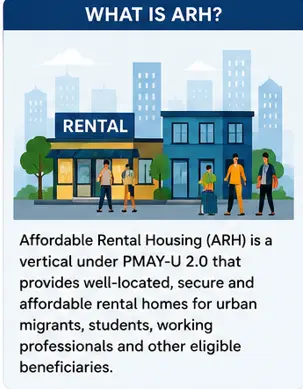
ARH stands for Affordable Rental Housing.
It is one of the four verticals under PMAY-U 2.0.
The four verticals are:
- Beneficiary-Led Construction (BLC)
- Affordable Housing in Partnership (AHP)
- Affordable Rental Housing (ARH)
- Interest Subsidy Scheme (ISS)
PMAY-U 2.0 is designed to support eligible urban families and beneficiaries who need to construct, purchase, or rent affordable housing. The scheme implementation period is from 2024 to 2029.
The ARH vertical specifically focuses on rental accommodation.
This makes it particularly relevant for people who:
- Do not want to buy a house at present
- Need housing for a temporary or shorter period
- Have moved to a city for work
- Cannot currently afford to construct or purchase a house
PMAY-U 2.0 ARH at a Glance
| Feature | PMAY-U 2.0 ARH |
|---|---|
| Full name | Affordable Rental Housing |
| Main purpose | Affordable rental accommodation |
| Target groups | Eligible EWS and LIG households |
| House ownership | Not required for the rental arrangement |
| Maximum supported house size | Up to 60 sq. m. carpet area |
| Main beneficiaries | Urban migrants, workers, working women and other eligible groups |
| Implementation | Two models |
| Housing availability | Depends on projects and rental stock in the area |
The official PMAY-U 2.0 FAQ states that ARH can support houses of up to 60 square metres of carpet area.
Who Can Benefit From PMAY-U 2.0 ARH?
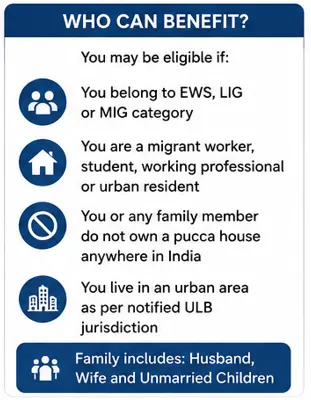
The ARH vertical is aimed at EWS and LIG beneficiaries and specifically targets people who need affordable rental accommodation.
The official scheme information identifies several groups, including:
- Urban migrants
- Homeless persons
- Destitute persons
- Industrial workers
- Working women
- Construction workers
- Street vendors
- Rickshaw pullers
- Other service providers
- Migrants working with market and trade associations
- Employees connected with educational institutions
- Health institutions
- Hospitality-sector workers
- Contractual employees
Students belonging to EWS and LIG categories can also avail ARH benefits according to the official FAQ.
What Do EWS and LIG Mean?
Under PMAY-U 2.0:
| Income Category | Annual Household Income |
|---|---|
| EWS | Up to ₹3 lakh |
| LIG | Above ₹3 lakh up to ₹6 lakh |
The scheme also defines MIG categories, but the ARH vertical specifically targets EWS and LIG beneficiaries.
General PMAY-U 2.0 Eligibility
The broader PMAY-U 2.0 framework states that eligible urban families belonging to EWS, LIG or MIG categories should not own a pucca house anywhere in India in the name of the beneficiary or any member of the beneficiary family.
A beneficiary family generally comprises:
- Husband
- Wife
- Unmarried children
The scheme also has conditions relating to previous housing benefits. Applicants who have received benefits under a Central, State or local government housing scheme during the previous 20 years are generally not eligible under PMAY-U 2.0.
Important clarification
For ARH, the exact process for identifying and allotting rental accommodation can depend on the applicable project, local authority, and contractual arrangements.
Therefore, meeting a broad income category does not automatically guarantee that rental accommodation is available or allotted to you.
Why Is Affordable Rental Housing Important?
A person may move from one city to another for:
- A new job
- Construction work
- Industrial employment
- Education
- Healthcare-sector employment
- Seasonal work
Buying a house may not make financial sense in such situations.
Private rental accommodation can also be difficult to find at an affordable price, particularly in large cities.
The PMAY-U 2.0 ARH vertical is designed to create affordable rental options for people who need accommodation without necessarily becoming homeowners.
How Does PMAY-U 2.0 ARH Work?
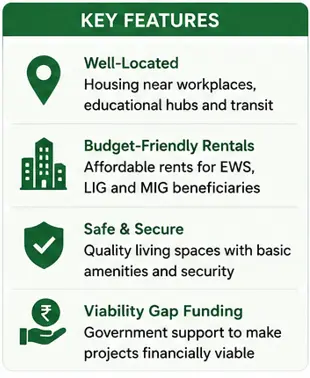
The ARH vertical is implemented through two models.
Model 1: Existing Government-Funded Vacant Houses
Under Model 1, existing vacant houses funded by government programmes can be converted into Affordable Rental Housing.
These houses can be developed and operated through:
- Public agencies, or
- Public-private partnership arrangements
What Happens to the Existing Houses?
Before they are used as rental accommodation, the houses may require work to make them suitable for occupation.
The concessionaire may be responsible for:
- Repairing or retrofitting buildings
- Improving water facilities
- Addressing sewerage or septage requirements
- Improving sanitation
- Completing internal roads and infrastructure gaps
- Operating and maintaining the housing complex
The concessionaire is also responsible for collecting rent under the applicable arrangement.
Model 2: New Rental Housing Projects
Under Model 2, new rental housing can be constructed, operated, and maintained by private or public entities.
These projects can serve:
- Urban poor
- Working women
- Employees of industries
- Workers in industrial estates
- Employees of institutions
- Other eligible EWS and LIG families
This model is important because it allows new rental accommodation to be created rather than relying only on existing vacant government-funded houses.
What Type of Accommodation Is Available Under ARH?
Under Model 2, ARH projects can include a mix of:
- Single-bedroom accommodation
- Double-bedroom accommodation
- Dormitories
The official FAQ states that the carpet area available per person should not be less than 6 square metres.
A maximum of one-third of the dwelling units in an ARH project may be in double-bedroom form.
The exact type of accommodation available to a tenant will naturally depend on the particular project.
Is Commercial Space Allowed in ARH Projects?
Yes.
Under Model 2, up to 10% of the total project area may be permitted for commercial use.
This does not mean that tenants automatically receive commercial facilities. It is a project-level provision.
How Much Rent Will You Pay Under PMAY-U 2.0 ARH?
This is one of the most important questions.
There is no single rent amount applicable across all ARH projects in India.
Rent depends on the applicable model and local conditions.
Rent Under Model 1
Under Model 1:
- The initial affordable rent is fixed by the local authority based on a local survey.
- Rent may subsequently be increased every two years by 8%.
- The aggregate increase over five years is subject to the applicable maximum mentioned in the scheme framework.
Rent Under Model 2
Under Model 2:
- The initial affordable rent is fixed by the concerned entity based on a local survey.
- Subsequent increases are subject to the applicable scheme conditions.
What This Means for You
Do not expect one national rent figure such as:
“Every PMAY-U ARH tenant pays ₹2,000 per month.”
That would be misleading.
The actual rent can vary depending on:
- City
- Project
- Local market conditions
- Accommodation type
- Applicable model
Always check the rent displayed for the specific ARH project.
How Can You Find Available PMAY-U 2.0 ARH Housing?
The official system provides an important mechanism for checking availability.
According to the PMAY-U 2.0 FAQ, details of available ARH housing stock can include:
- Project details
- Rent details
- Project-wise occupancy status
This information is intended to be displayed and updated on the Unified Web Portal and on the website of the concerned Urban Local Body.
Practical Step 1: Check the Official PMAY-U 2.0 Portal
Start with the official PMAY-U 2.0 system:
Look for current information relating to Affordable Rental Housing availability.
Practical Step 2: Check Your Local Urban Local Body
Your concerned:
- Municipality
- Municipal Corporation
- Urban Local Body
may also provide project or rental information.
Availability can differ significantly from one city to another.
Practical Step 3: Check Project Details Before Proceeding
If ARH accommodation is available, check:
- Location
- Type of accommodation
- Monthly rent
- Occupancy status
- Eligibility requirements
- Rent agreement conditions
Do not assume that an ARH project in one city has the same rent or allotment process as another project.
How to Apply for PMAY-U 2.0 ARH
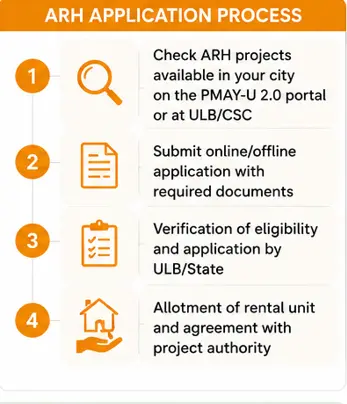
The official PMAY-U 2.0 FAQ states that beneficiaries meeting the scheme eligibility conditions may submit applications through:
- The Unified Web Portal
- Common Service Centres (CSCs)
- The concerned Urban Local Body or Municipality
However, ARH is different from directly receiving money to construct a house.
The practical process for obtaining a rental unit can depend on:
- Availability of ARH housing stock
- The relevant project
- The local authority
- The implementing entity
A Practical Approach
Step 1: Check Whether ARH Is Available
First, find out whether there is an ARH project or rental stock available in your city.
This is the most important step.
Step 2: Check Whether You Meet the Relevant Conditions
Review:
- Your income category
- Your family circumstances
- Your housing situation
- Any previous government housing benefits
- The requirements of the specific rental project
Step 3: Check the Project Details
Review the:
- Rent
- Location
- Accommodation type
- Occupancy information
- Tenancy conditions
Step 4: Follow the Applicable Application or Allotment Process
Use the process provided by the relevant official authority or ARH project.
Do not pay money to an unofficial agent claiming to guarantee an ARH allotment.
Step 5: Sign the Required Rent Agreement
Under ARH, rental accommodation is allotted to eligible tenants through a rent agreement.
The agreement will govern the applicable tenancy conditions, including the period of stay.
Tenants are expected to follow the contract terms and vacate the premises according to the applicable agreement and rules.
Can You Stay in ARH Permanently?
ARH is rental housing.
The official scheme information states that a house on rent is allotted to eligible tenants through a rent agreement that includes the applicable tenure of stay.
The tenant must follow the contractual terms.
Therefore, ARH should not be treated as permanent ownership of the house.
The exact duration can depend on the applicable rent agreement and project conditions.
Is PMAY-U 2.0 ARH Free?
No.
ARH is designed to provide affordable rental accommodation, not necessarily free accommodation.
Tenants are expected to pay the applicable rent.
The exact rent should be checked for the relevant project.
Be cautious of anyone claiming:
“PMAY-U will give you a completely free rental house.”
That is an oversimplification and may be misleading.
Technology Innovation Grant Under ARH
The funding structure for creating rental housing projects should not be confused with a direct cash payment to every tenant.
Under Model 2, Central Assistance in the form of a Technology Innovation Grant (TIG) is available for eligible projects using innovative and alternate construction technologies.
According to the official FAQ:
- The Central Government TIG is ₹3,000 per square metre of carpet area, subject to the applicable scheme limit.
- State or UT governments provide the applicable State share under the ARH framework.
The project must use eligible innovative construction technologies to qualify for TIG. Projects using conventional technologies do not receive TIG under this particular provision, although they may be eligible for other incentives under applicable State or UT affordable housing policies.
Important for Tenants
This does not mean that ₹3,000 per square metre is paid directly to a tenant.
It is project-level assistance connected with eligible construction and technology provisions.
How Long Can New ARH Projects Take to Complete?
For Model 2 projects using the Technology Innovation Grant, the official FAQ states that projects should be completed within:
18 to 24 months after obtaining all statutory approvals.
Actual construction timelines can still depend on approvals and project implementation.
Who Can Operate ARH Projects?
ARH projects can involve:
- Public agencies
- Private entities
- Organisations
- Industrial bodies
- Associations
- Institutions
Under Model 1, the implementing entity may be referred to as a concessionaire.
A concessionaire can be selected through a transparent bidding process by the relevant State, Union Territory, Urban Local Body or other concerned authority.
Can Private Houses Be Converted Into ARH Under Model 1?
The official FAQ distinguishes between existing government-funded vacant houses and private houses.
Under Model 1, vacant houses constructed under various Central, State, UT or parastatal schemes can be converted into Affordable Rental Housing Complexes.
However, the FAQ states that houses constructed by private agencies are not covered for conversion under this particular Model 1 provision.
PMAY-U 2.0 ARH vs Buying a House Under PMAY-U 2.0
The main difference is simple.
| Feature | ARH | BLC/AHP |
|---|---|---|
| Main purpose | Rental housing | Home construction or ownership |
| Do you own the house? | No | Subject to the applicable vertical |
| Suitable for | People needing rental accommodation | People seeking a permanent housing solution |
| Housing period | Based on rental agreement | Ownership-oriented |
| Main users | Migrants, workers, students and eligible families | Eligible home-building or home-buying families |
When ARH May Be More Suitable
ARH may be more suitable if you:
- Move frequently for work
- Work temporarily in another city
- Cannot currently afford to buy a house
- Need accommodation near your workplace
- Prefer renting instead of taking a home loan
When Another PMAY-U 2.0 Vertical May Be More Suitable
You may need to consider another option if your goal is to own a house.
For example:
- BLC: You have eligible land and want to construct a house.
- AHP: You want ownership housing through an affordable housing project.
- ISS: You are eligible for a qualifying home loan subsidy.
Your choice should depend on your actual housing requirement.
Common Mistakes to Avoid
1. Assuming ARH Housing Is Available Everywhere
ARH availability depends on actual housing stock and projects.
Before applying, check whether accommodation exists in your city.
2. Assuming ARH Means Free Housing
ARH is affordable rental housing.
The tenant is generally required to pay the applicable rent.
3. Believing There Is One Fixed Rent Across India
Rent is determined according to the applicable model and local conditions.
There is no single national ARH rent for every project.
4. Confusing ARH With House Ownership
ARH provides rental accommodation.
A tenant does not become the owner of the house simply by living there.
5. Paying an Agent Without Official Verification
Always verify the:
- Project
- Authority
- Rent
- Application procedure
through official sources.
Do not rely only on social media advertisements or WhatsApp messages.
Frequently Asked Questions
Q1. What is PMAY-U 2.0 ARH?
PMAY-U 2.0 ARH stands for Affordable Rental Housing. It is a PMAY-U 2.0 vertical designed to promote affordable and hygienic rental accommodation for eligible urban residents, particularly EWS and LIG groups who need rental housing.
Q2. Who can get ARH accommodation?
The targeted groups include eligible EWS and LIG beneficiaries such as urban migrants, industrial workers, working women, construction workers, street vendors and other eligible urban residents.
Q3. Can students apply for PMAY-U 2.0 ARH?
The official FAQ states that students belonging to EWS and LIG categories can avail the benefit of ARH.
Q4. Is PMAY-U 2.0 ARH available in every city?
Not necessarily. Availability depends on the presence of ARH housing stock or projects in the relevant area.
Q5. How can I check ARH rent?
The official scheme information states that available ARH project details, rent details and project-wise occupancy status can be displayed on the Unified Web Portal and the website of the concerned Urban Local Body.
Q6. Is ARH housing free?
No. ARH is intended to provide affordable rental accommodation. The applicable rent depends on the relevant project and local conditions.
Q7. Can I stay permanently in an ARH house?
ARH accommodation is governed by a rent agreement and applicable tenancy conditions. The duration of stay depends on the relevant agreement and rules.
Q8. What types of accommodation can be available?
Model 2 ARH projects can include single-bedroom units, double-bedroom units, and dormitories.
Q9. Where can I get official PMAY-U 2.0 information?
You can check the official scheme portal and guidelines.
Final Takeaway
PMAY-U 2.0 ARH is the rental housing option under PMAY-U 2.0.
It is particularly relevant for people who need an affordable place to live but are not currently looking to buy or construct a house.
The vertical targets eligible EWS and LIG groups, including:
- Migrant workers
- Industrial workers
- Working women
- Construction workers
- Street vendors
- Students in eligible income categories
- Other urban residents requiring rental accommodation
But the most important practical point is this:
First check whether ARH accommodation is actually available in your city.
Your eligibility alone does not guarantee that a rental unit is currently available.
Check the official portal and your concerned Urban Local Body for current project details, rent information and occupancy status before making any decision. The official PMAY-U 2.0 FAQ is the best starting point for understanding the current ARH framework.
Related Benefitomics Guides
- PMAY-U 2.0 Guide (2026): Eligibility, Benefits, Housing Options & How to Apply
- PMAY-U 2.0 Eligibility 2026: Who Can Apply and Who Is Not Eligible?
- PMAY-U 2.0 BLC Guide 2026: Eligibility, Land Requirement & How to Apply
- PMAY-U 2.0 AHP Guide 2026: Eligibility, Affordable Housing Projects & How to Apply
- PMAY-U 2.0 Interest Subsidy Scheme Guide