
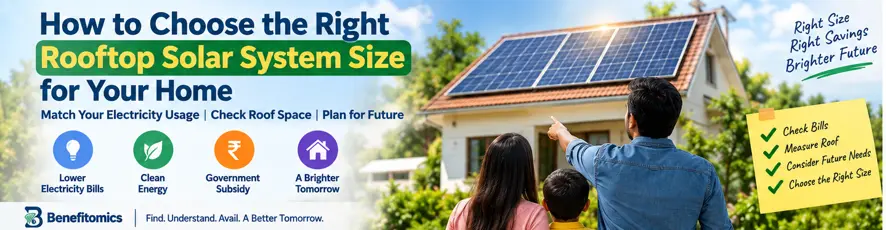
Choosing the correct Rooftop Solar System Size is one of the most important decisions you will make before installing solar panels.
A system that is too small may not reduce your electricity bill as much as expected. A system that is larger than your practical requirement may increase your upfront investment without providing a proportionate benefit.
The right choice depends on more than just the size of your roof.
You should consider your monthly electricity consumption, available shadow-free roof area, daytime electricity use, budget, electricity tariff, future electricity needs, and the applicable DISCOM rules.
Choosing the right Rooftop Solar System Size depends mainly on your electricity consumption, available roof space, budget and the amount of solar generation you want.
Quick Answer: What Solar System Size Do I Need?
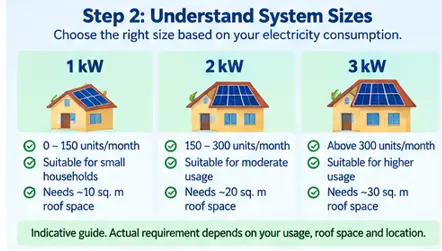
As a starting point, official PM Surya Ghar material has associated average monthly consumption ranges with indicative rooftop capacities:
| Average monthly consumption | Indicative rooftop capacity |
|---|---|
| 0–150 units | 1–2 kW |
| 150–300 units | 2–3 kW |
| Above 300 units | Above 3 kW |
These are useful starting points, not a universal rule for every household. The actual system size should consider your roof, consumption pattern, and local conditions.
How to Choose the Right Rooftop Solar System Size
The right Rooftop Solar System Size should be based on your recent electricity usage rather than simply choosing the largest system that fits on your roof.
To check the official PM Surya Ghar process and access the National Portal, visit the PM Surya Ghar Muft Bijli Yojana portal.
Why Your Electricity Bill Matters More Than the Number of Family Members
A four-person household does not necessarily need a larger solar system than a two-person household.
What matters more is electricity consumption.
For example:
- A small family using multiple air conditioners may consume more electricity than a larger family.
- A household that uses most appliances during the daytime may benefit differently from one that uses most electricity at night.
- Future purchases such as an air conditioner, electric vehicle or heat pump can increase electricity demand.
So start with your actual electricity bills rather than guessing from household size.
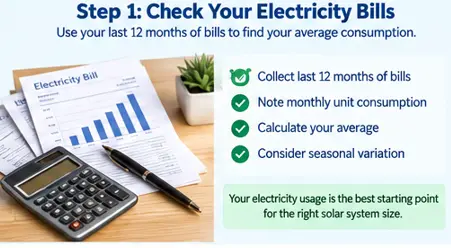
Step 1: Check Your Last 12 Electricity Bills
This is one of the easiest ways to estimate your requirement.
Look at the number of units consumed each month.
For example:
| Month | Consumption |
|---|---|
| January | 180 units |
| February | 165 units |
| March | 190 units |
| April | 220 units |
| May | 270 units |
| June | 250 units |
Don’t base the decision only on your lowest bill.
If your consumption changes significantly between summer and winter, consider the pattern across the year.
Step 2: Calculate Your Average Monthly Consumption
Add your electricity consumption for the previous 12 months and divide by 12.
For example, if your total annual consumption is:
2,400 units
Then:
2,400 ÷ 12 = 200 units per month
That gives you a much better starting point than looking at a single bill.
Step 3: Understand the 1 kW, 2 kW and 3 kW Options
1 kW rooftop solar
A 1 kW system can be suitable for households with relatively modest electricity consumption.
It can also be useful when:
- Roof space is limited.
- Budget is limited.
- You want to start with a smaller system.
- Your electricity consumption is relatively low.
Under the standard PM Surya Ghar CFA structure, a qualifying 1 kW system can receive ₹30,000 central CFA.
2 kW rooftop solar
A 2 kW system can make sense for households with moderate electricity consumption.
The standard central CFA for 2 kW is ₹60,000 for eligible residential installations.
It may be appropriate where electricity usage includes appliances such as:
- Refrigerator
- Washing machine
- Television
- Fans
- Water pump
- Computers
- Air conditioner used moderately
Actual suitability depends on consumption and local conditions.
3 kW rooftop solar
A 3 kW system is particularly relevant under PM Surya Ghar because the standard CFA reaches its maximum of ₹78,000 at 3 kW.
It may suit households with higher electricity consumption, especially when they have adequate roof space.
The scheme does not mean that every household should install 3 kW simply because the maximum subsidy is available.
The right size should come first; subsidy should be considered as part of the financial calculation.
Step 4: Check Your Roof Area
Roof space is another important factor.
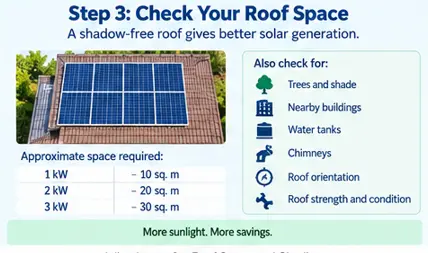
An official rooftop-solar FAQ notes that a 1 kWp rooftop system generally requires around 10 square metres of shadow-free area, although the actual requirement can vary depending on module efficiency and placement.
So, as a rough planning guide:
- 1 kW → around 10 sq. m
- 2 kW → around 20 sq. m
- 3 kW → around 30 sq. m
These are planning estimates, not installation guarantees.
Your installer should assess the actual usable roof area, shadows, orientation, structure and equipment placement.
Step 5: Check for Shade
A large roof does not necessarily mean a good solar roof.
Look for:
- Nearby buildings
- Trees
- Water tanks
- Chimneys
- Parapet walls
- Other structures
Shade can reduce solar generation.
A smaller system installed on a good, shadow-free portion of the roof may be more practical than placing panels across a larger shaded area.
Step 6: Consider Your Daytime Electricity Consumption
Ask yourself:
When do I use the most electricity?
For example, if you regularly use:
- Air conditioner
- Water pump
- Washing machine
- Refrigerator
- Work-from-home equipment
during the day, rooftop solar generation can directly offset part of your consumption.
If most of your electricity use occurs at night, your savings pattern will depend more heavily on the applicable net-metering/billing arrangement and your DISCOM rules.
Step 7: Think About Future Electricity Needs
Don’t look only at today’s electricity bill.
Consider whether you may add:
- Air conditioner
- Electric scooter
- Electric car
- Water heater
- Additional refrigerator
- Home office equipment
- Other high-power appliances
If your consumption is likely to increase, discuss the future requirement with the vendor before finalising the system.
Step 8: Consider PM Surya Ghar Subsidy
The standard residential CFA structure is:
| Capacity | Standard central CFA |
|---|---|
| 1 kW | ₹30,000 |
| 2 kW | ₹60,000 |
| 3 kW | ₹78,000 |
| Above 3 kW | Maximum standard CFA ₹78,000 |
This is important because installing more than 3 kW does not mean receiving a proportionally higher standard central subsidy.
So don’t increase the system size solely to chase a higher subsidy.
Example: Choosing Between 2 kW and 3 kW
Suppose your household uses around 200–250 units per month.
A 2 kW system may be a reasonable starting point based on the indicative consumption ranges published for the scheme.
A 3 kW system could make sense if:
- You have higher seasonal consumption.
- You expect future electricity demand to increase.
- You have sufficient roof space.
- The economics work for your household.
The decision should be based on the complete picture rather than subsidy alone.
Should You Install More Solar Than Your Current Consumption?
Sometimes it can make sense, but don’t automatically assume that more capacity is always better.
Consider:
- Current annual consumption
- Future electricity demand
- Roof area
- System cost
- Subsidy
- Electricity tariff
- Local net-metering/billing rules
- Financing cost
- Expected generation
- Maintenance and equipment quality
A good installer should explain the expected generation and assumptions instead of simply recommending the largest system.
How Much Electricity Can a Solar System Generate?
Solar generation depends on:
- Location
- Solar radiation
- Panel orientation
- Tilt
- Shading
- Weather
- Module efficiency
- System losses
- Inverter performance
- Maintenance
Therefore, don’t publish a fixed statement such as “1 kW always generates exactly X units every month.”
Generation changes throughout the year.
For planning, ask the vendor for an estimated annual generation figure and the assumptions behind it.
Which Solar System Size Is Right for You?
Use this simple starting framework:
If your consumption is low
Consider 1 kW or 2 kW, depending on your actual bills and roof.
If your consumption is moderate
A 2 kW or 3 kW system may be worth evaluating.
If your consumption is high
You may need to evaluate 3 kW or more, but remember that the standard central CFA is capped at 3 kW.
If your roof is small
Prioritise high-quality panels and efficient use of available shadow-free space.
Questions to Ask a Solar Vendor Before Finalising
Ask:
- What system capacity are you recommending?
- Why is this capacity suitable for my consumption?
- What annual electricity generation do you estimate?
- What assumptions are used for the estimate?
- How much shadow-free roof area is required?
- Which panels will be installed?
- Which inverter will be installed?
- What is included in the quoted price?
- Does the price include installation and required electrical work?
- What happens if generation is lower than estimated?
- What warranty is provided?
- What is the expected maintenance requirement?
These questions can help you compare quotations on more than just price.
For official information about grid-connected rooftop solar and the PM Surya Ghar programme, you can also refer to the Ministry of New and Renewable Energy (MNRE) rooftop solar programme page.
Frequently Asked Questions
Q1. How do I calculate the solar system size for my home?
Start with your electricity consumption over the previous 12 months. Calculate your average monthly usage, then discuss the appropriate capacity with a registered/eligible vendor based on roof space, location and expected generation.
Q2. Is 1 kW solar enough for a house?
It may be enough for a household with relatively low electricity consumption, but suitability depends on your actual usage and solar conditions.
Q3. Is 2 kW solar enough for a home?
A 2 kW system can be suitable for many households with moderate electricity consumption. Check your annual electricity use rather than relying only on household size.
Q4. Is 3 kW solar enough for a house?
A 3 kW system may suit households with higher consumption, but the correct capacity depends on electricity use, roof space, and future requirements.
Q5. Does PM Surya Ghar give more subsidy for a 5 kW system?
The standard residential CFA is capped at 3 kW, with the standard maximum of ₹78,000. Installing a larger system does not automatically produce a higher standard central subsidy.
Q6. How much roof space is needed for 1 kW solar?
An official rooftop-solar FAQ gives approximately 10 square metres of shadow-free area for 1 kWp as a general reference, but actual space requirements vary.
Final Takeaway
The right rooftop solar system size is not necessarily the biggest system you can fit on your roof.
Start with your electricity bills, calculate your average consumption, check your available shadow-free roof area, and consider your future electricity needs.
Then compare the system cost, PM Surya Ghar subsidy, expected generation, and financing before making the final decision.
The goal should be a well-matched solar system, not simply the maximum possible capacity.
Related PM Surya Ghar Guides
- PM Surya Ghar Muft Bijli Yojana (2026): Eligibility, Subsidy, Cost & How to Apply
- PM Surya Ghar Subsidy 2026: How Much Subsidy Can You Get?
- PM Surya Ghar Eligibility 2026: Who Can Apply and Who Cannot?
- PM Surya Ghar Apply Online: Step-by-Step Application Guide 2026
- PM Surya Ghar Loan: Interest, EMI and Eligibility
- PM Surya Ghar Subsidy Calculator