
PM Surya Ghar Loan 2026: Interest, EMI and Eligibility
The upfront cost of a rooftop solar system can be a concern even after the PM Surya Ghar subsidy.
A loan can help spread the remaining cost over several years instead of paying the entire amount at once.
Under the current PM Surya Ghar financing provisions, collateral-free loans from nationalized banks are available at a concessional rate linked to the repo rate. As of the latest July 2026 government information, the rate is repo rate + 50 basis points, or 5.75% per year at that time, with a tenure of up to 10 years under the stated provision.
However, the actual product offered to a borrower can depend on the participating bank and its lending terms.
Quick Answer: What Is the PM Surya Ghar Loan Interest Rate?
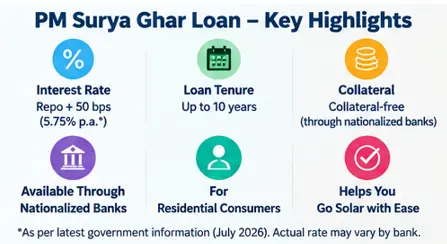
As of the latest official July 2026 information, the concessional financing provision is:
- Interest: repo rate + 50 basis points
- Rate stated by the government at that time: 5.75% per year
- Tenure: 10 years
- Collateral: collateral-free under the stated scheme financing provision
- Banks: nationalized banks/participating financial institutions
Because the interest is linked to the repo rate, the applicable rate can change when the underlying rate changes.
Important: Do not treat 5.75% as a permanently fixed rate for every borrower or every bank product.
Who Can Consider a PM Surya Ghar Loan?
The financing is intended to help eligible residential consumers finance rooftop solar installations.
The PM Surya Ghar scheme itself is available to residential consumers with a grid-connected electricity connection of the local DISCOM, subject to the scheme’s conditions.
For the loan, the bank will still apply its own credit and documentation requirements.
So there are two separate questions:
Scheme eligibility: Can you benefit from PM Surya Ghar?
Loan eligibility: Will the participating bank approve your loan?
Being eligible for the solar subsidy does not automatically guarantee loan approval.
PM Surya Ghar Loan Eligibility
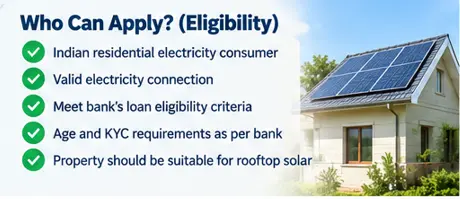
A lender may look at factors such as:
- Applicant identity
- Residential electricity connection
- Rooftop solar application details
- Loan amount
- Repayment capacity
- Existing financial obligations
- Bank-specific credit criteria
- Required KYC and income/financial documents
The exact requirements can differ by bank.
The National Portal’s financing framework is integrated with lending channels such as Jan Samarth so beneficiaries can be directed toward relevant loan products.
How Much Loan Can You Get?
There is no single loan amount that applies identically to every household.
The amount can depend on:
- Solar system cost
- Subsidy
- Your contribution
- Bank’s loan product
- Your repayment capacity
- Bank-specific rules
Therefore, avoid assuming that every applicant will receive the same loan amount.
The important calculation is:
Solar system cost − applicable subsidy − your upfront contribution = amount you may need to finance
PM Surya Ghar Loan EMI Example
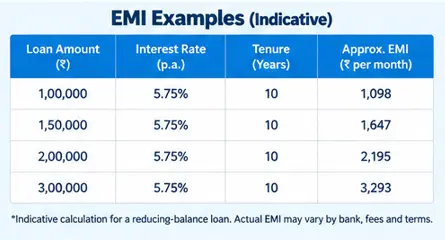
To understand the approximate EMI, consider a hypothetical loan at 5.75% annual interest for 10 years.
| Loan amount | Approx. monthly EMI* |
|---|---|
| ₹1,00,000 | ₹1,098 |
| ₹1,50,000 | ₹1,647 |
| ₹2,00,000 | ₹2,195 |
*Illustrative calculation assuming a monthly reducing-balance loan at 5.75% for 120 months. Actual EMI can differ depending on the bank’s product, rate, fees, insurance or other terms.
This table is useful for planning, but it is not a bank quotation.
Example: How Subsidy Can Reduce the Amount You Finance
Suppose a household installs a 3 kW system.
The standard central CFA can be up to ₹78,000 for a qualifying residential installation.
If the eligible system cost were hypothetically ₹1,80,000:
₹1,80,000 − ₹78,000 = ₹1,02,000
The household may then need to arrange the remaining amount through its own funds and/or financing.
This is only an illustration. Actual installation prices vary by vendor, equipment, location, roof structure and other factors.
How to Apply for a PM Surya Ghar Loan
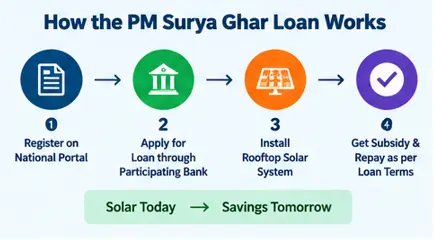
The broad process is:
Step 1: Register on the National Portal
Start your rooftop solar application through the official PM Surya Ghar portal.
Step 2: Select the solar system and vendor
Complete the required application process and choose an eligible vendor.
Step 3: Explore financing
Where available, use the financing facility integrated with the National Portal/Jan Samarth or the participating bank’s process.
Step 4: Submit loan information
Provide the documents and information requested by the lender.
Step 5: Bank assessment
The bank evaluates the application under its applicable lending criteria.
Step 6: Installation and verification
After the required approvals, the rooftop solar system is installed, and the DISCOM completes the applicable verification and commissioning process.
Step 7: Subsidy processing
The applicable CFA is processed according to the scheme rules. Where a loan has been used, the CFA may flow to the loan account for the relevant adjustment.
Does PM Surya Ghar Subsidy Reduce the Loan?
It can reduce the amount that ultimately needs to be financed or can be credited to the loan account, depending on how the loan and subsidy are structured.
The scheme guidelines specifically provide that CFA may flow to the beneficiary’s bank account or loan account when a loan is used for the rooftop solar installation.
This is one reason you should ask the bank exactly how the subsidy will be treated before signing the loan agreement.
What Documents May Be Needed?

Depending on the bank and application stage, you may be asked for:
- Aadhaar or other KYC document
- PAN, where applicable
- Electricity consumer details
- PM Surya Ghar application information
- Bank account details
- Income/financial information if required
- Solar quotation or system details
- Vendor information
- Loan-related documents
The exact list should be confirmed with the participating bank.
Is a PM Surya Ghar Loan Worth Considering?
There is no single answer for every household.
Compare:
- Total solar system cost
- Subsidy
- Loan amount
- Interest rate
- EMI
- Expected electricity savings
- Your current electricity bill
- Loan processing charges, if any
- Your ability to repay the EMI
- Expected system life and maintenance
A lower EMI does not automatically mean a lower total borrowing cost because a longer tenure generally means paying interest for longer.
Frequently Asked Questions
Q1. What is the current PM Surya Ghar loan interest rate?
The latest July 2026 government information states a concessional rate of repo rate + 50 basis points, which was 5.75% per year at that time, with a 10-year tenure.
Q2. Is the PM Surya Ghar loan collateral-free?
The government states that collateral-free loans are available through nationalized banks under the concessional financing provision. Individual bank eligibility and documentation still apply.
Q3. Does PM Surya Ghar guarantee a loan?
No. Scheme eligibility and bank loan approval are different. The lender applies its own credit and documentation requirements.
Q4. Can the subsidy be adjusted against the loan?
The scheme guidelines allow CFA to flow into the loan account where a loan has been used for the rooftop solar installation.
Q5. Is the 5.75% rate permanent?
No. The government describes the concessional rate as linked to the repo rate plus 50 basis points. Therefore, the applicable rate can change when the underlying rate changes.
Final Takeaway
A PM Surya Ghar Loan can help households spread the upfront cost of rooftop solar over a longer period.
The latest official information available in July 2026 states a concessional rate of repo + 50 bps, then 5.75% per year, with a 10-year tenure. But borrowers should check the participating bank’s current terms before applying.
Don’t look only at the EMI. Compare the total solar cost, subsidy, loan amount, interest, total repayment, and expected electricity savings.
Related PM Surya Ghar Guides
- PM Surya Ghar Muft Bijli Yojana (2026): Eligibility, Subsidy, Cost & How to Apply Pillar Post
- PM Surya Ghar Solar System Cost 2026: 1 kW, 2 kW and 3 kW Price
- PM Surya Ghar Subsidy 2026: How Much Subsidy Can You Get?
- PM Surya Ghar Apply Online: Step-by-Step Application Guide 2026
- PM Surya Ghar Eligibility 2026: Who Can Apply and Who Cannot?
- PM Surya Ghar Subsidy Calculator